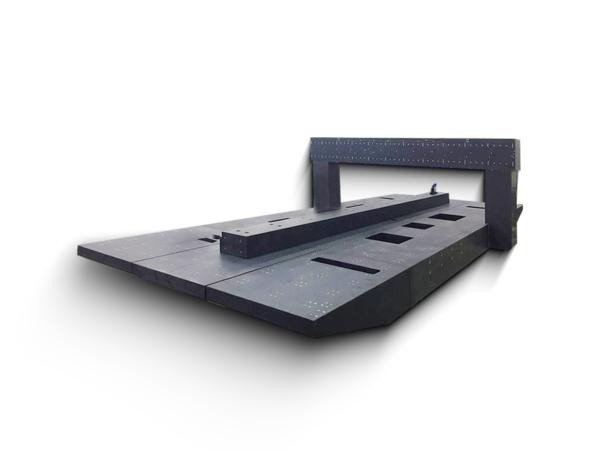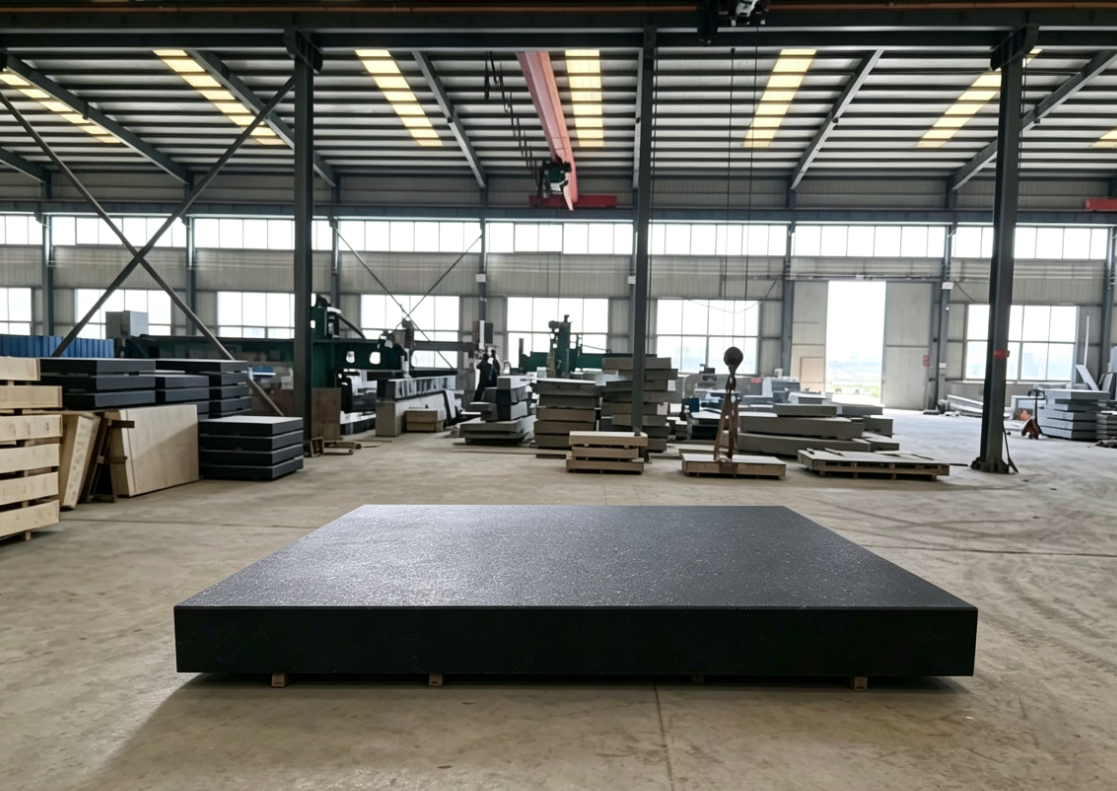
In the semiconductor industry, high-hardness ceramics (Al₂O₃, SiC, Si₃N₄, etc.) primarily target “chamber interiors / moving parts / extreme operating conditions,” while granite focuses on “large bases / platforms / vibration isolation references,” forming a clear complementary division of labor. The following is a direct comparison from four aspects: performance, typical applications, machining and assembly, and cost and selection.
I. Core Performance Comparison (Semiconductor Concerns)
Table
Comparison Item High-Hardness Ceramics (SiC/Al₂O₃/Si₃N₄) Precision Granite (Jinan Green, etc.) Semiconductor Impact
Coefficient of Thermal Expansion Extremely low: 0.2–3.2×10⁻⁶/℃, close to silicon wafers Medium: 4–6×10⁻⁶/℃ Ceramics are more dimensionally stable under temperature differences / thermal cycling
Thermal Conductivity High (especially SiC): 150–400 W/m・K Low: 2–4 W/m・K Ceramics dissipate heat well and have uniform heat distribution; granite is prone to local heat accumulation
Hardness / Wear Resistance Mohs 9–9.5, extremely wear-resistant, plasma-resistant Mohs 6–7, easily scratched by hard particles Ceramics are suitable for long-term sliding / chamber corrosion environments
Vibration Damping / Damping Low damping, weak shock absorption High damping (0.012–0.015), strong vibration suppression Granite is used for bases / platforms, offering stronger resistance to vibration interference
Density / Cleanliness Pore-free, non-gas absorbing / non-oil seeping, ultra-high purity Micro-pores, requires sealing to prevent oil contamination / water vapor Ceramics are better suited for high vacuum / cleanrooms / chamber interiors
Chemical / Plasma Resistance Resistant to strong acids, strong bases, and fluorine-containing plasma Not resistant to strong acids and bases, easily eroded over the long term Ceramics are used in etching / deposition / ion implantation chambers
Internal Stress / Aging Sintered molding, no natural internal stress Natural stone, requires long-term aging to relieve stress Ceramics have smaller long-term precision drift
Size Upper Limit Limited by sintering, mainly small to medium parts (≤500mm) Can be made into multi-meter ultra-large monolithic beds / platforms Granite is suitable for large bases of lithography machines / inspection machines
II. Comparison of Typical Semiconductor Application Scenarios
- High-Hardness Ceramics: First Choice for Chamber Interiors, Moving Parts, and Extreme Operating Conditions
Etching / Deposition Machines: High-purity Al₂O₃ liners, gas showerheads, focus rings, insulation rings, plasma corrosion resistant, low contamination.
Lithography Machine Worktables / Micro-motion Stages: SiC ceramics, low thermal expansion, high thermal conductivity, lightweight, ensuring nanometer-level motion stability.
Wafer Transfer: Si₃N₄ ceramic arms, electrostatic chucks (ESC), vacuum suction plates, anti-static, wear-resistant, no particle shedding.
Heat Treatment / Epitaxy: Ceramic heating plates, crucibles, insulation parts, long-term stability at 1000℃ .
Ion Implantation: Insulating brackets, high-voltage isolation parts, high insulation, high-voltage resistant, sputter-resistant.
- Precision Granite: The preferred choice for large bases, platforms, and vibration isolation references
Lithography (EUV/ArF) main machine base: Ultra-large size, high rigidity, strong vibration damping, isolates ground vibration, ensures nanometer-level positioning.
Wafer inspection / metrology equipment: CMM, optical inspection instruments, laser interferometer platforms, high flatness, long-term stability.
CMP equipment bed / guide rails: Heavy load, low vibration, good thermal stability, ensures polishing uniformity.
Bonding / packaging equipment base: Suppresses vibration, improves bonding accuracy and yield.
III. Machining and Assembly Differences (Semiconductor Mass Production Concerns)
High-Hardness Ceramics
Machining: Only diamond grinding / polishing; drilling, tapping, and complex cavities are extremely difficult and expensive.
Assembly: Mostly pre-embedded metal inserts, flexible fixation, impact-forbidden, suitable for precision assembly of small and medium-sized parts.
Advantages: Clean, burr-free, no particle shedding, no wafer contamination.
Precision Granite
Machining: Fully mature processes for sawing, milling, grinding, drilling, and tapping; capable of complex steps, hole systems, and embedded parts.
Assembly: Direct tapping, installation of threaded sleeves, rigid connection, high fault tolerance, suitable for large-scale structural integration.
Limitations: Micro-pores easily trap dirt; requires surface sealing / coating to meet cleanroom requirements.
IV. Cost and Selection Recommendations
Cost
Ceramics: Expensive raw materials machining; high cost for small and medium-sized, high-precision parts.
Granite: High cost-performance ratio; cost for large parts is far lower than ceramics, suitable for mass-produced equipment.
Selection Guide (Semiconductor Scenarios)
✅ Prioritize High-Hardness Ceramics
Internal components of etching / deposition / ion implantation chambers (plasma-resistant, low contamination);
Lithography machine worktables / micro-motion stages, wafer transfer arms, electrostatic chucks (low thermal expansion, high thermal conductivity, wear-resistant);
High-temperature / thermal cycling conditions (heat treatment, epitaxy);
High vacuum / ultra-clean environments (non-outgassing, no particle shedding).
✅ Prioritize Precision Granite
Large mainframes / beds / platforms for lithography machines, inspection machines, and CMP (ultra-large size, strong vibration damping, high rigidity);
Precision measurement equipment sensitive to vibration but with controllable temperature differences;
Budget-sensitive, large-scale, mass-produced equipment bases.
V. One-Sentence Summary
High-Hardness Ceramics: The “King of High Precision and Cleanliness” for in-chamber / moving parts / extreme conditions, but brittle, difficult to machine, expensive, and cannot be made large.
Precision Granite: The “Stable and Heavy Skeleton” for large bases / platforms / vibration-damping references, with good vibration damping, easy machining, and high cost-performance, but susceptible to corrosion and scratching.