High-Hardness Ceramics vs. Granite (Precision Instrument Components) Pros and Cons Comparison
Both are low-expansion, high-rigidity, wear-resistant, and non-magnetic precision base materials widely used in measurement platforms, machine tool beds, optical bases, and inspection fixtures. The core differences lie in physical properties, machinability, cost, and operating condition suitability. The following is a dimensional comparison and selection guide.
I. Basic Core Physical Properties Comparison
Table
Property High-Hardness Structural Ceramics (Alumina / Zirconia / Silicon Carbide) Natural Granite (Jinan Green / Black Gold Sand, etc., precision grade)
Hardness Extremely high, Mohs 9~9.5, far exceeding granite, extremely scratch-resistant and wear-resistant Mohs 6~7, good wear resistance, easily scratched by hard objects
Density 3.0~3.9 g/cm³, generally heavier 2.6~2.8 g/cm³, lighter for the same size
Coefficient of Thermal Expansion Extremely low, 0.2~0.8×10⁻⁶/℃, top-tier dimensional stability under temperature changes Relatively low, 4.0~6.0×10⁻⁶/℃, greater thermal deformation than ceramics
Elastic Modulus (Rigidity) High rigidity, strong resistance to deformation Good rigidity, slightly lower than ceramics
Thermal Conductivity Fast heat conduction, uniform heat dissipation, small local temperature rise Slow heat conduction, prone to local heat accumulation
Hygroscopicity Completely dense, zero water absorption, no stain penetration Contains tiny natural pores, slight water absorption, prone to oil stain penetration
Magnetic Conductivity / Static Electricity Non-magnetic, unlikely to generate static electricity Non-magnetic, friction easily generates slight static electricity
II. Detailed Pros and Cons by Dimension
(1) High-Hardness Ceramics
Advantages
Overwhelming Dimensional Thermal Stability
The coefficient of thermal expansion is only 1/5 to 1/10 that of granite, resulting in almost no deformation in high-temperature, low-temperature, or temperature-varying environments. It is suitable for temperature-sensitive scenarios such as semiconductors, optics, laser equipment, and high-precision online inspection.
Wear, Scratch, and Chemical Corrosion Resistance
Hardness is close to diamond, so long-term repeated sliding and workpiece dragging will not cause scratches. It is resistant to acid, alkali, cutting fluids, and cleaning agents, showing strong tolerance to harsh industrial operating conditions.
Dense Structure Without Pores
The material is completely dense, does not absorb oil or water, and does not stain. The surface is easy to clean, and the base will not expand or drift in precision due to medium penetration.
Creep Resistance and Excellent Long-Term Precision Retention
As an inorganic sintered material, it has no natural internal stress and minimal deformation under long-term loads, making it suitable for ultra-high precision, 24-hour continuous operation equipment.
Disadvantages
High Machining Difficulty and Extremely High Cost
Due to its extremely high hardness, it can only be machined with diamond tools/grinding tools. Cutting, drilling, tapping, and slotting are difficult. The cost of machining irregular shapes, deep holes, and complex cavities doubles, and lead times are long.
High Brittleness and Poor Impact Resistance
It is prone to chipping, cracking, and hidden cracks when subjected to impact, drops, or heavy blows. It is not impact-resistant, and strict precautions against bumps are required during handling and use.
Poor Toughness, Cannot Withstand Large Torsional / Shear Stress
It is not suitable for large beds or gantry structures subjected to heavy loads, dynamic impacts, or strong reciprocating friction.
Limited Large-Scale Molding
Due to sintering process limitations, it is difficult to manufacture ultra-large-sized monolithic components. It is mostly used for small-to-medium precision parts and small platforms.
Relatively High Self-Weight
It is heavier than granite for the same volume, which affects equipment load capacity and motion inertia.
(II) Precision Granite (Natural Granite)
Advantages
Excellent machinability and high cost-performance ratio
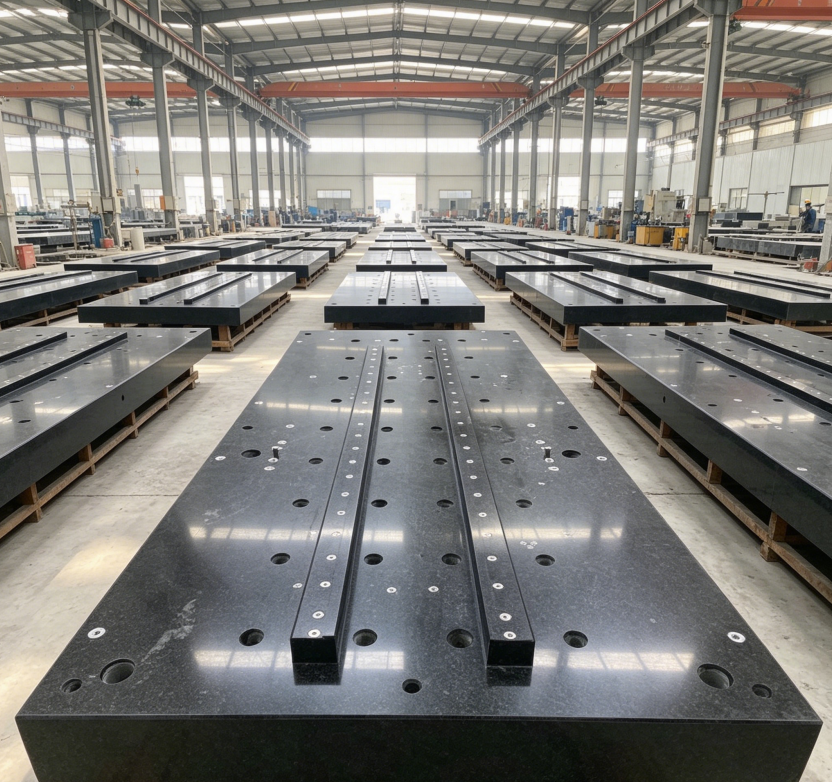
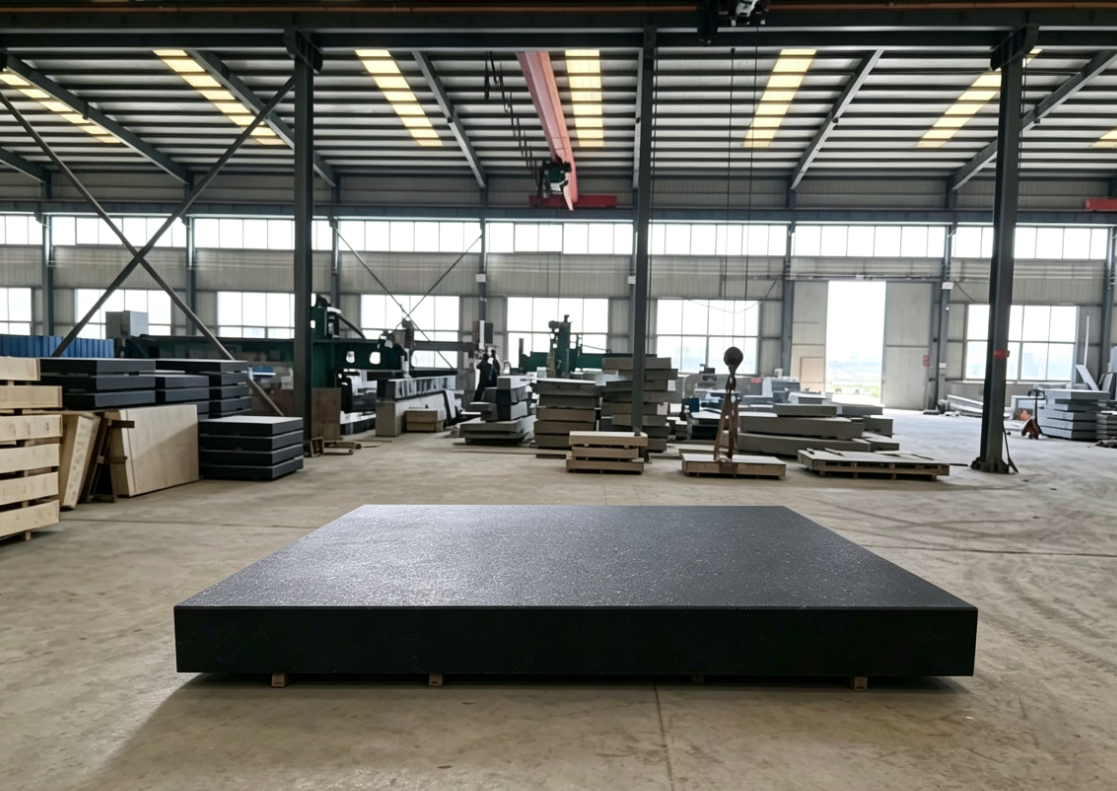
Can be sawed, milled, drilled, embedded with threaded inserts, and machined into complex steps / guide rails / cavities, with mature forming processes; large and ultra-large monolithic components (meter-scale beds, gantries, platforms) can be easily fabricated at a cost far lower than ceramics.
Better toughness and stronger impact resistance than ceramics
Natural crystalline bonded structure with low brittleness, making it less prone to cracking from slight bumps or accidental impacts, offering a higher tolerance for on-site use and a more friendly workshop environment.
Relatively light self-weight and low motion inertia
Low density means smaller drive loads and smoother motion response when used for moving guide rails and sliding platforms.
Excellent vibration damping performance
Natural polycrystalline structure provides good shock absorption and damping effects, effectively attenuating equipment vibration and external interference, making it suitable for machine tools and precision measurement tables.
Controllable stress and mature stability for large components
After multi-stage aging for stress relief, large beds and ultra-long guide rails exhibit minimal long-term deformation, making it the first choice for heavy-duty large precision equipment.
Disadvantages
More pronounced thermal expansion and contraction
Dimensional changes are greater than ceramics during ambient temperature fluctuations, limiting accuracy in ultra-high precision (sub-micron, nano-level) and large temperature difference scenarios.
Presence of micropores on the surface
Natural stone has microscopic pores; long-term contact with oil and coolants can lead to seepage, which is difficult to clean thoroughly, and slight water absorption and expansion under extreme conditions can affect accuracy.
Relatively low hardness and prone to scratching
Hard metals or dropped tools can easily leave scratches, and surface accuracy will slowly degrade over long-term sliding friction.
Risk of natural internal stress
If raw material selection and aging treatment are inadequate, slow deformation may occur later, placing high demands on the supply chain and processing technology.
Average corrosion resistance
Long-term contact with strong acids and bases will corrode the surface crystals, making it unsuitable for strong chemical media environments.
III. Precise Selection Based on Application Scenarios
Scenarios for choosing [High-Hardness Ceramics]
Nano / sub-micron ultra-high precision optical, laser, and semiconductor equipment;
Workstations with large ambient temperature differences and average constant temperature conditions, but requiring absolute dimensional stability;
Small precision fixtures and positioning bases that are long-term wear-resistant, subject to frequent workpiece sliding, and in contact with chemical reagents / cutting fluids;
Small to medium-sized precision reference tables, vacuum suction plates, and optical mirror mounts.
Scenarios for choosing [Precision Granite]
Large and ultra-large precision machine tool beds, gantries, ultra-long guide rails, and heavy-duty measurement platforms;
General-purpose precision inspection equipment used in workshops with conventional constant temperatures, emphasizing vibration damping, impact resistance, and on-site ease of use;
Medium to large components requiring complex structures, multiple holes, multiple inserts, and irregular contours;
Industrial precision instruments with limited budgets, pursuing high cost-performance, and used under long-term heavy loads.
IV. Summary in One Sentence
Ceramics: High precision limits, corrosion and wear resistant, unbeatable thermal stability, but brittle, difficult to machine, expensive, and cannot be made into large parts; mainly for ultra-high precision, miniaturization, and harsh chemical / friction working conditions.
Granite: Easy to machine, can be made into large parts, impact resistant, good vibration damping, and high cost-performance, but slightly weaker thermal stability and density; mainly for medium to large precision equipment, machine tools, and general-purpose measurement platforms.