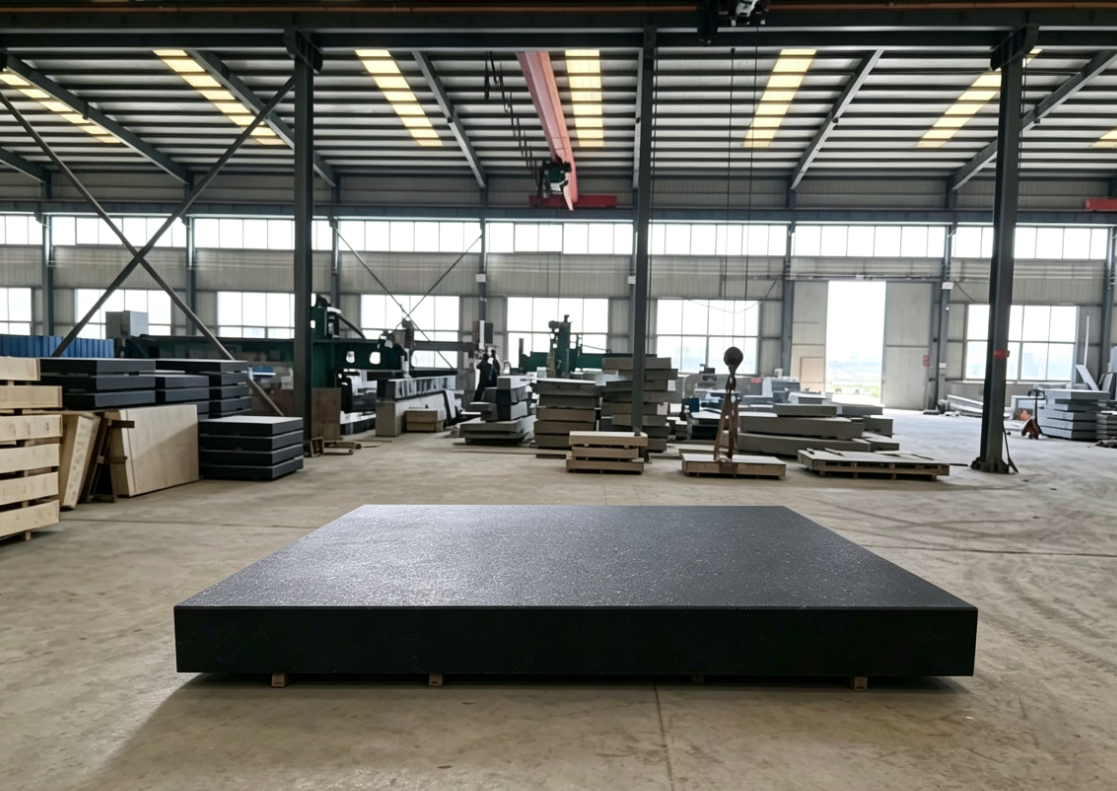
Precision granite serves as the physical cornerstone of high-precision metrology. Leveraging its extreme stability from natural aging, ultra-low thermal expansion, high damping vibration damping, and wear/corrosion resistance, it has become an irreplaceable reference material in modern precision measurement and high-end manufacturing, widely applied in core scenarios such as Coordinate Measuring Machines (CMMs), semiconductor lithography stages, and aerospace inspection equipment.
Core Physical Characteristics and Metrological Value
Table
| Characteristics | Technical Specifications | Metrological Significance |
|---|---|---|
| Long-term geometric stability | Formed over millions of years of geological processes, with complete release of internal stress | Minimal dimensional drift over decades, ensuring the measurement reference remains permanently reliable |
| Ultra-low thermal expansion | Linear expansion coefficient ~0.5–1.2×10⁻⁶/℃, 1/3 that of cast iron | Minimal deformation under temperature fluctuations, ensuring measurement precision remains “stable” |
| High damping vibration damping | Crystal structure efficiently absorbs vibration, 10x better than cast iron | Rapidly stabilizes measurement systems, suppressing errors from environmental and motion vibrations |
| Ultra-high hardness and wear resistance | Mohs hardness 6–7, far exceeding cast iron | Surface remains smooth and glossy, maintaining flatness and measurement repeatability over the long term |
| Corrosion resistance and non-magnetic | Resistant to acids and alkalis, rust-free, no magnetic interference | Adapts to complex working conditions, compatible with magnetic measurements and clean environments |
Key Application Scenarios
Core of Coordinate Measuring Machines (CMMs)
Serving as key components such as substrates, guides, and beams, it provides a stable measurement reference and motion plane, enabling micron-level and even sub-micron dimensional measurements, making it core equipment for manufacturing quality inspection.
Semiconductor and Precision Manufacturing
Used in ultra-precision equipment like lithography machine worktables and wafer inspection platforms, isolating nanoscale vibrations and temperature drifts to support the evolution of chip processes to 7nm and below.
Aerospace and Defense
Provides metrological references for high-precision components such as satellite parts, engine blades, and radar antennas, ensuring dimensional consistency and reliability in extreme environments.
Laboratories and Calibration
Serves as metrological standards such as standard plates, right angle rulers, and straight edges, providing an unshakable geometric reference for value transmission and calibration.
Material Comparison: Why Granite is Superior to Metal?
Stability: Metals (steel/cast iron) have residual stresses and are prone to creep with temperature and time; granite undergoes natural aging, offering shape stability far exceeding metals.
Thermal Response: Granite has a significantly lower coefficient of thermal expansion than steel and cast iron, making it easier to maintain dimensional constancy in non-constant temperature environments (e.g., ordinary workshops).
Vibration Damping Performance: Granite has strong damping capabilities, allowing measurement probes to stabilize quickly; metals have low damping and are easily disturbed by vibrations, leading to measurement fluctuations.
Maintenance Cost: Granite is rust-free and resistant to acids and alkalis, with simple surface cleaning; it requires no rust-proof coatings or regular lubrication, resulting in lower long-term maintenance costs.
Precision Grades and Standards
Classified into four grades (000, 00, 0, 1) according to GB/T 4987-2019 (equivalent to ISO 8512-1); Grade 000 is the ultra-precision grade, suitable for top-tier metrological scenarios such as chips and optics.
Acceptance requires full-parameter testing including flatness, parallelism, and roughness; typically requires flatness ≤1 μm/m², accompanied by a traceable calibration report.
In summary: With its material endowments of “stability, accuracy, and durability,” precision granite serves as the “physical anchor” of modern high-precision metrology, providing the underlying guarantee for high-end manufacturing and scientific metrology.