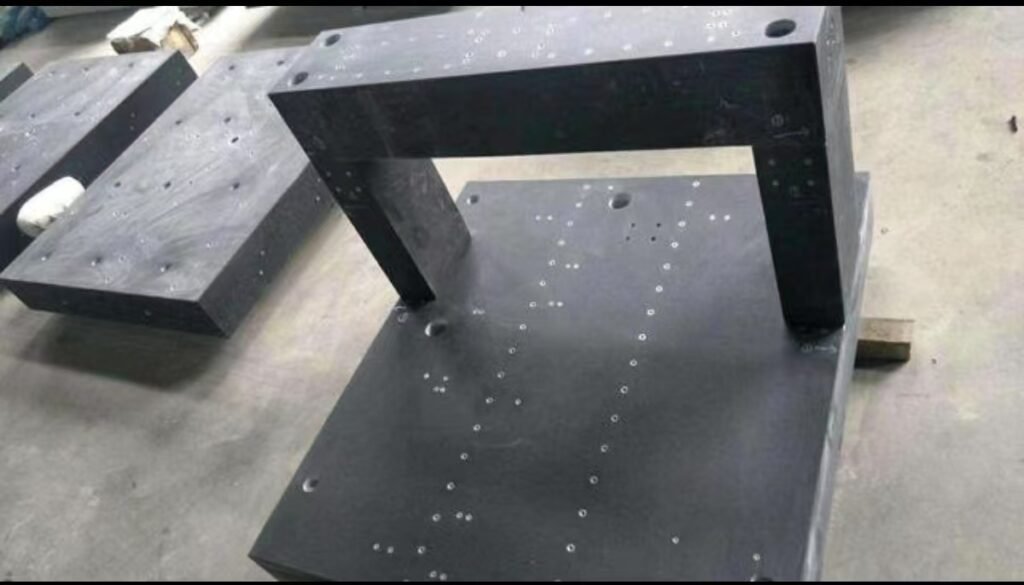
I. Core Definitions and Functions
The granite base (worktable gantry/column fraa CMM serves as the absolute reference for measurement, establishing a stable three-dimensional coordinate system, supporting workpieces and moving components, and suppressing vibration and thermal deformation; high-end models ofadopt an all-granite structure (integrated three-axis guides) to ensure overall thermal consistency.
Granite Base
II. Irreplaceable Material Characteristics
Long-term dimensional staed naturally over millions of years, with internal stresses fully released, resulting in almost no creep or residual deformation; far superior to cast iron/steel (which require artificial aging and to residual internal stresses).
Low coefficient of thermal expansion: High-quality Jinan Green/Black granite is approximately 7–9 ppm/°C, only 1/2 tof steel and 1/4 that of aluminum; deformation is minimal during temperature fluctuations, and using the same material for all three axes can cancel out thermal gradient errors.
Excellent damping and vibratin reduction: The crystalline structure rapidly absorbs mechanical vibrations (decaying several times faster than cast iron), significantly reducing interference from motion inertia and environmental vibrations on the probe, thereby improving measent repeatability.
High hardness, wear resistance, non-magnetic, and corrosion-resistant: Mohs hardness of 6–7; after precision grindin(Ra ≤ 0.02 μm), the surface remains almost scratch-free with long-term use; non-magnetic and rust-free, avoiding magnetic/erosive influences on precision measurements.
III. Material Seln, Machining, and Precision Standards
Preferred stone: Jinan Green, Shanxi Black, imported Black Granite; requirements include dense structure, uniform grain, and no cracks/delaminaed according to ISO 8512, with Grade 00/000 being metrological grade.
Precision machining process: Rough cutting → Rough grinding → Stress relaxationion grinding → Hand scraping/polishing → Constant temperature aging → Flatness/Perpendicularity inspection; flatness of critical surfaces can reac 0.002–0.005 mm/m².
Installation foundation: Requires vibration-isolating foundations/air cushions; working environment should be controlled at 20±2°C with temperature grdients < 0.5°C/h to avoid micro-deformation of the base caused by uneven temperatures.
IV. Comparison with Other Base Materials
Table
Material Advantages Disadvantages Ale Scenarios
Granite Thermally stable, good damping, non-magnetic, wear-resistant, high long-term precision Heavy, difficult to transport, brittle and vulnerableimpact Metrology rooms, high-precision CMMs, standard part calibration
Cast Iron Low cost, capable of casting complex shapes, good toughness Prone to rust, al expansion, weak damping, long-term deformation Shop-floor economy CMMs
Aluminum Alloy Lightweight, fast machining Extremely high thermal expansion, prone to creepsuitable for long-term high precision Portable articulated arm CMMs
Ceramic/Composite Near-granite performance Extremely high cost, difficult to machine Ultra-precisioic equipment
V. Limitations and Maintenance Points
Brittleness: Strictly prohibit impact by heavy objects or dropping; installation and transportation require professional lifting and protection.
Weight: Large platforms can weigh several tons, requiring high foundation load-bearing capacity.
Cleaning and maintenance: Avoid oily/acidic stains; wipe with lint-free cloth and specialized neutral cleaner; reguy re-inspect flatness and perpendicularity, and re-grind if necessary.
VI. Industry Trends
With the demand for nanoscale measurement in semiconductors and aerospace, compote granite (granite carbon fiber/ceramic reinforcement) and granite bases with active constant temperature control are gradually being applied. While maintaining traditional advantages, these advancements further improve thermal stability and performance.