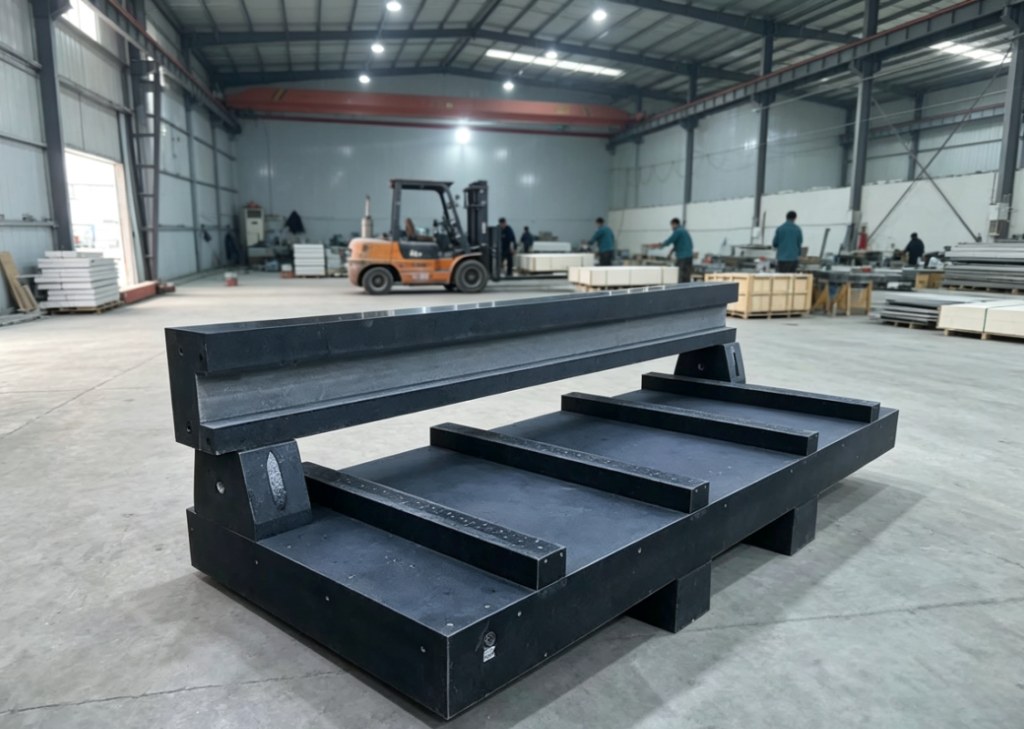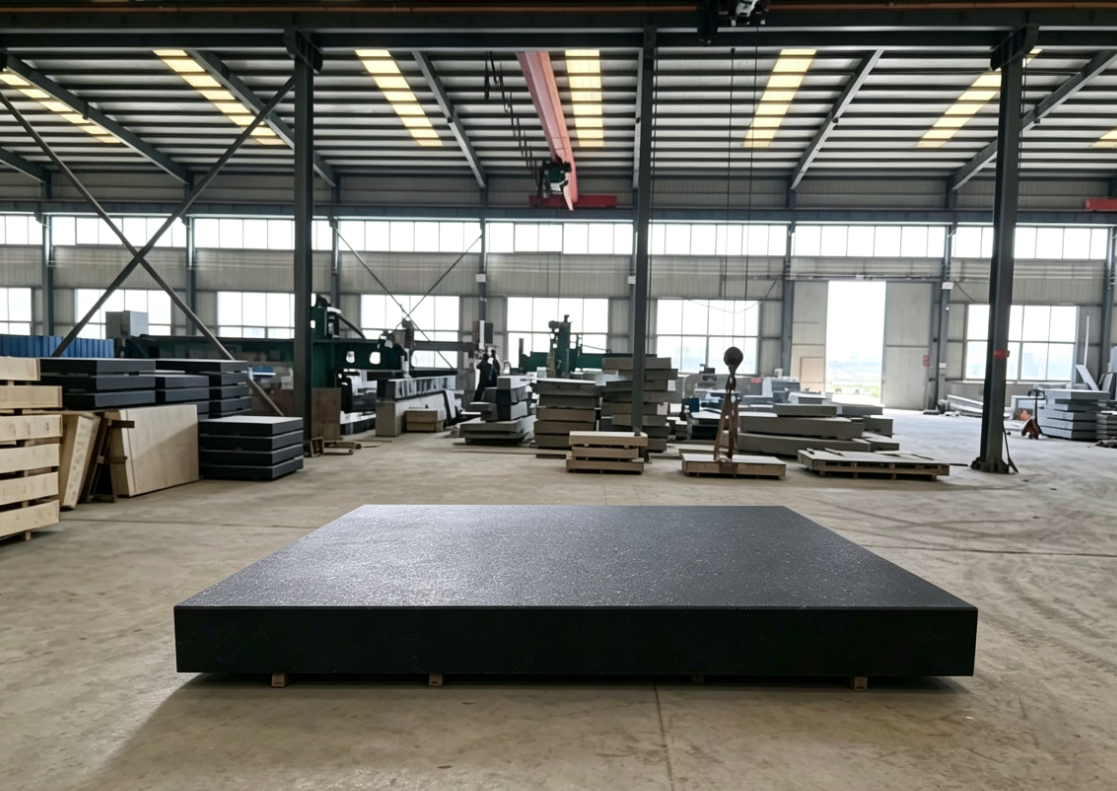
How to select high-precision granite platforms with long-term stability
The long-term precision drift and warping deformation of granite platforms are mostly not caused by insufficient grinding precision, but by the loss of control in five major stages: raw material selection, stress aging, structural design, processing technology, and acceptance inspection. To achieve long-term stability, one cannot only look at the flatness at the time of factory delivery; the focus must be on controlling long-term dimensional stability.
I. Raw Material Selection (The Source of Stability)
Prioritize fine-grained diabase / gabbro; reject coarse-grained, stratified, mica-rich, or soft-layered stones; strictly prohibit the use of spliced slabs for Grade 00/000 platforms.
Comparison of Mainstream Stones
Jinan Green (Diabase): Top choice, fine-grained, low thermal expansion, high elastic modulus; preferred for semiconductor, CMM, lithography machine bases, and metrology laboratory Grade 000/00; density 2.97-3.07g/cm³, Mohs hardness 6-7.
Indian Black Granite: A cost-effective alternative to Jinan Green, fine-grained, excellent stability, suitable for high-end equipment bases.
Zhangqiu Black (Sesame Black): Cost-effective, suitable for Grade 0 industrial-grade measurement platforms.
Northeast Sesame White: Coarse-grained, average thermal stability, only suitable for ordinary Grade 1 tooling, not recommended for high-precision long-term benchmarks.
Mandatory Physical Indicators (Request material reports from manufacturers)
Density ≥2.95 g/cm³
Water absorption rate ≤0.15% (to prevent expansion from water absorption during temperature and humidity cycles)
Coefficient of linear expansion ≤4.5×10⁻⁶/℃ (the smaller the value, the less temperature-induced deformation)
Shore hardness HS ≥70
Compressive strength >240MPa
Slabs must undergo ultrasonic flaw detection to screen for internal hidden cracks, pores, and looseness; internal cracks invisible to the naked eye are the biggest hidden danger for later deformation and cracking.
Appearance inspection: Uniform color throughout the block, no sand holes, pores, cracks, or traces of glue repair; no repairs allowed on the working surface.
II. Core: Stress Release and Aging (The Most Critical Process for Long-term Stability)
Many platforms have excellent factory precision but slowly warp after 6 months to 1 year of use. The root cause is that residual stresses from processing have not been fully released.
Aging must be performed after rough processing
High-end Grade 000/00: After rough cutting and rough grinding, natural aging in a constant-temperature workshop for 2-12 weeks, with regular flipping to release stress; higher requirements require natural outdoor aging for several months at the quarry stage.
Industrial Grade 0: Artificial aging through hot and cold cycles (80°C insulation → low-temperature cycling → return to constant temperature for resting) can be used to simulate environmental changes and release cutting stresses.
Processing methods
Cutting should use water-cooled diamond saws / wire saws; dry cutting is prohibited to avoid introducing thermal stress; leave a 0.5-1mm precision grinding allowance on one side for slotting and drilling; deep cutting in a single pass is prohibited to prevent micro-cracks.
❌ Pitfall to avoid: Going directly from rough processing to precision grinding without an aging process will inevitably lead to slow deformation later, no matter how beautiful the grinding looks.
III. Precision Grades, Grinding Technology, and Roughness
Execution standard: GB/T20428-2006 “Rock Plate”, 000 > 00 > 0 > 1, the smaller the precision number, the higher the grade.
Grade 000: Metrology institutes, semiconductor testing, optical benchmarks, laboratory constant-temperature environments.
Grade 00: CMM bases, linear motor platforms, high-precision inspection.
Grade 0: Precision quality inspection, 2D measurement, tooling benchmarks.
Factory flatness only represents the precision at the moment of delivery; stability depends on aging, not just the grade.
Grinding: For 00/000 grade, multiple flips and manual ultra-precision grinding are required; single-sided processing by CNC grinding machines is not allowed. Surface roughness Ra≤0.2μm, micropores must be closed to reduce the impact of water vapor penetration.
Precautions for slotting and threaded inserts:
Avoid deep slots on high-precision platforms as much as possible, as slotting will change the stress distribution of the stone; if slotting is necessary, perform a round of aging after slotting before final precision grinding.
Threaded holes must use metal inserts; direct threading of granite is prohibited to prevent chipping; low-stress adhesive must be used for bonding the inserts.
IV. Structural Thickness and Support Design (Self-weight Deformation Control)
Granite is very heavy; if the support is unreasonable, even the best stone will bend and deform.
Thickness Selection
Cuadro
Platform Size | Recommended Minimum Thickness
600×600 | 150mm
1000×1000 | 200-250mm
1500×1000 | 250-300mm
2000×1500 | 350-400mm
Do not blindly pursue thinness for large platforms; insufficient thickness will cause self-weight deflection and long-term creep deformation.
Support Principles: Three-point rigid support is the baseline; add auxiliary supports for large platforms. Support points must strictly follow the manufacturer’s drawings; arbitrary shimming, local suspension, and single-point overloading are prohibited. Support points should be placed as close as possible to the 1/5 position from the edge; do not support at the exact center, nor at the very edge.
The supporting frame must be sufficiently rigid; deformation of the frame will indirectly cause platform deformation. Ultra-high precision scenarios require an independent vibration-isolated foundation.
V. Required Documentation for Acceptance (Do not rely solely on a certificate of conformity)
Flatness test report (actual measured data from electronic level grid method, not just a qualified conclusion)
Raw material physical property report, ultrasonic flaw detection records
Aging process description (aging method, cycle)
Factory inspection certificate, traceable metrology.
If conditions permit: After delivery, place the platform in a constant-temperature environment for 48-72 hours, re-measure the flatness, and observe if it drifts.
VI. Impact of Operating Environment on Long-term Stability (Must be prioritized after platform selection)
Even with the best granite, accuracy will decrease in harsh environments:
Temperature: Optimal 20±1°C; avoid direct sunlight and direct blowing of hot/cold air. Local temperature differences will cause warping; the hazard of temperature gradients on large platforms is far greater than the average temperature.
Humidity: 45-60% RH; long-term high humidity will cause slight water absorption and expansion.
Keep away from vibration sources; equip high-precision setups with vibration isolation pads.
Prohibit impact and knocking; prohibit local concentrated overloading; distribute the load as evenly as possible.
Regularly re-check flatness every year.
VII. Selection Pitfall Avoidance Summary Checklist
✅ Must: Monolithic slab, ultrasonic flaw detection, sufficient aging, water-cooled low-stress machining, reasonable thickness standardized support, complete test reports.
❌ Avoid: Spliced granite, glued repairs on the working surface, direct precision grinding without aging, only reporting grades without providing actual measured flatness data, making large platforms too thin, arbitrarily changing support positions.