Selection Comparison and Application Principles of Granite Guides and Machine Tool Bases in Precision Engineering
In preciachine tools, CMMs, grinders, optical equipment, and semiconductor equipment, the selection of granite vs. cast iron vs. steel bases & guides revolves around core factors: precisin retention, vibration resistance, thermal deformation, long-term stability, and machining conditions.
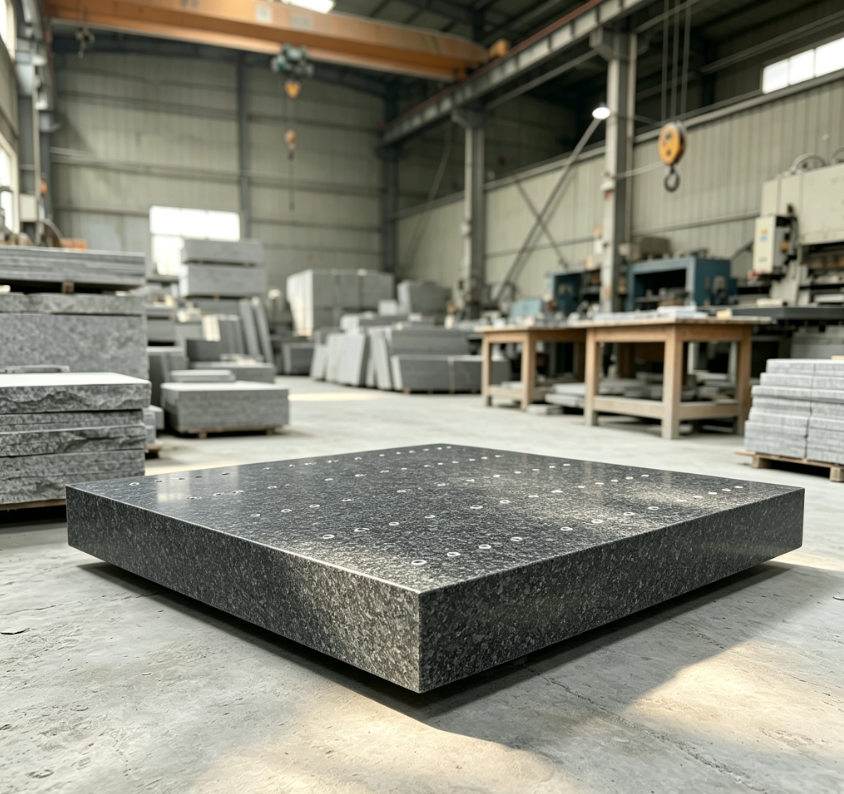
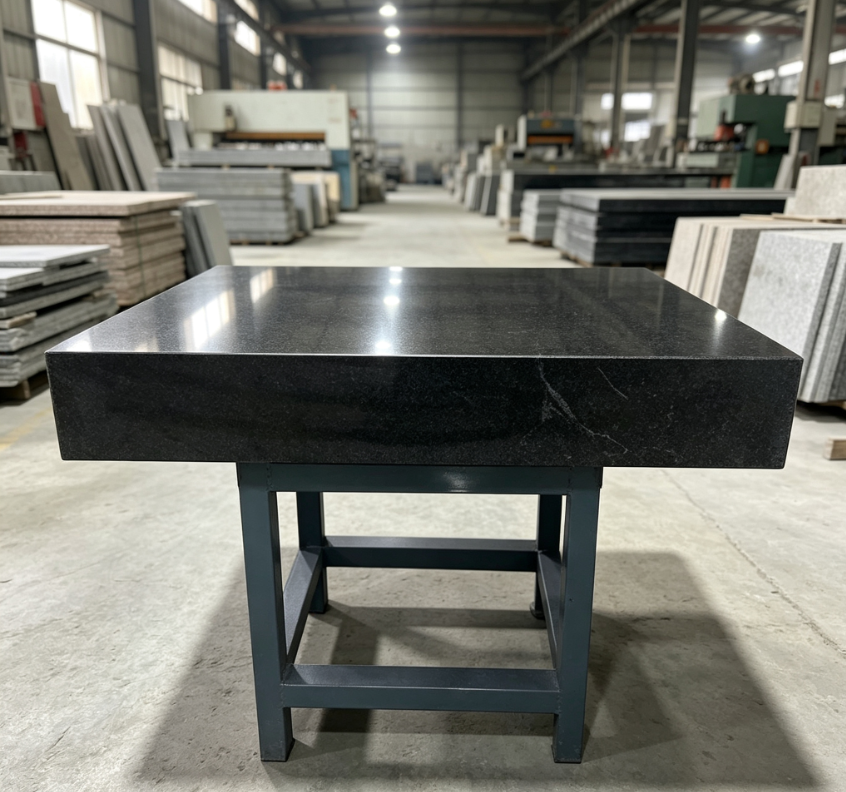
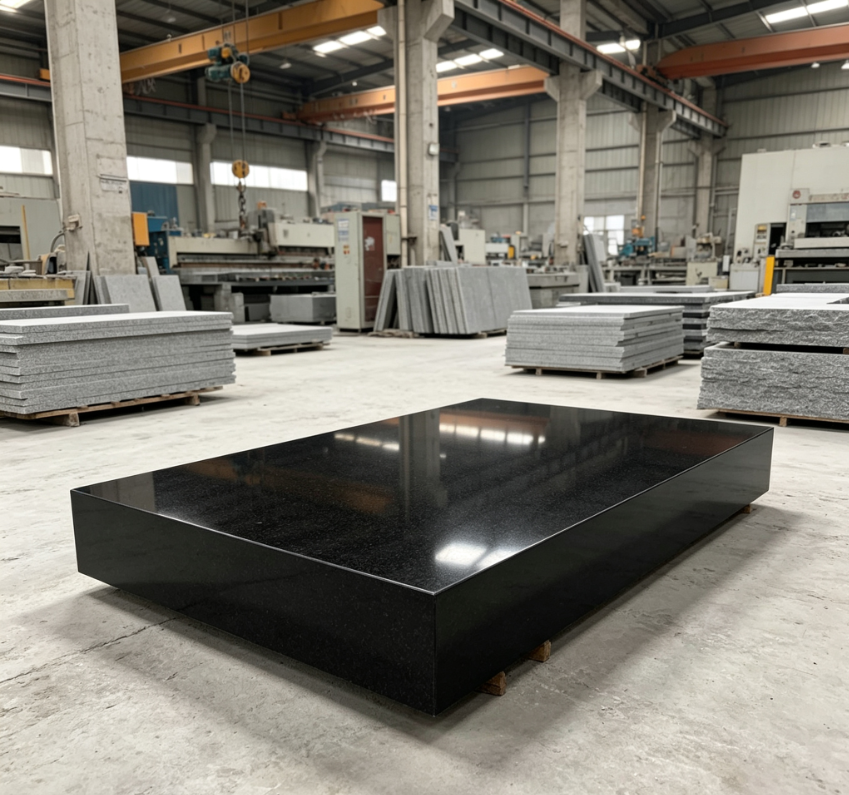
I. Why Precision Engineering Prioritizes Natural Precision Granite
Lifetime Super-Stable Geometric Dimensural granite has released geological stresses over hundreds of millions of years, leaving no residual internal stress. Unlike cast iron or steel plates, it does not creep, deform, or ware. Precision drift is almost negligible over ten to twenty years, making it the only long-term reliable substrate for ultra-precision benchmarks.
Extremely Low Thermal Expansion, Stable Precision Regardless of Terature Fluctuations
Granite linear expansion coefficient ≈ 0.5~1.1×10⁻⁶/℃
Steel≈ 11×10⁻⁶/℃
Under the same workshop temperature differences, granite deformation is only 1/10 that of steel, enabling stable nanometer and micron-level precision even in non-thermostatworkshops.
Ultra-High Damping Vibration Reduction, Extremely High Surface Finish
The rock crystal structure has vibration absorption capacity 8~10 times that of cast iron.
No vibrring cutting, grinding, or high-speed reciprocating motion; fewer tool marks; significantly improved workpiece surface roughness; and long-term wear-free straightness of gu
Rust-Proof, Corrosion-Resistant, Non-Magnetic
No fear of oil stains, cutting fluids, or humid environments; no need for rust-proof maintenance.
Nic, suitable for optical inspection, linear scales, magnetic scales, and semiconductor precision equipment.
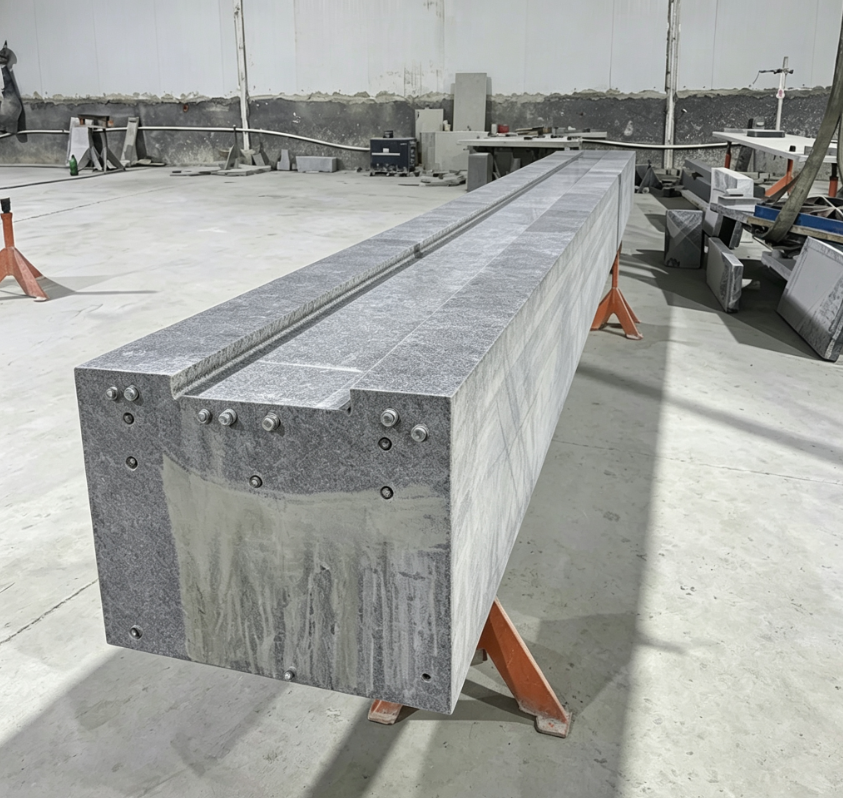
Extremely High Guide Fitting Precision
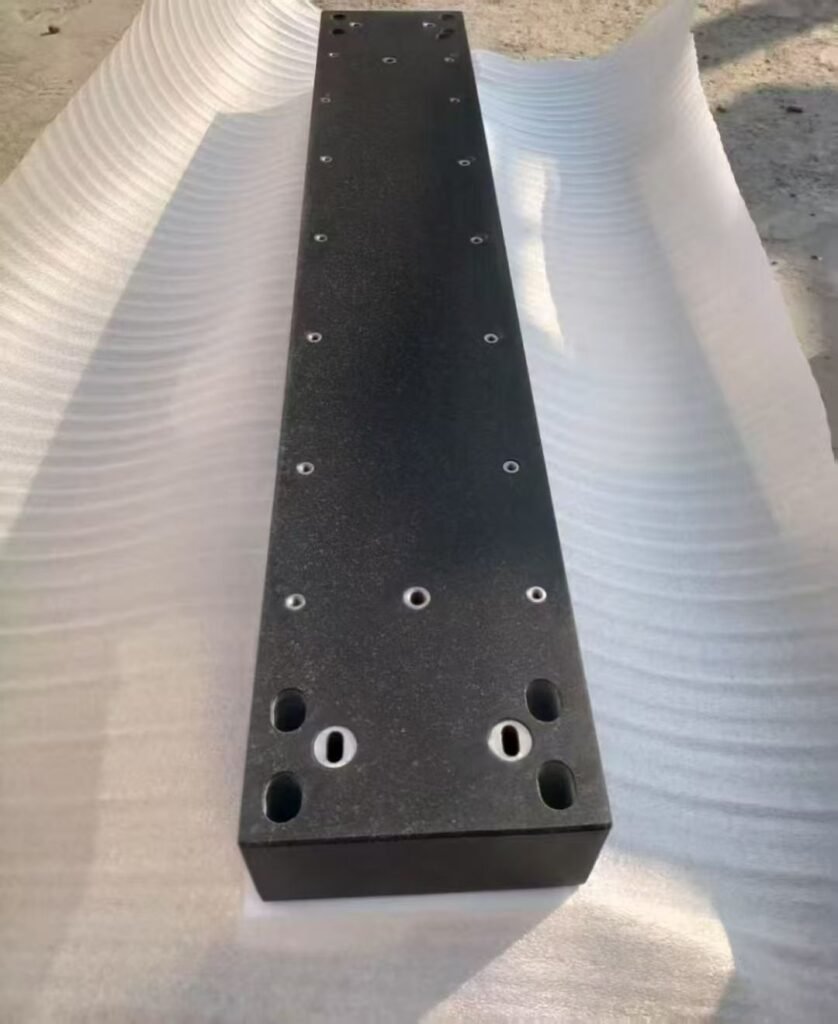
Can be ground to 000-grade ultra-hflatness and straightness. Air-bearing and ball-bearing guides have excellent fitting rigidity, and motion repeatability far exceeds metal structures.
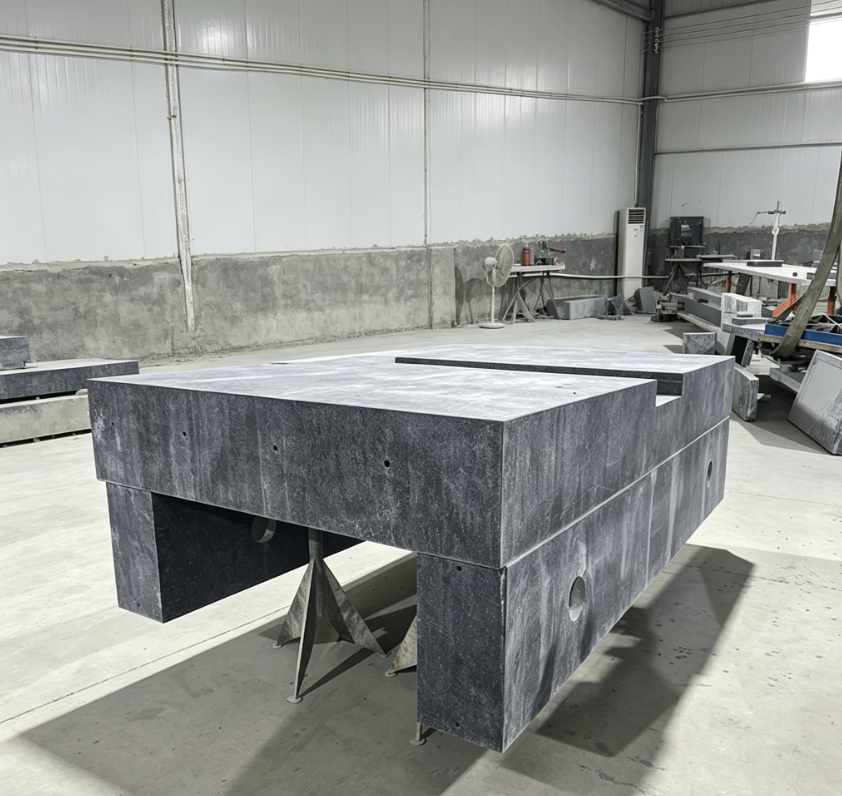
II. Application Scenarios for Granite Basanite Guides
Mandatory Granite Conditions
High-precision Coordinate Measuring Machines (CMM)
Ultra-precision grinders, optical grinding machines
Semiconductor equipment, lithography maon platforms
Linear scales, laser interferometry metrology equipment
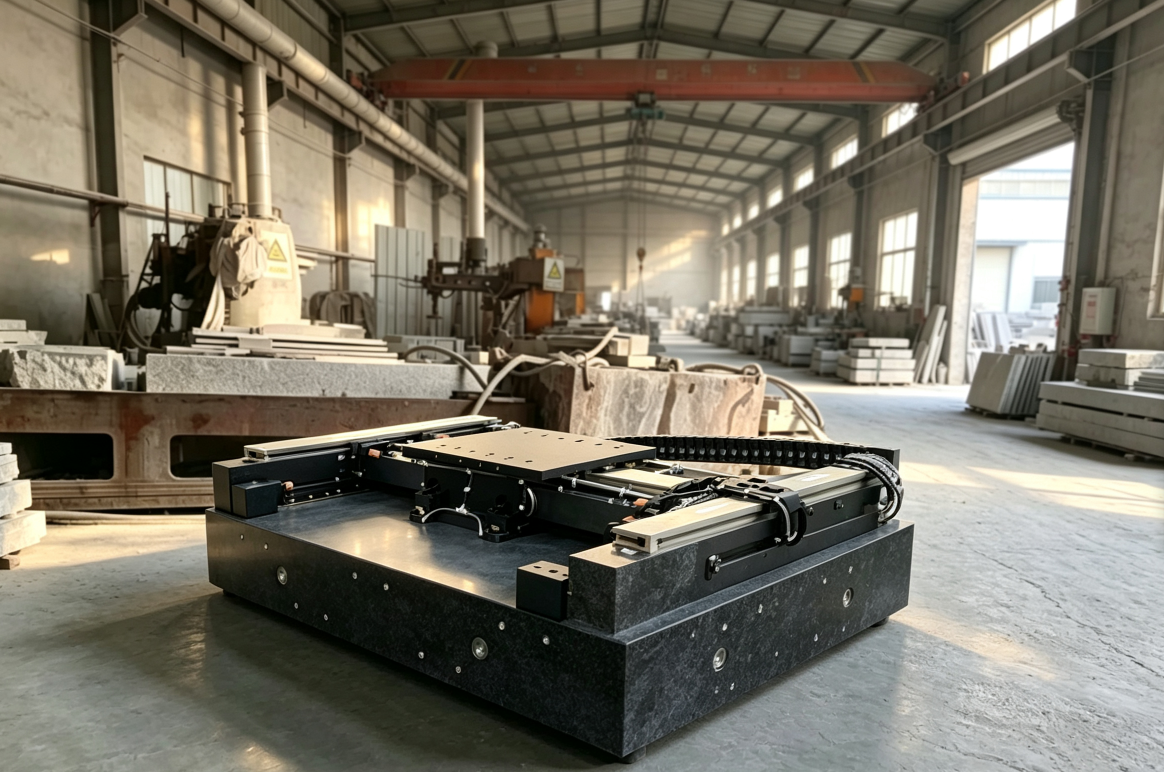
High-speed precision linear motor machine tools
Laboratory reference platforms, inspection tooling
Characteristics: Micrer precision, long-term traceability, low vibration, general temperature control requirements
Cautious / Not Recommended for Granite Conditions
Heavy cutting, heavy load impact machine toolmping, roughing gantries)
Granite is brittle with poor impact resistance; prone to cracking or chipping under heavy impact
High-temperature conditions (>60℃ longse)
Frequent severe collisions, rough handling of equipment
Ultra-large tonnage heavy machine tool main structures
III. Selection Comparison: Granite vs. Cast Iron Machine Tool Bases
| Tablparison Item | Granito de precisión | High-Quality Cast Iron (HT300) | Selection Conclusion |
|---|---|---|---|
| Long-term Dimensional Stability | Excellen deformation | Average, prone to stress deformation and aging failure | High precision must use granite |
| Coeficiente de dilatación térmica | Very small | Moderate | Granite wins in temperature fluctuation evironments |
| Damping Vibration Reduction Performance | Super strong | Moderate | Select granite for mirror processing and high surface finish |
| Rigidity and Hardness | High hardness, wear-resistanigh rigidity, good toughness | Cast iron for heavy loads and rough machining; granite for precision machining | |
| Impact Toughness | Brittle, afraid of impact | Good toughness, impacttant | Heavy work uses cast iron; precision uses granite |
| Magnetic Properties | Non-magnetic | Weakly magnetic | Optics / Semiconductor must use granite |
| Mantenimiento | Rust-freerry-free for life | Prone to rust, requires regular maintenance | Granite has lower long-term costs |
| Grado de precisión | 000/00-grade ultra-high precision | Ordinary presion grade | Nanometer-level precision can only use granite |
IV. Guide Structure Selection: Integral Granite Base vs. Granite Guide Inserts
Integral granite base guides
Best straightness and parallelism consistency, no assembly gaps, highest overall machine accuracy
Suitable for: Ultra-precision CMMs, high-speed linear motor machine tools
Cast iron base granite-embedded guide surfaces
Balances cast iron’s heavy-duty toughness with granite’s high precision and wear resistance
High cost-effectiveness, high versatility
Suitable for: Precision grinders, CNC engraving machines, medium and small inspection equipment
All-cast iron guide base
Heavy cutting, rough machining, mold machine tools, general CNC lathes
Low cost, impact resistant, unsuitable for ultra-high precision long-term retention
V. Summary Mnemonic for Precision Engineering Selection
For measuring dimensions, optical applications, or nanoscale work, always choose granite
For light cutting, high gloss, high-speed reciprocation, or vibration sensitivity, select granite
For heavy cutting, large impacts, or rough machining, use cast iron
If workshop temperature fluctuations are large and strict constant temperature cannot be maintained → prioritize granite base
For requirements of precision retention over 10 years or metrological traceability benchmarks → natural granite is irreplaceable.