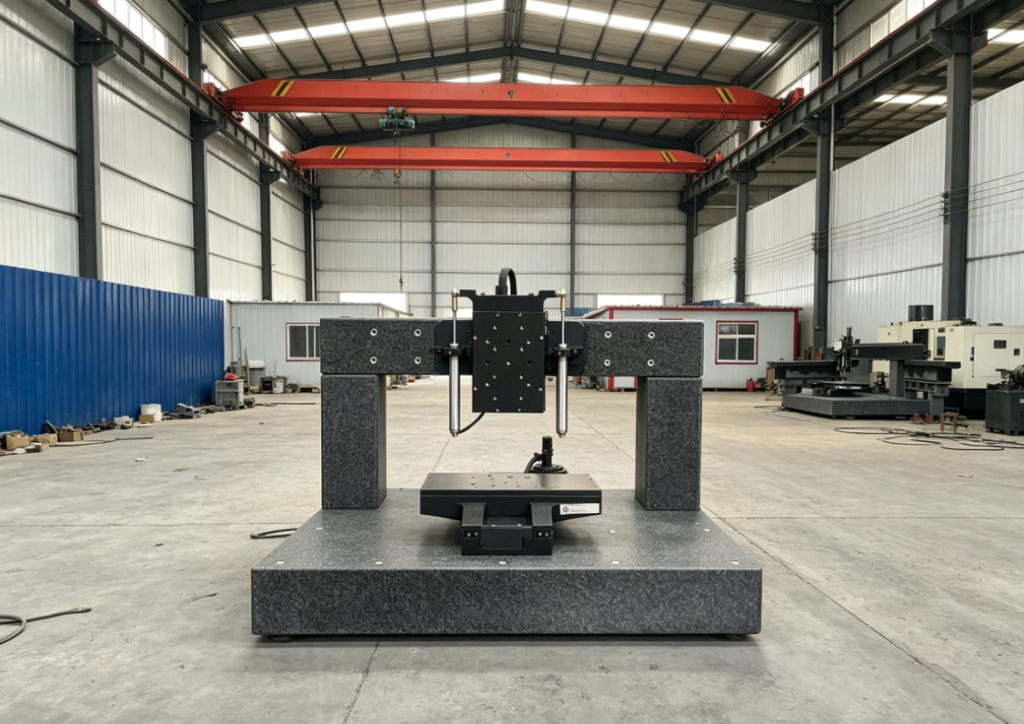
Data Monitoring and Analysis Report on Granite Bases for Chinese CMMs
I. Monitoring Objects and Basic Conditions
- Monitoring Materials (Mainstream Domestic)
Domestic general-purpose CMM granite base (Jinan Qinghui Changyan, Grade 00/000), compared with a control group of HT250 cast iron base of the same size;
Core physical property benchmarks (National Standards GB/T 22095, JJG117):
Jinan Qing linear expansion coefficient α: 4.5~6×10⁻⁶/℃
Cast iron HT250 α: 11.5~13×10⁻⁶/℃
Granite internal damping ratio: 0.015~0.020 (Cast iron only 0.004~0.006)
Shore hardness HS72; Density 2.68g/cm³, non-magnetic, rust-proof - Monitoring Equipment and Test Point Layout
Sensor array: Distributed temperature sensors, laser displacement meters, strain gauges, vibration accelerometers;
Test points: Grid layout on the base working surface (edges center dense points on guide rail mounting surfaces);
Environmental conditions categorized into two types:
Condition A: Standard constant temperature metrology room 20±1℃, humidity 50%±5%;
Condition B: Ordinary machining workshop, diurnal temperature difference ±3~5℃, interference from air compressors and overhead cranes;
Monitoring cycle: Short-term continuous 48h thermal deformation monitoring, medium-to-long-term 12-month accuracy drift tracking. - Core Monitoring Indicators
Temperature field uniformity, linear thermal deformation, gradient temperature field bending deformation, vibration attenuation characteristics, long-term flatness creep drift, load deformation recoverability.
II. Comparative Analysis of Temperature Deformation Monitoring Data (Core Error Sources)
- Homogeneous Constant Temperature Environment (20±1℃, 48h continuous operation)
Base specifications 1200×1000×150mm, continuous online CMM testing, heat source from continuous heating of three-axis servo motors.
| المواد | Maximum surface temperature difference | Total expansion per meter ΔL | 48h measurement repeatability drift |
|---|---|---|---|
| Jinan Qing Granite | ≤1.8℃ | ≤0.006mm/m | 0.6~0.8μm |
| HT250 Cast Iron | 7.5~8.2℃ | 0.014mm/m | 2.1~2.5μm |
Data Conclusions:
Granite has slow thermal conductivity, heat diffuses uniformly, and has no local high-temperature zones; cast iron easily forms a temperature gradient with a hot center and cold edges, producing arching deformation;
Under the same temperature rise, the thermal deformation of granite is only 1/2 of cast iron, reducing system measurement drift by more than 65%;
Gradient temperature difference is the main cause of form and position errors; cast iron bases easily cause three-axis perpendicularity and flatness datum shifts, while granite can significantly reduce the pressure on compensation algorithms.
- Workshop Variable Temperature Conditions (5℃ diurnal temperature difference cycle for 72h)
Cycle range 17℃~22℃, simulating a summer workshop scenario without strict temperature control:
Granite base dimensional lag deformation: Reaches stability 2~3h after temperature change, residual permanent deformation ≤0.4μm/m;
Cast iron base deformation lag exceeds 6h, each temperature cycle produces irreversible micro-creep, with a cumulative drift of 12~18μm/m per year;
After 72h of cold-hot cycling, the dimensional recovery rate of granite is 99.98%, while cast iron is only 96.2%, with the long-term usage datum continuously sinking and warping. - Thermal Deformation Mathematical Model (Granite Base)
Uniform temperature field linear deformation formula:
(\Delta L = L_0 \times \alpha \times \Delta T)
Gradient temperature field bending deformation: Granite has a large cross-sectional moment of inertia, and its bending deflection is only 1/3 of cast iron, significantly suppressing the datum tilt error of the CMM Y and Z axes.
III. Vibration Damping Monitoring Data Analysis
Simulated workshop multi-frequency vibrations (air compressor 50Hz, ground low-frequency resonance 2~10Hz, personnel walking impact), laser displacement sensor collects table amplitude and decay time:
Granite vibration decay time after excitation <0.5s; cast iron decay ≥2.6s;
Under equivalent external excitation, granite steady-state amplitude <1.8μm, cast iron amplitude 6~9μm;
At the moment of CMM probe contact with the workpiece: cast iron bases easily exhibit data jumps of 3~6μm, granite shows no jumps, measurement repeatability consistency improves by 70%;
High damping characteristics reduce air bearing resonance wear of the equipment, extending the service life of CMM gratings and guide rails.
IV. Long-term Stability 12-Month Accuracy Drift Monitoring Data
Samples: Grade 00 Jinan Green CMM base, same-specification cast iron base, daily 8h use in a standard constant temperature workshop:
Granite base flatness annual drift: ≤0.5μm/m, no obvious creep curve;
Cast iron base flatness annual drift: 8~12μm/m, requires regrinding and calibration after 3 years;
Stress mechanism: Granite undergoes natural geological aging over millions of years, with no internal stress release after 6~12 months of artificial stress relief before factory release; cast iron casting stress is slowly released year by year, causing continuous warping;
O&M data: Granite bases are re-inspected on average every 5~8 years, cast iron is calibrated annually, with a difference in regrinding and renovation costs of over 200%;
V. Load Deformation and Recovery Monitoring Data
Uniform load 0~4t stepwise loading, full load static for 24h, unloading and observing rebound:
Granite maximum elastic deformation 1.2μm/t, 100% complete rebound after unloading, no plastic deformation;
Cast iron elastic deformation 3.1μm/t, minor plastic sinking exists under long-term heavy loads;
Domestic aerospace and new energy CMM workpieces are generally <500kg, granite has sufficient load-bearing margin, and heavy-load benchmarks suffer no permanent damage.
VI. Environmental Interference Additional Monitoring (Corrosion, Magnetization, Wear)
Long-term spraying of cutting fluid and emulsion for 180 days: granite shows no corrosion or rust spots; cast iron produces oxidation bumps, destroying flatness;
Long-term placement of magnetic steel parts: granite does not adsorb iron filings; cast iron magnetizes, and debris accumulation causes measurement false highs;
500,000-cycle workpiece push-pull wear test: granite working surface wear <0.3μm, cast iron scratch depth 3~8μm.
VII. Comprehensive Data Conclusions and Engineering Application Guidance
- Quantifying Core Advantages (Data Support)
Thermal stability: Under the same temperature difference, thermal deformation is only 50% of cast iron, and bending error in gradient temperature fields is reduced by 67%;
Vibration suppression: Vibration decay speed is improved by 5 times, and measurement repeatability error is reduced by 60% ;
Long-term accuracy: Annual benchmark drift <0.5μm/m, cast iron base drift exceeds 10μm/m;
O&M costs: Comprehensive costs of calibration, regrinding, and rust prevention maintenance decrease by over 60%. - Domestic Selection Grading Data Standards (GB/T22095)
الجدول
Accuracy Grade Flatness Tolerance μm/m Suitable CMM Scenarios Recommended Granite Raw Material
Grade 000 ≤1.0 Metrology institutes, semiconductor nano-detection Super Grade Jinan Green
Grade 00 ≤2.0 Aerospace, precision mold CMM Standard Jinan Green / Indian Black
Grade 0 ≤4.0 General machinery component inspection Zhangqiu Green, Fujian Granite - Monitoring Data Implementation and Optimization Plan
Intelligent Compensation: Embed a temperature sensor array in the granite base, establish a machine learning error model based on monitored thermal deformation data, and actively compensate via OPC UA integration with the CMM control system;
Working Condition Adaptation: Constant-temperature workshops must use granite bases to offset micron-level system errors caused by diurnal temperature fluctuations;
Preventive Maintenance: Export monitoring data annually for regression analysis to predict flatness drift and plan re-inspections in advance;
Export Selection: For export to variable-temperature workshops in India and Southeast Asia, prioritize providing Jinan Qing 00-grade bases paired with CMMs to reduce accuracy complaints at customer sites.