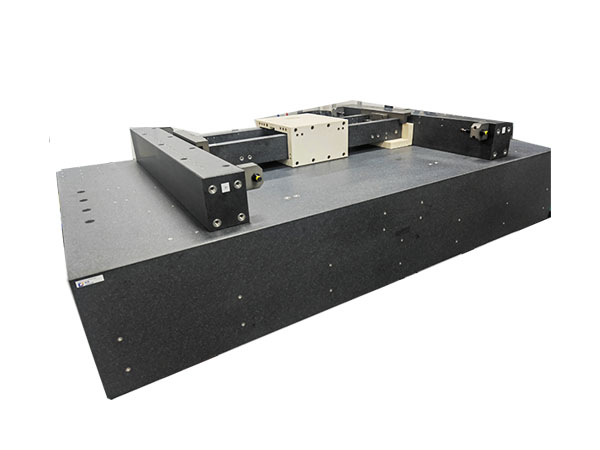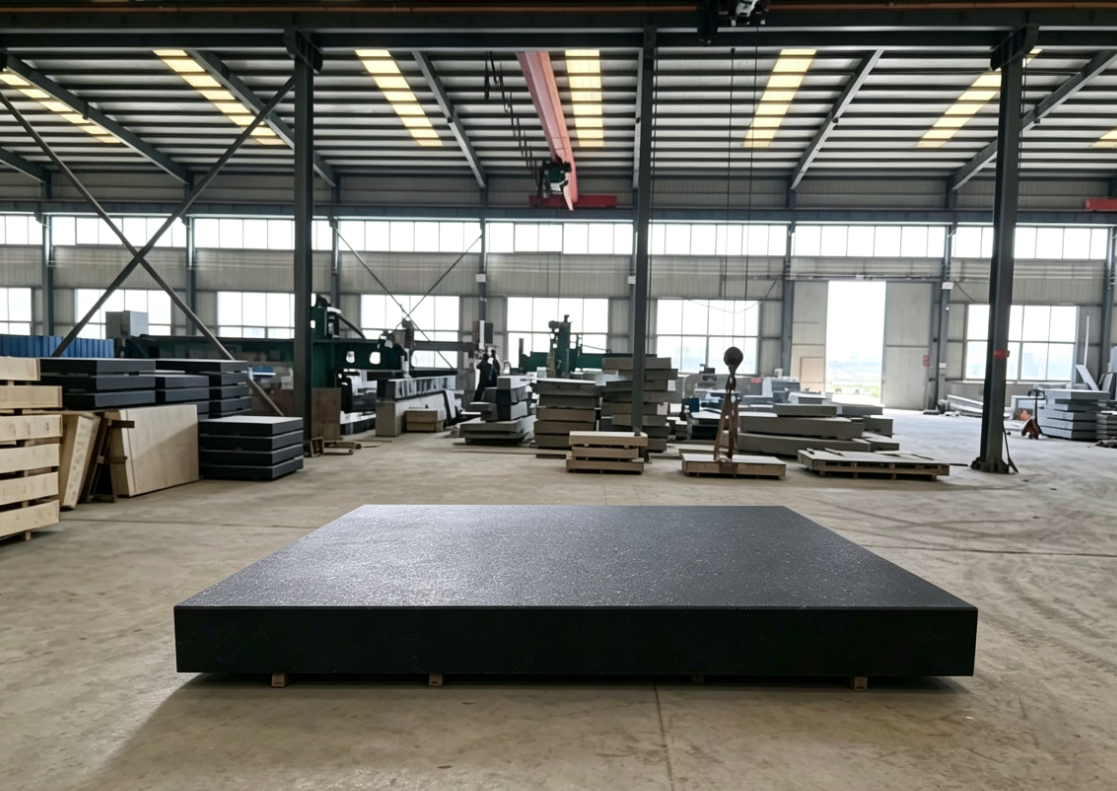
Complete Selection Guide for High-Precision Granite Machine Tool Bases with Threaded Inserts
Follow the 7-step screening process: Application Scenario → Material → Precision → Dimensions & Thickness → Threaded Insert Configuration → Supporting Structure → Manufacturer Process to avoid common pitfalls such as hole deformation, insert detachment, insufficient precision, and inadequate rigidity in one go.
I. Step 1: Determine Precision Grade Based on Equipment Purpose (Most Critical)
Referring to the national standard GB/T20428, a large number of threaded inserts will increase machining difficulty. Match directly according to the equipment’s precision requirements:
Grade 000 (Ultra-precision, dedicated to small dimensions)
Flatness ≤ 1.5μm/m, total diagonal tolerance K=1
Applications: Wafer dicing machines, lens grinding, coordinate grinders, nano-optical equipment, interferometer bases
Limitations: Base length and width ≤ 1200mm, cannot be fully covered with M10/M12 heavy-duty inserts; difficult to achieve stable standards for large sizes, costs increase by 30%
Grade 00 (Preferred choice for general precision machine tools)
Flatness ≤ 3μm/m, total diagonal tolerance K=2
Applications: Micro-hole CNC, precision engraving machines, fully automatic vision measuring machines, multi-axis linear modules, PCB/FPC processing equipment
Advantages: Stable mass production is possible for both large and small bases with full-grid threaded inserts; highest cost-performance ratio; the vast majority of precision machine tools use this grade
Grade 0 (Conventional automation equipment)
Flatness ≤ 6μm/m
Applications: Ordinary visual inspection, dispensing, screw locking, grinding fixture bases; can be selected if there are no micron-level machining requirements
Synchronous supporting precision requirements (Must-read for machine tool bases):
Working surface roughness Ra ≤ 0.32μm; side perpendicularity ≤ 2μm/m; threaded hole position tolerance ±0.1mm
II. Step 2: Granite Raw Material Selection, Directly Determining Long-term Stability
- High-end Ultra-precision Equipment (Semiconductor / Optical / Coordinate Grinding)
Jinan Qinghui Green Granite (Preferred)
Density ≥ 2.97g/cm³, fine-grained without impurities, thermal expansion coefficient 2.5~4.6×10⁻⁶/℃, Shore hardness ≥ 70HS, extremely low water absorption, no internal stress, minimal long-term precision decay; suitable for constant-temperature high-precision equipment. - Mid-to-High-end Precision CNC, Vision Inspection Equipment
Zhangqiu Black / Indian Black Granite (Cost-effective alternative)
Performance close to Jinan Qing, price 15%~25% lower; suitable for 3C, lithium battery, and general precision machining machine tools; stability meets long-term use for Grade 00. - Ordinary Automation Fixtures (Limited Budget)
Ordinary Sesame Black; only recommended for Grade 0 bases, not recommended for micron-level machining machine tools.
❌ Prohibited Materials: White marble, coarse-grained multicolored granite; prone to deformation, low hardness, and oil seepage/cracking.
III. Step 3: Matching Base Length, Width, and Thickness Rigidity (The more holes, the thicker the base must be) - Length and Width Determination Rules
Base Length and Width = Maximum equipment travel 100~150mm reserved installation space on each side, reserving space for guide rails, motors, and protective covers. - Thickness Rigidity Standards (Thickening requirements for threaded inserts)
Ordinary measuring platforms: Thickness ≥ Length ÷ 15;
Machine tool bases (with a large number of threaded inserts) must be thickened by 1.5 times to prevent stone rigidity reduction and grinding deformation after drilling and embedding:
Small bases up to 600×800: Thickness ≥ 120mm; for heavy-duty full-coverage M10 inserts, 150mm is recommended
Medium bases 1000×800~1500×1000: Base thickness 150~200mm
Large gantry bases over 1500mm: Thickness ≥ 220~300mm
Load-bearing reference
IV. Step 4: Full Parameter Selection for Threaded Inserts (Crucial for preventing detachment and stripping)
- Insert Material (Mandatory for machine tools: 304/316 stainless steel thickened bushings)
Standard dry equipment: 304 stainless steel threaded inserts
Contact with cutting fluids, cleaning solvents, or humid environments: 316 stainless steel, rustproof and corrosion-resistant
❌ Brass and ordinary carbon steel are prohibited; they rust in long-term oily environments and have insufficient pull-out strength - Thread Specification Matching Installation Screws
Small optical and vision modules: M6 (light load)
Mainstream guide rails, sliding tables, cameras, and tooling: M8 (industry standard)
Spindles, heavy-duty gantry machines, and heavy motors: M10 / M12
Imported equipment inch-sized parts: 1/4-20, 3/8-16 customized inserts - Insert Layout Scheme Selection Based on Needs
Full grid layout: 50/100mm standard matrix, for tooling with frequent product switching or multi-axis module equipment; requires thickened base for dense hole drilling
Local area hole drilling: Pre-embed only in guide rail and motor installation areas, leaving the rest smooth to reduce costs and stone stress
Multi-surface inserts: Pre-embed on top, side, and bottom surfaces; side surfaces for mounting guard brackets, bottom surface for fixing vibration-damping brackets - Hard Process Requirements (Confirm with manufacturer before purchasing)
Insert countersink depth 0.3~1mm below the surface, flush after grinding, without affecting guide rail fit;
Hole edge distance to stone edge ≥50mm, center-to-center distance between holes ≥100mm to avoid stone cracking;
Epoxy structural adhesive fully filled and cured for over 72h before overall constant-temperature grinding; pull-out strength of a single insert ≥400kg without loosening;
Provide a standard tightening torque table to prevent screws from over-tightening and pulling out the insert.
V. Step 5: Machine-Specific Supporting Structures Added as Needed
Guide rail installation steps / clearance grooves: Direct recessed installation for linear guide rails and scales to improve straightness and reduce shim usage;
Chip removal grooves: Essential for CNC and drilling machines to prevent cutting fluids from soaking the stone for long periods;
Lifting threaded inserts: Pre-embed lifting holes on the bottom of large-sized bases for safe handling, avoiding direct damage to the surface by steel wire ropes;
Anti-seepage glazing treatment: Full-machine anti-seepage sealing to prevent oil and cutting fluids from penetrating the stone interior;
Composite T-slots threaded inserts: For multi-functional machines requiring both guide rail fixing and rapid workpiece clamping;
Vibration-damping accessories: Pair with granite-specific cast iron brackets inflatable vibration-damping pads to isolate floor vibrations and improve machining finish.
VI. Step 6: Selection Based on Operating Environment
Constant temperature workshop (20±1℃): Prioritize Grade 000/00 Jinan Blue granite to fully leverage low thermal expansion advantages;
Ordinary workshop with large temperature fluctuations: Grade 000 is not recommended; choose Grade 00 with a thickened base to reduce thermal deformation;
Presence of cutting fluids and coolants: 316 stainless steel inserts overall anti-seepage glazing, with thickened slabs;
Optical / semiconductor non-magnetic requirements: Granite is naturally non-magnetic, no extra treatment needed;
Heavy-duty continuous cutting: M12 inserts, thickness ≥200mm, high rigidity and vibration damping to suppress resonance.
VII. Step 7: Manufacturer Process Acceptance Standards (Key to avoiding pitfalls)
Confirm the manufacturer possesses the following processes before ordering, otherwise the threaded insert base is highly prone to precision failure:
Raw material natural aging treatment, no splicing, no cracks, no air bubbles;
Overall constant-temperature grinding after pre-embedding inserts, rather than block-by-block processing;
Factory-issued laser interferometer flatness test report and hole position precision test data;
Diamond water-cooled drilling process, as dry drilling causes micro-cracks inside the stone.