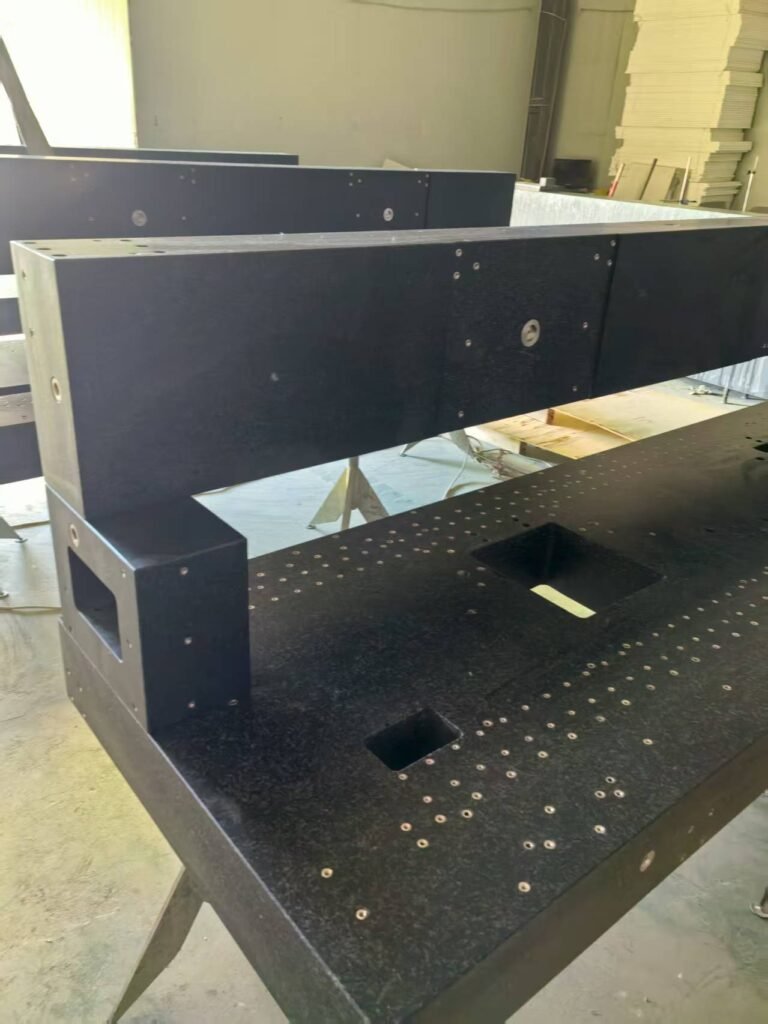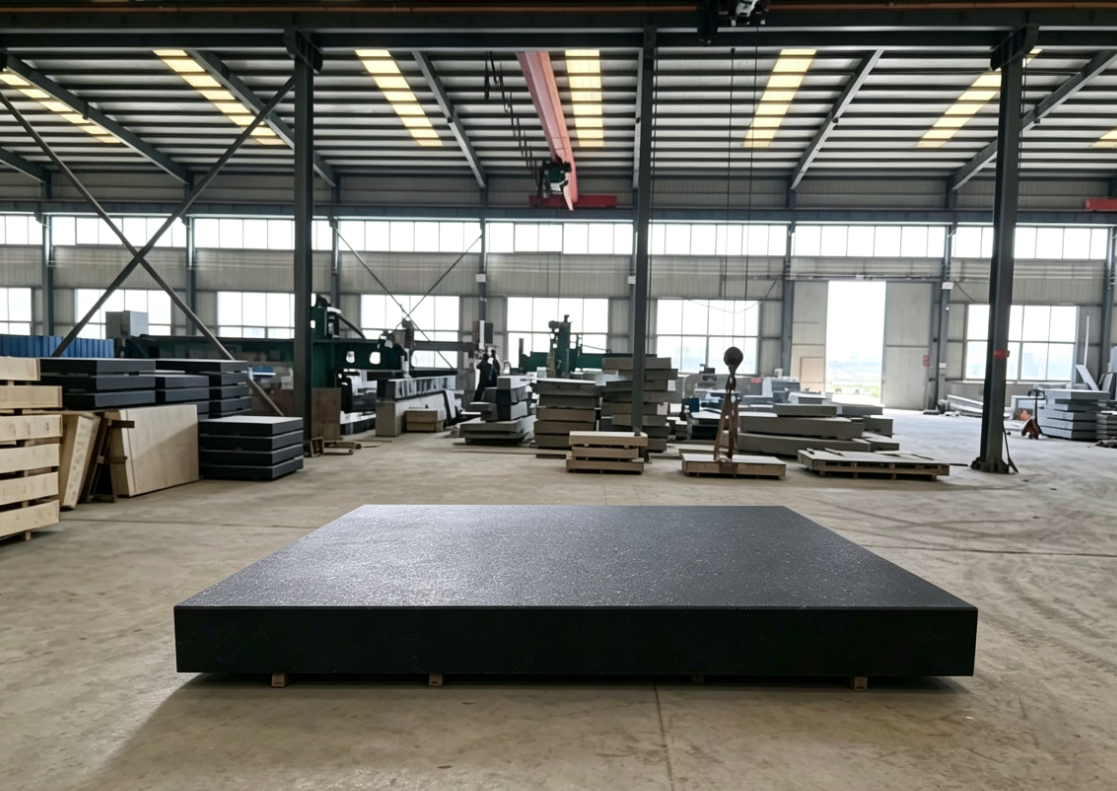
In aerospace manufacturing, large granite bases (platforms) serve as the core reference for ultra-precision machining,measurement, and assembly. Their precision is tested across four major dimensions: flatness, thermal stability, dynamic stiffness, and long-term stability, with larger sizes demanding even stricter stds.
I. Core Precision Indicators and Aerospace Standards
The aerospace industry (CMMs, large machine tools, assembly references) typically requires Grade 00 orrade 000 (ultra-precision grade) accuracy:
Flatness: Core indicator.
Conventional: ≤1~2 μm/m²
Aerospac: ≤0.5 μm/m², even 0.1~0.2 μm/m² (sub-micron level)
Large (e.g., 3m×6m): Total dinal error ≤2~3 μm
Geometric Tolerances:
Parallelism, perpendicularity, straightness: ≤0.5~1 μm/m
Surface Rghness: Ra ≤ 0.02~0.05 μm (mirror finish)
Load Deformation: Deflection under full load 0.1~0.3 μm/m
II. Five Core Precision Tests
- Temperature Stability (The Most Stringent Test)
Challenge: Although granite has a low coefficient of thermal expanion (CTE≈4.5~5.5×10⁻⁶/℃), temperature fluctuations of ±1℃ in large bases (meter-scale) can generate cumulative errors of veral micrometers*.
Aerospace Requirement: Working environment 20±0.5℃, local temperature difference *<0.1℃/m*.
Risk: Worksop sunlight, equipment heat dissipation, and personnel heat sources cause local warping, directly scrapping measurement/machining results. - Dynamic Stiffness and Vibration Resistancellenge:
Self-weight (several tons to tens of tons) workpiece load easily cause micro-sagging.
Machine tool cutting and workshop equipment generate high-frequency vibrations.
GranitAdvantages:
Internal damping is 5~10 times higher than cast iron, efficiently absorbing vibrations and suppressing chatter marks.
High modulus of elasticity (), resisting deflection under large spans.
Aerospace Requirement: Vibration transmissibility <2%, ensuring sub-micron level positioning stability. - Material Unand Internal Stress
Challenge: Natural granite exhibits grain patterns, color variations, and hidden cracks; large monolithic blocks are prone to anisotropic deformation.
Material Selection Standards:
Limited to special-grade black granites such as Jinan Black and Mount Tai Black.
الكثافة ≥2.7~3.1 g/cm³, uniform and free of impurities, nally aged for hundreds of millions of years, zero internal stress.
Risk: Inferior stone shows micron-level warping within 3~5 years; aerospace requires precision stabiity for 10~20 years. - Support and Installation Precision
Challenge: Large bases (e.g., 4m×2m) require multi-point support; uneven loading triggers three-p bending and twisting.
Aerospace Solution:
Three-point floating support (statically determinate) auxiliary load-distributing pads.
Installation levelness≤0.2 μm/m**, foundation vibration isolation settlement control. - Long-Term Stability (Time Test)
Requirement: Flatness drift within 10 years<0.5~1 μm*.
Guarantees:
No metal rusting or creep issues.
Dense surface prevents penetration (water absorption rate *<0.01%*).
Resis to coolants and acids/bases, maintenance-free.
III. Typical Aerospace Applications and Value of Precision
Coordinate Measuring Machine (CMM): Measurement of fuselage panels and engine blades, repatability ±0.3~0.8 μm.
Five-axis Machine Tool Bed: Machining of aerospace structural components and titanium alloys, dimensional tolerance control ±2 μptical/Laser Equipment Base: Inspection of satellite components and assembly of infrared systems, stability 0.1 μm/24h.
Final Assembly Datum Platform: Docking of wand fuselage, flatness of entire working surface ≤1 μm.
IV. Fatal Consequences of Precision Failure
Distorted Measurement Data: Leads to scrapping of qualified parts and inslation of unqualified parts.
Machining Out of Tolerance: Causes part assembly interference, degradation of aerodynamic performance, and insufficient strength.
Assembly Stress: Triggers deformation, cnd resonance failure during flight.
V. Key Technologies for Precision Control
Materials: Super-grade crack-free granite, full material flaw detection.
Machining: Constant temperature wrkshop (20±0.5℃), CNC grinding manual precision lapping.
Inspection: Laser interferometer, autocollimator, capacitance micrometer, full-size traceability.
Usa temperature and humidity, active vibration isolation, slow temperature variation.