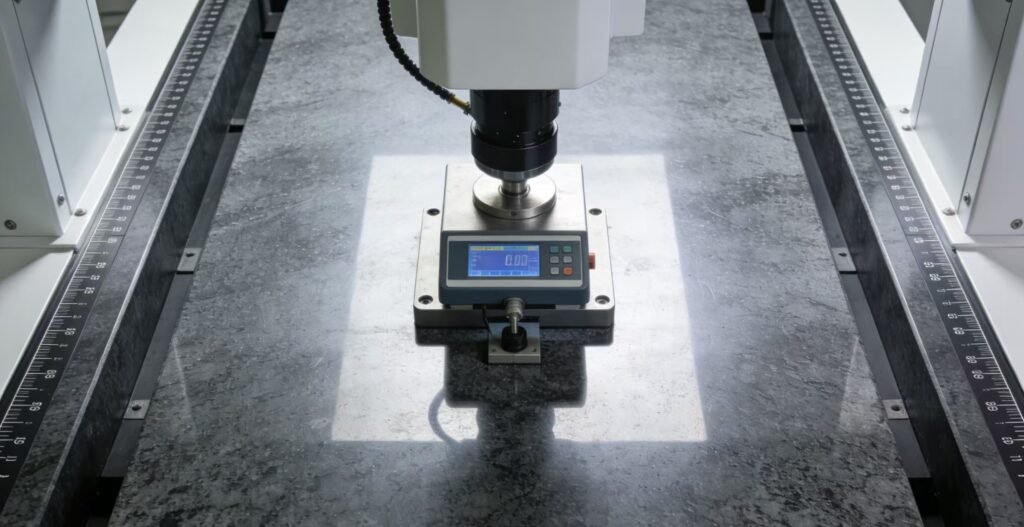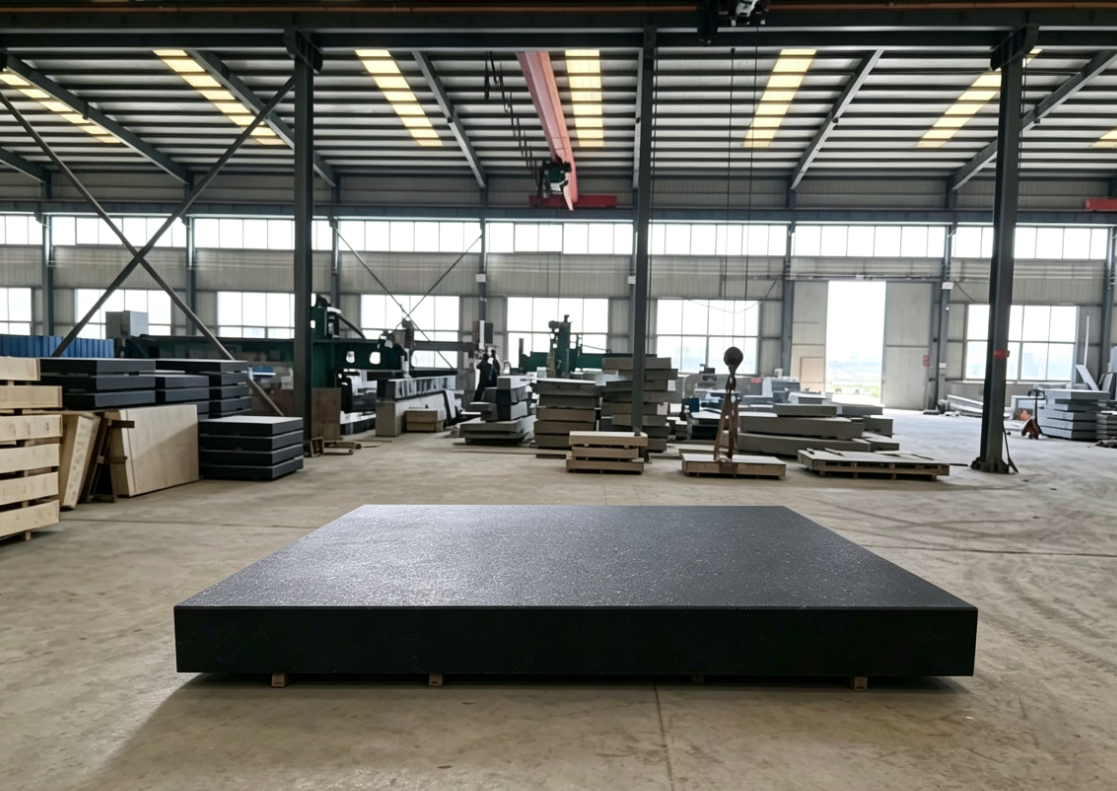
I. On-site Precision Verification by Buyer (Operable Directly)
- Core Geometric Precision Inspost Critical)
(1) Flatness (Levelness)
Tools: 1m/2m Precision Straightedge (Linearity ≤0.01mm/m), Thickness Gauge (Sarting from 0.005mm), Electronic Level / Optical Level
الطريقة:
Place the table stably to eliminate support stress
Measure sectionally along two diagonals,sides, short sides, and cross center lines
Press the straightedge against the table surface and measure the maximum gap with a thickness gauge; for precision tables, measure height differences at va points with an electronic level to calculate flatness error
Precision Standards (Reference):
Grade 000: ≤0.001mm/m
Gade 00: ≤0.002mm/m
Grade 0: ≤0.005mm/m
Grade 1: ≤0.01mm/m
(2) Thicknes Uniformity
Tools: Digital Micrometer (Accuracy 0.001mm)
Method: Measure at 8–10 points: four corners center midpoins; calculate thickness range (Max – Min)
Standard: Thickness range of precision tables is usually ≤0.02–0.05mm (depending on grerpendicularity / Angle (Right-angle Table)
Tools: 90° Square (Grade 0 Precision), Thickness Gauge
Method: Press the square against adjacent edges of t and measure the gap with a thickness gauge; measure all four corners
Standard: Angular deviation ≤0.01mm/100mm or ≤3″ (acseconds)
(4) Surface Roughness (Finish)
Tools: Surface Roughness Tester (Ra/Rz)
Method: Measure at multiple positions on the working surface
Standard: Precision ground surfacusually Ra ≤0.05–0.4μm (Mirror finish can reach Ra ≤0.02μm) - Material and Appearance Verification
Density / Watersorption: On-site weighing displacement method to measure density; density of precision tables is usually ≥2.6g/cm³, water absorption ≤0.2%
Appearance: No cracks, pinholes, porosity, or color spots; edges have no chipping or corner loss; texture is uniform
Stability: Observe with a level for significant flatness drift (verifies internal stress release)
II. Most Important Inspection Reports (Must Be Verified)
- Geometric Precision Inspection Report (Core of te)
Essential Content:
Flatness: Multi-point measurement data across the entire table, error curve, grade determination (000/00/0/1 Grade)
Thickness: Va measurement point, range
Perpendicularity / Parallelism / Straightness: Comparison of actual values vs. tolerances
Roughness: Ra/Rz values
Key Focus: Inspection method (Diagonal method / Three-point method / Electronic Level), distribution of measurement points, raw data, pass/fail determination
Standard Basis: GB/T 28541, JB/T 10129, ISO 8512, etc. - Material Performance Inspection Report
Core Indicators:
Bulk Dnsity: ≥2.6g/cm³ (Higher = denser and more stable)
Water Absorption: ≤0.2% (Lower = better water resistance and deformation resistance)
Compressive trength: ≥150MPa (Dry)
Flexural Strength: ≥20MPa (Higher requirements for precision tables)
Shore / Rockwell Hardness: Verifies wear rece
Key Focus: Stamp of third-party testing institution, testing standards (GB/T 9966 series), whether actual values meet standards - Certificate of Conformity and ty Documents
Includes: Model, Grade, Dimensions, Flatness Grade, Factory Number, Production Date
Requirement: One certificate per board (numbers correspond), traceable to production batch antion records - Third-party Authoritative Inspection Report (Mandatory for Large-scale/High-precision Applications)
Issued by metrology/testing institutio with CNAS/CMA accreditation
Key Verification: Independent retest data for flatness, thickness, roughness, and material density/water absorption
Purpose: Eliminate deviations in manufacturer selpection data and ensure fair acceptance - Stability/Aging Report (For High-precision Scenarios)
Content: Records of natural aging/thermal aging treatment, and retest dfor flatness after placement
Significance: Verifies that internal stresses in the workbench have been fully released, ensuring long-term stable precision.
III. Summary of Key Points for Buye Acceptance
Check Reports First: Verify that precision grades and key indicators meet contract/technical requirements
On-site Measurement: Reproduce core report data using straight edges feeleauges/micrometers; focus on flatness and thickness variation
Cross-reference: Ensure report numbers, factory serial numbers, and workbench markings are consistent
Document Evidence: Photograph the measurementess and data; archive original reports
IV. Common Precision Pitfalls and How to Avoid Them
Providing only a “Qualified” conclusion without attaching raw measurement data and error cu
Passing off lower-grade workbenches as higher-grade (e.g., Grade 0 as Grade 00)
Thickness variation exceeds standards but the report only lists the average vang treatment performed; short-term compliance but long-term deformation occurs