- Comparative Analysis with Other Base Materials
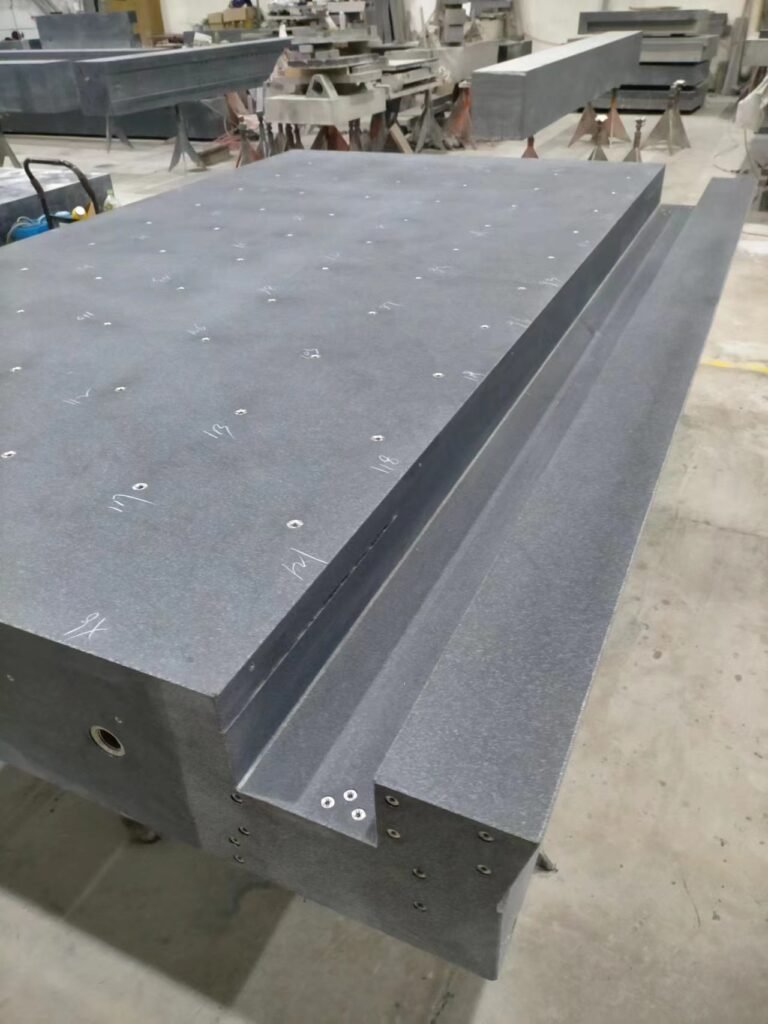
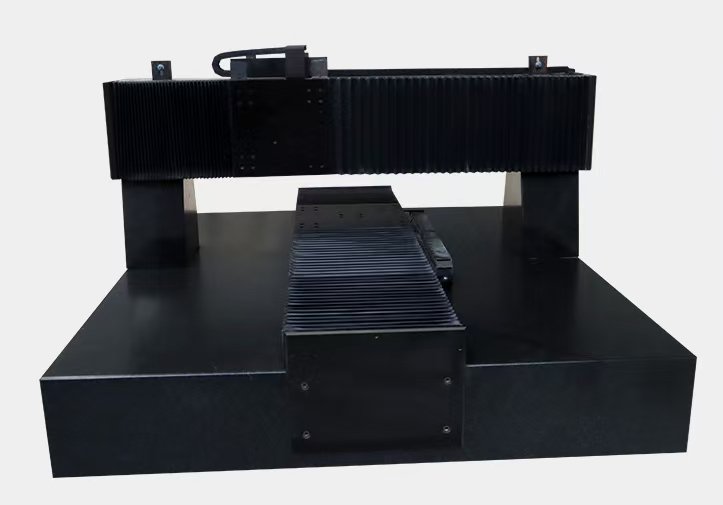
To more clearly demonstrate the characteristics of granite, it is compared with the currently maiam cast iron and artificial marble (mineral casting) bases across multiple dimensions. These three materials represent three distinct technical routes: traditional manufacturing, artificial synthesis, and natural aging, respey, and their characteristic differences directly correspond to the requirements of different application scenarios.
5.1 Comparison with Cast Iron (Traditional Material)
Cast iron is the traditional material for machine tool bases, witdvantages in mature processes and controllable costs. However, in high-precision and high-speed machining scenarios, its inherent defects have gradually become a bottleneck. The core differences between granite and c iron are as follows:
Characteristic Index
Granite
Cast Iron
Advantage
Density
2.65-3.02 gm³
6.8-7.3 g/cm³
Granite (lightweight, low foundation requirements)
Specific Stiffness
~28.3
~17.4
(60% higher stiffness at the same weight)
Damping Coefficient
0.008-0.012
0.002-005
Granite (damping capacity is 4-6 times that of cast iron)
Thermal Conductivity
2.3-2.6 /(m·K)
40-55 W/(m·K)
Granite (smaller local temperature differences)
معامل التمدد الحراري
0.6-.61×10⁻⁶/℃
11×10⁻⁶/℃
Granite (thermal deformation is 1/2 to 1/18 of cast iron)
Hadness
HS70-80
HS20-30
Granite (wear resistance is 3-5 times that of cast iron)
Residual Internal Stress
None (fully released by nural aging)
Present (only about 80% released by artificial aging)
Granite (superior long-term precision stability)
Cost (Same Size)
High (approximate3 times that of cast iron)
Low
Cast Iron
Source of the above data:
From a practical application perspective, the advantage of cast iron lies in heavy-load cutting cond— its higher elastic modulus provides higher absolute stiffness, making it suitable for heavy cutting scenarios where cutting force > 5000N, such as rough machining of large molds and machiny mechanical parts; whereas the advantage of granite lies in high-precision and high-speed machining scenarios, such as precision machining of aerospace parts, machining of optical molds, and reference platforms for sconductor wafer equipment.
5.2 Comparison with Artificial Marble (Mineral Casting / Polymer Concrete)
Artificial marble (mineral casting) i new type of material that has emerged in recent years, consisting of inorganic aggregates such as granite chips and quartz sand mixed with epoxy resin binders and cast. Its characteristics lie between c and granite, possessing certain damping properties while allowing performance optimization through formula adjustments. The core differences between granite and artificial marble are as follows:
الخصائص
Granite
Artificiale
Advantage
Density
2.65-3.02 g/cm³
2.3-2.8 g/cm³
Artificial Marble (Lighterght)
Modulus of Elasticity
80-140 GPa
30-55 GPa
Granite (High static stiffness)
Damping Coeficient
0.008-0.012
0.01-0.015
Artificial Marble (Slightly superior damping capability)
Thermal Conductivity
2.3-2.6 W/(m·K)
1.8-2.0 W/(m·K)
Artificial Marble (Smaller local temperature differences)
Coefficient of Liner Expansion
0.6-4.61×10⁻⁶/℃
2×10⁻⁶/℃
Granite (Some grades have superior thermal staty)
الصلابة
HS70-80
HS40-50
Granite (Superior wear resistance)
Forming Freedom
Low (Requires machining, difficult to x structures)
High (Monolithic casting, allows integration of pipelines, guide rail mounting surfaces)
Artificial Marble
Cost (Same size)
High
Medium
Artificial Marblource of the above data:
From the differences in characteristics, it is evident that the advantage of artificial marble lies in its forming freedom—its monolithic casting process allows for the integration ouctures such as pipelines and guide rail mounting surfaces in a single step, eliminating the need for subsequent machining, significantly shortening the production cycle, and making it suitable for bed designs x structures. On the other hand, the advantage of granite lies in its higher modulus of elasticity and hardness—this results in superior static stiffness and wear resistance, enabling it to withstand er loads and offering better long-term precision stability. For example, under the same load, the deformation of a granite bed is only about 50% of that of artificial marblking it more suitable for scenarios with extremely high requirements for long-term precision.
From the perspective of market penetration trends, from 2023 to 2026, the penetration rate of granite bases in the ultra-precisihining field has exceeded 50%, making it the preferred material in this sector; meanwhile, artificial marble has rapidly penetrated the high-speed carving and milling and small-to-medium precision machine ool sectors, with its market share rising from 12% in 2018 to 37% in 2025, becoming one of the standard materifor high-end models.