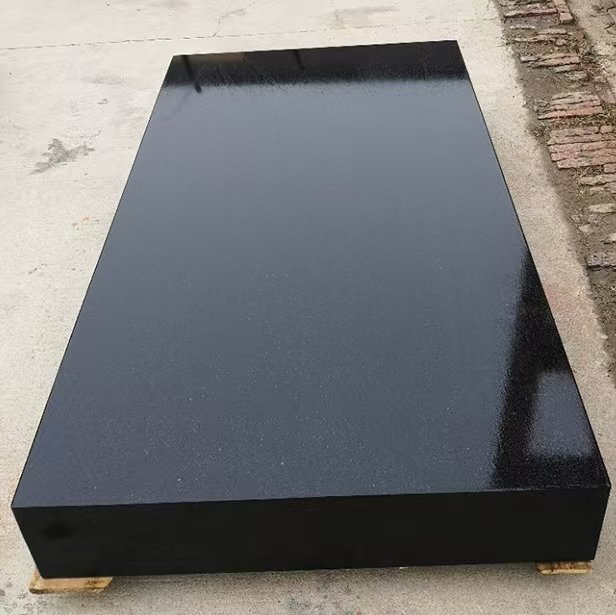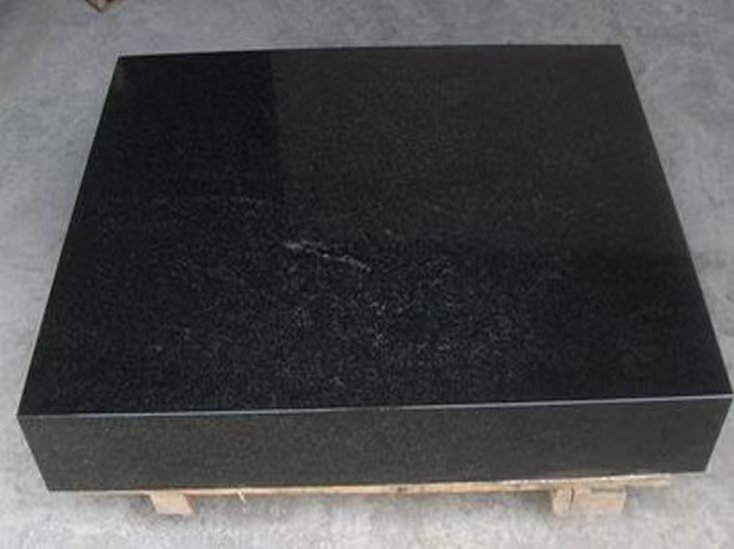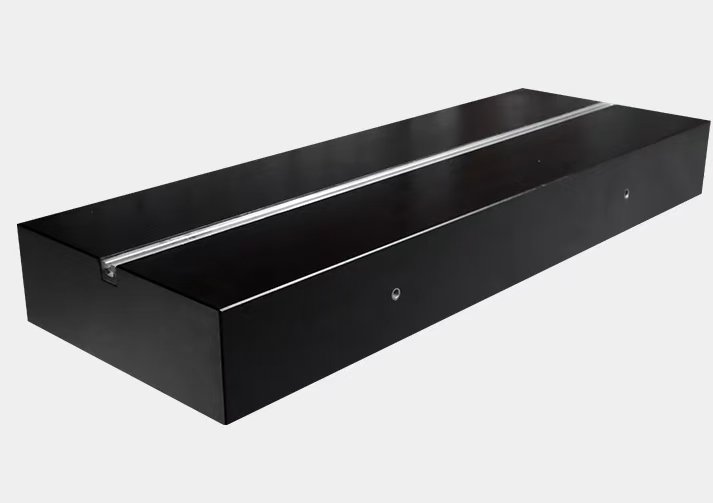
- The sub-micron stability of granite: intrinsic material advantages
Granite, formed by geological processes over hundreds of millions of years, with internal stresses completely released, has static/dynamic stability unmatched by metals, making it the natural cornerstone of sub-micron systems. - Core physical characteristics (the underlying guarantee of sub-micron precision)
Extremely low coefficient of thermal expansion: about (2–3)×10⁻⁶/℃, only 1/2 of steel, 1/4 of aluminum, and 1/3 of cast iron; in an environment of 20±0.5℃, the thermal drift can be controlled within 0.3μm/m within 24 hours.
Ultra-high damping and anti-vibration: vibration attenuation capability is about 40% better than cast iron, which can quickly suppress low-frequency vibrations from 0.1–100Hz, and the operating amplitude can be as low as 0.02mm/s.
Zero internal stress and long-term stability: no creep, no aging deformation, 5-year precision drift ≤0.2μm, calibration cycle can be extended from half a year to 2 years.
High rigidity and low deformation: elastic modulus 50–70GPa, density 2.6–2.8g/cm³, deformation can be negligible under sub-micron level loads.
Surface precision limit: precision grinding / manual fine grinding can achieve flatness 0.002mm/m², roughness Ra≤0.2μm, suitable for frictionless motion of air bearings / magnetic levitation. - Material selection (determining the upper limit of stability)
Preferred: dense black granite such as Jinan Qing, Taishan Qing, etc., with density ≥2.7g/cm³, water absorption rate ≤0.1%, and no obvious mineral segregation.
Key indicators: coefficient of thermal expansion ≤3×10⁻⁶/℃, elastic modulus ≥60GPa**, and no visible micro cracks inside. - Functional granite components: key integration technologies for sub-micron stability
Functional integration is the core of upgrading the “stable base” to the “core of precision systems”, aiming to achieve the integration of measurement, drive, sensing, and compensation on granite substrates, eliminating assembly errors and environmental interference. - Ultra-precision machining and geometric integration (basic precision guarantee)
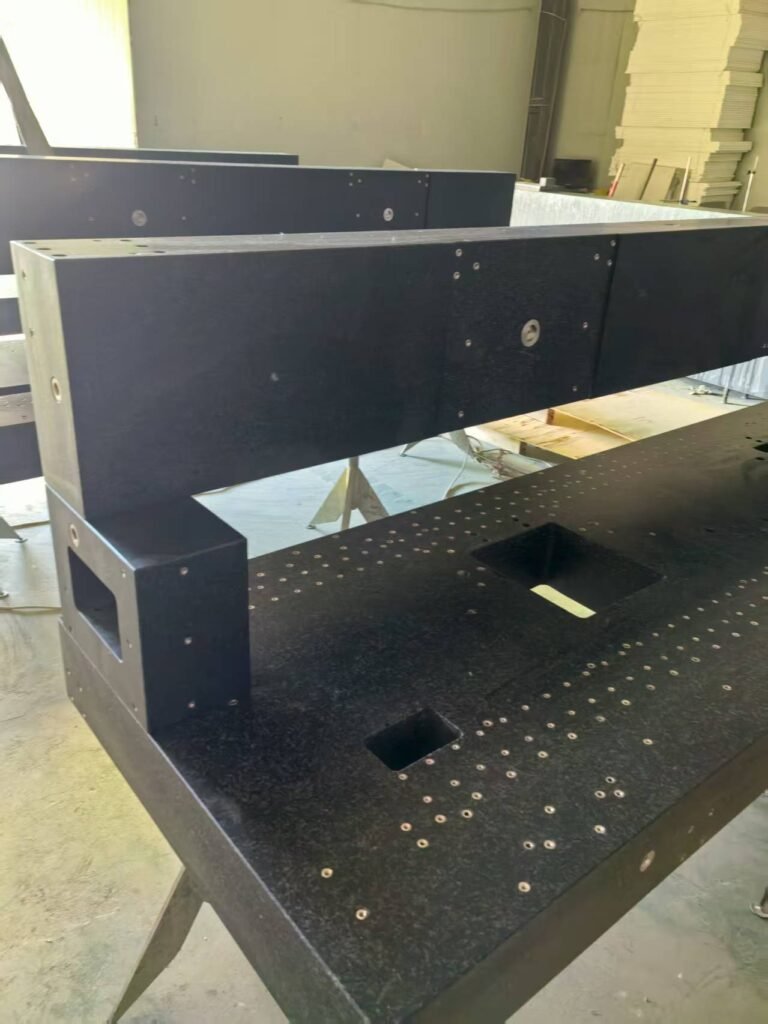
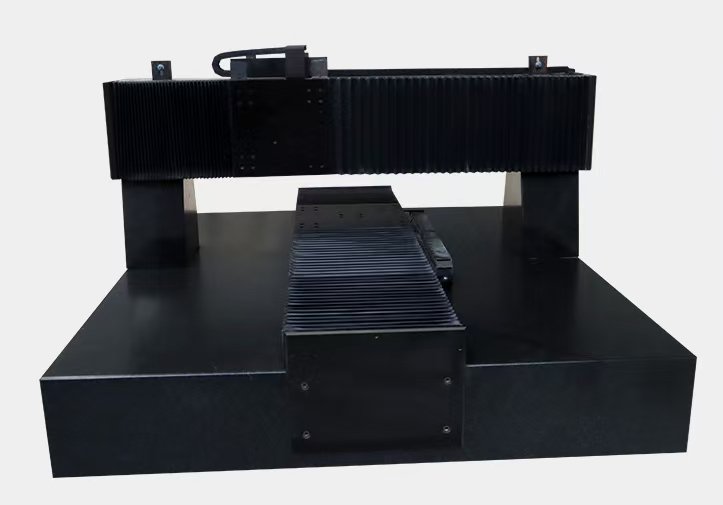
Integral molding: using a gantry/bridge-type integral structure to avoid splicing errors; large components (such as 30m beams) are processed as a whole, with flatness/perpendicularity/parallelism controlled ≤0.5μm/m.
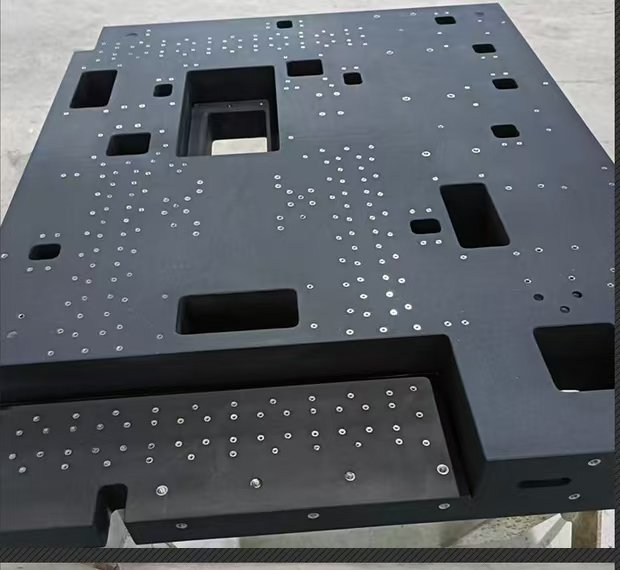
Precision hole and feature processing: CNC manual grinding composite process, with location hole, T-shaped groove, and threaded hole position accuracy ≤1μm, ensuring the coaxial/coplanar installation of air float guide rails, linear motors, and encoders.
Surface treatment:
Datum surface: manually fine ground to Ra≤0.1μm, flatness 0.1μm/100mm.
Abrasion-resistant surface: ceramic coating (HV1200), abrasion resistance increased by 3 times, suitable for high-frequency motion scenarios. - Air float/magnetic levitation motion integration (frictionless, high dynamic stability)
Integration of air float bearings: direct machining of air float guide rails/air float pads on the granite substrate to form a 10–15μm air film, achieving zero friction, zero wear motion, with a positioning resolution of up to 0.01μm.
Low Abbe error design: reduce the height of the shaft system, and align the drive/feedback/motion centers in a straight line, controlling the Abbe error at the sub-micron level.
Integrated motion system (IGM): linear motors, grating scales, and air float bearings are directly installed on the granite base, reducing intermediate links and increasing system stiffness by more than 40%. - Sensing and closed-loop compensation integration (active stability, breaking material limits)
In-situ sensing network (smart granite):
Pre-embedded ** fiber Bragg grating (FBG) ** - Engineering Realization of Sub-micrometer Stability: From Material to System
- Design Principles
Homogeneous: Full systems are prioritized with materials like granite/ceramics with low thermal expansion to avoid thermal mismatch between dissimilar materials.
Force Flow Shortest: Loads are transferred to the granite base to reduce deformation at intermediate links.
Symmetric Layout: Symmetric temperature and force fields are maintained to reduce inhomogeneous deformation. - Assembly and Calration Process
Constant Temperature Assembly: Assembly is performed in a 20±0.1℃ cleanroom to eliminate thermal stresses from assembly.
Laser Interferometer Calration: Calibration of flatness, straightness, and verticality is performed using a Renishaw laser interferometer, with accuracy traceable to the national metrology institute.Dynamic Performance Verification: Verification of the ability to maintain sub-micrometer stability under 0–50℃ temperature cycling and 1g acceleration vibration conditions.
4 Typical Application Scenarios (Value Realization of Sub-micrometer Stability)
Semiconductor Manufacturing: Photolithography alignment platforms, wafer inspection tables, andching machine bases with positioning accuracy ≤0.1μm and repeat positioning ≤0.05μm.
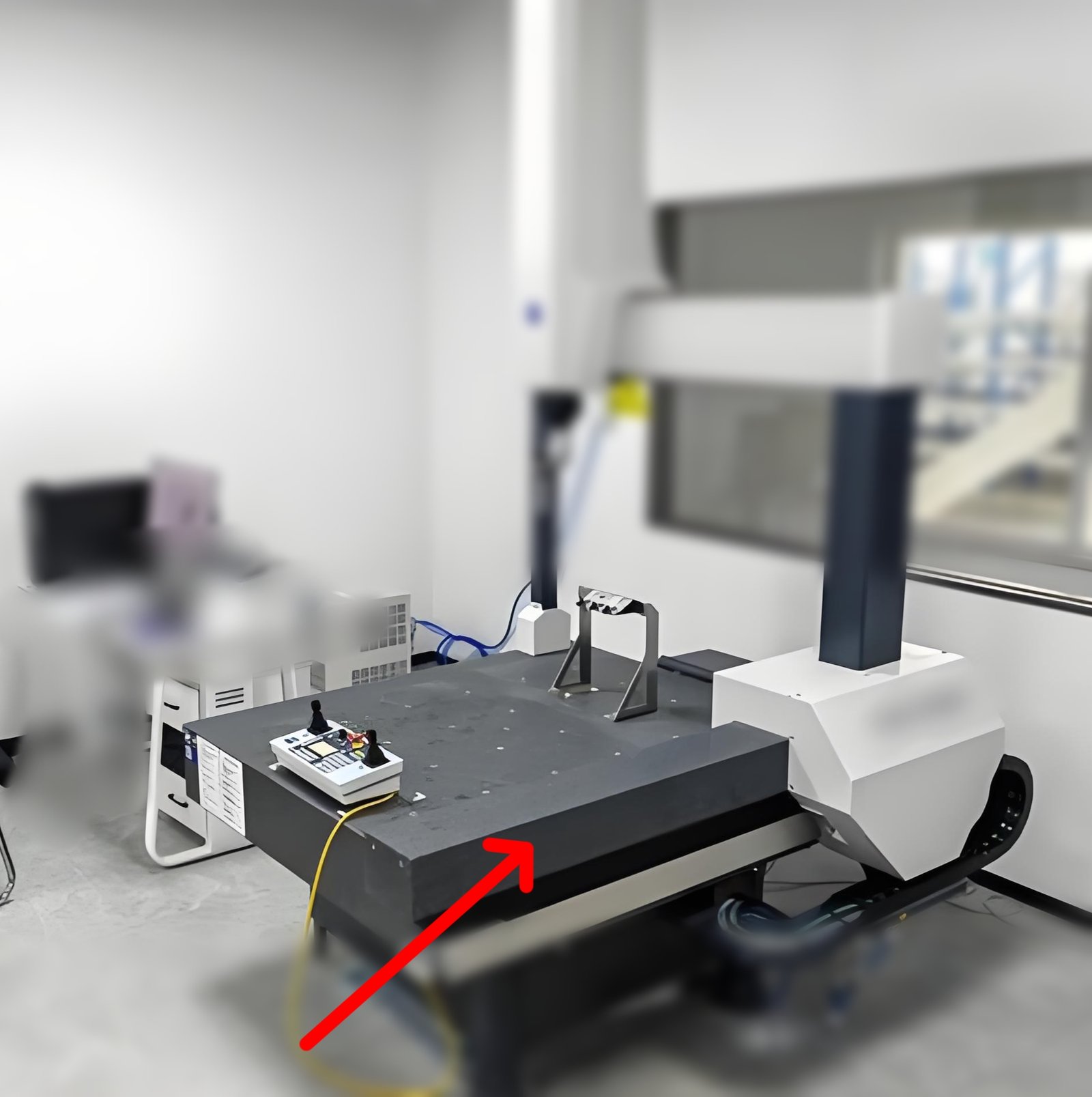
Precision Metrology: Base for measuring machines (CMMs), profilometers, and laser interferometers with measurement uncertainty ≤0.1μm.
Optical Engineering: Astronomical telescopes,ars, and space optical systems ensuring sub-micrometer coaxiality of lenses/mirrors.
Precision Machining: Ultra-precision lathes, grinding machines, and-imprint equipment with machining accuracy ±0.5μm. - الاتجاهات المستقبلية: جرانيت الوظائف الذكية
منصة ذكية متكاملة تمامًا: التكامل، والحوسبة، والقيادة، والتعويض من أجل الاستقرار الذاتي، مما يلغي الحاجة إلى المعايرة الخارجية.
طفرة في الاستقرار النانوي: من خلال الجمع بين الاستشعار الكمي والدقة الفائقة، يتم دفع الاستقرار إلى ≤0.01 ميكرومتر (10 نانومتر) المستوى.
ابتكار المواد المركبة: مركّبات السيراميك/الألياف الكربونية المصنوعة من الجرانيت ذات الأساس الجرانيتي صلابة عالية وتمدد حراري منخفض وخفة وزن.