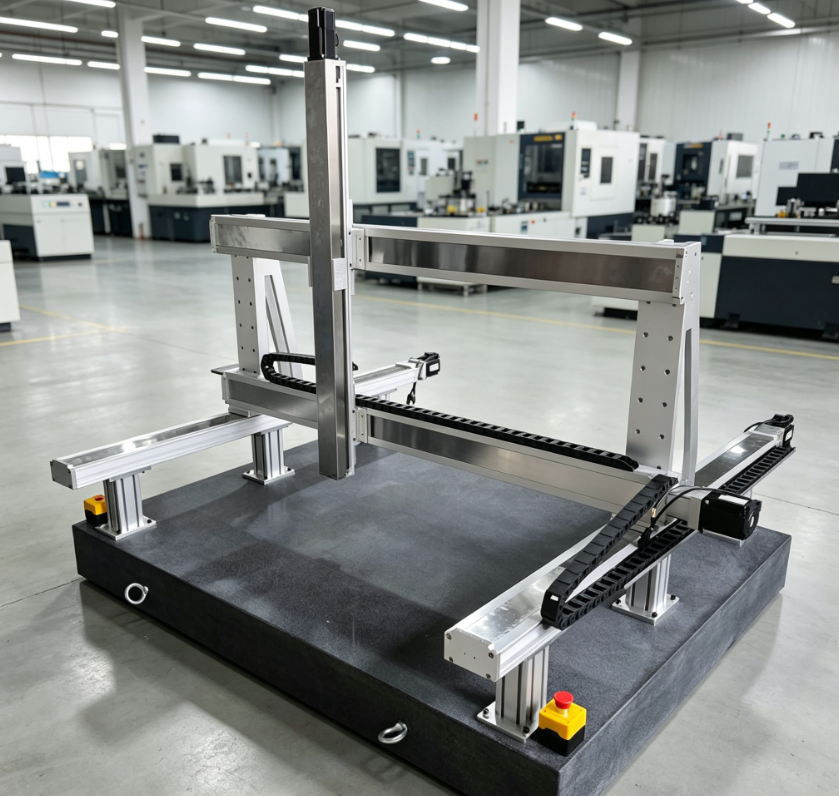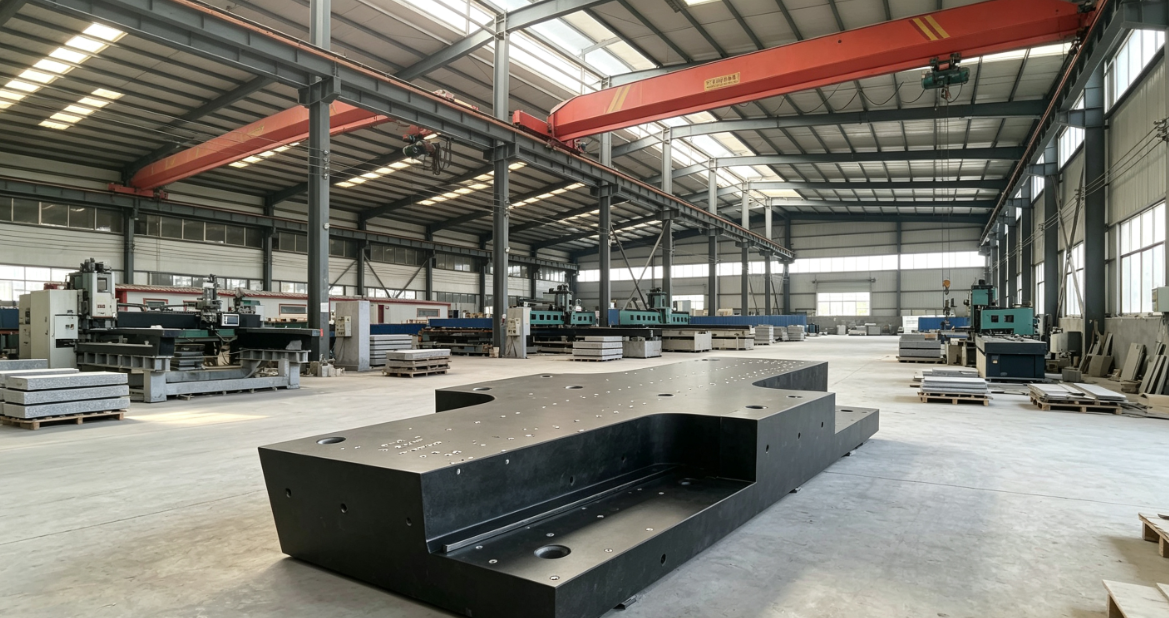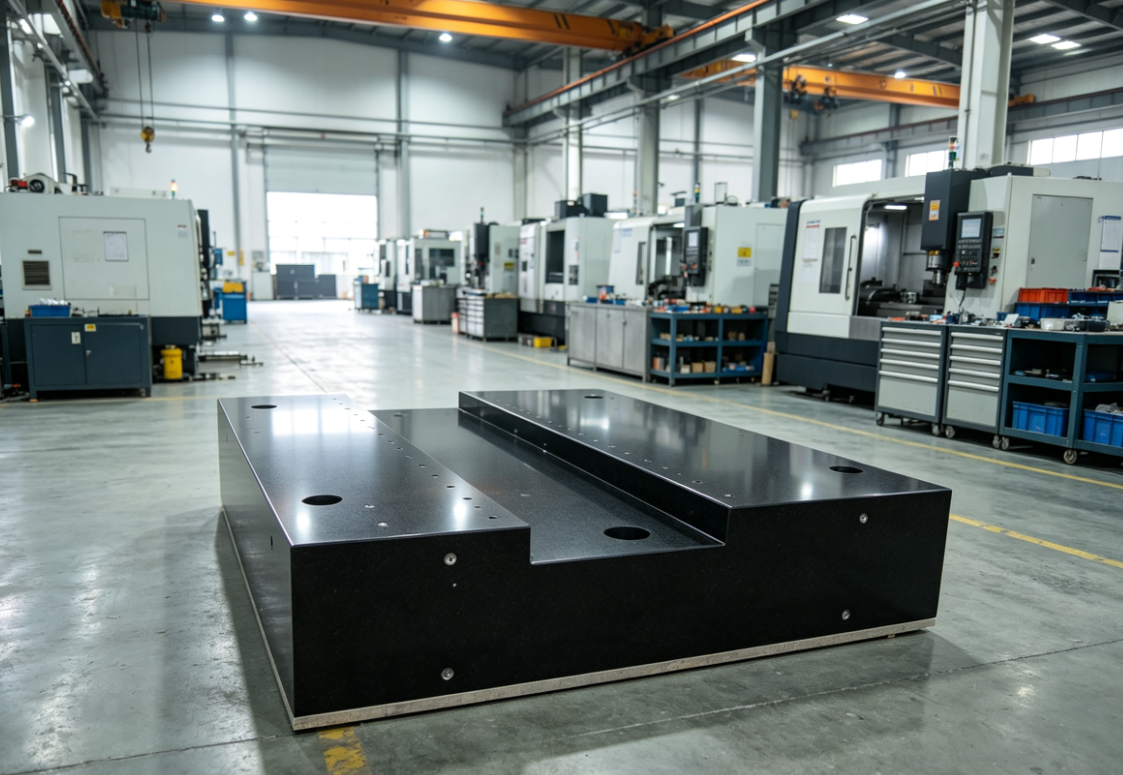
Implementation Principle of Constant Temperature Machining for High-Precision Machine Tool Granite Structural Components
The thermal expansion coefficient of granite (such as Jinan Blue) is approximately 4.5e-6/℃. Although far superior to cast iron, a 1℃ temperature difference in a 1m component still causes about 4.5μm of deformation. Achieving micron-to-submicron precision machining must be realized through a five-in-one integration of constant ambient temperature, constant workpiece temperature, heat source control during machining, stress aging, and constant temperature inspection.
Industry standard reference temperature: 20℃; ordinary precision component workshops: 20±1℃; Class 000 and semiconductor equipment bases: 20±0.5℃; lithography-class ultra-precision: up to 20±0.1℃. Simultaneously, humidity is controlled at 45-55% RH to prevent stone moisture absorption expansion and corrosion of embedded parts.
I. Overall Workshop Constant Temperature Environment (Macro-environment Foundation)
- Constant Temperature Workshop System
Utilize variable-frequency precision central air conditioning stabilized return air system, with top-diffuser air supply. Direct airflow blowing on workpieces and grinders is strictly prohibited. Indoor wind speed ≤0.2m/s to reduce local hot and cold gradients; set up buffer changing rooms to isolate the intrusion of external hot and cold air. - Floor Insulation: The floor is equipped with an insulation layer to isolate the seasonal fluctuations of ground temperature. Large components have significant self-weight, and the ground temperature gradient can cause bending deformation due to the temperature difference between the top and bottom of the component.
- Heat Source Isolation: Grinder motors, cooling units, air compressors, and lighting are all isolated from the constant temperature machining room. Personnel heat dissipation is also an interference source; the number of personnel at high-precision workstations must be controlled.
Rough machining (sawing, rough milling) does not require a constant temperature; semi-precision grinding, precision grinding, polishing, and final inspection must be completed within the constant temperature workshop.
II. Workpiece Constant Temperature Soaking (The most easily overlooked, core step)
Granite has high thermal inertia, and the synchronization of internal and external temperatures in large blocks is very slow. Workpieces cannot be machined immediately after being moved in.
- After rough machining is completed (sawing, grooving, drilling, pre-embedding steel sleeves), they are transferred to the constant temperature workshop for static soaking:
- Small and medium-sized parts: ≥12-24h;
- Large bases / gantry components (>1m): 7-30 days of constant temperature static soaking, to ensure the internal and surface temperatures of the stone are completely consistent with the workshop environment, with no temperature gradient between the inside and outside.
- Artificial hot-cold cycle aging (as an alternative to long-term natural soaking): 80℃ insulation for 24h → -10℃ insulation for 4h cycle, then return to 20℃ constant temperature soaking for 72h; to release machining stresses caused by sawing and drilling; the heating rate is strictly 5-8℃/h, and rapid heating or cooling is strictly prohibited to prevent internal micro-cracks in the stone.
- Inter-process transfer: After components are moved out of the constant temperature workshop for processes such as sandblasting and bonding, they must be re-soaked upon returning to the constant temperature area. They are only allowed on the grinder when the temperature difference is less than 0.5℃.
Even if the ambient temperature is 20℃, a granite block just moved from outdoors may feel like 20℃ on the surface, but an internal temperature difference of 2-3℃ may still exist. During grinding, it will continue to slowly warp, and the precision will worsen as more grinding is done.
III. Heat Source Control During the Machining Process (Heat generated during machining must not cause the stone to rise in temperature)
Granite has poor thermal conductivity, and grinding heat can cause local hotspots and local thermal deformation. Even if the ambient temperature is constant, a local temperature rise in the workpiece will still ruin the precision.
- Large-volume water cooling for diamond grinders: Use a large flow of constant-temperature grinding coolant, with the coolant temperature controlled at 20°C ± 0.5°C; immediately carry away the heat generated by grinding, and do not allow a local temperature rise in the stone.
- Multi-pass progressive grinding, no deep cuts: Rough grinding → Semi-precision grinding → Precision grinding → Polishing; the allowance for each grinding pass is very small to avoid instantaneous large-scale heat generation; do not aim to achieve the final dimension in a single pass.
- Intermittent cooling during grinding: Stop the machine after each grinding interval, allow the workpiece to cool down completely to the ambient temperature at the workstation, and then proceed to the next pass.
- High-end equipment: Giant granite gantry bases have pre-embedded water-cooling channels inside, connected to precision chillers, to actively suppress the internal temperature gradient; this is mostly used for semiconductor equipment bases.
IV. Binding Logic of Machining Processes and Constant Temperature
- Blanking, wire saw cutting, rough milling and grooving: Ordinary workshop, no constant temperature required, leave grinding allowance.
- Rough machining completed → Stress relief (natural constant temperature soaking / artificial thermal cycling).
- Transfer to constant temperature workshop for soaking; after temperature equilibration, start semi-precision grinding, precision grinding, and manual grinding, which must be performed entirely within the constant temperature environment.
- Embedding steel sleeves, glue injection: Glue curing must also be completed in the constant temperature workshop to eliminate curing shrinkage stress; after curing, soak again before precision grinding the reference surface.
- Precision inspection must also be at constant temperature: Laser interferometers and autocollimators detect flatness and perpendicularity; the component and the inspection instruments must be at the same constant temperature for the inspection data to be truly valid.
V. Local Micro-Constant Temperature Solution (Upgraded Solution)
For ultra-precision single pieces, in addition to the large workshop’s constant temperature, an insulated, dustproof, and constant temperature cover is installed around the machine tool. Secondary temperature control is performed inside the cover to compress local fluctuations within ±0.3°C, isolating minor disturbances caused by personnel movement and lighting.
VI. Key Differences in Constant Temperature Machining with Cast Iron Beds
- Granite has huge thermal inertia, so the soaking time is much longer than that of cast iron parts; cast iron takes a few hours, while large granite requires days to weeks.
- Granite has poor thermal conductivity, making local grinding hotspots more harmful, and requires higher cooling water temperature control for grinding.
- Granite is not prone to corrosion, but it can expand due to moisture absorption; therefore, humidity must be controlled simultaneously with constant temperature.
- Granite stress relief relies on long-term constant temperature soaking / thermal cycling; cast iron relies more on vibration stress relief.