Comprehensive Analysis of the Synergy between XYZ Three-Axis Modules and Marble Bases
I. Underlying Synergy Logic: Base Sets the Reference, Module Performs Motion
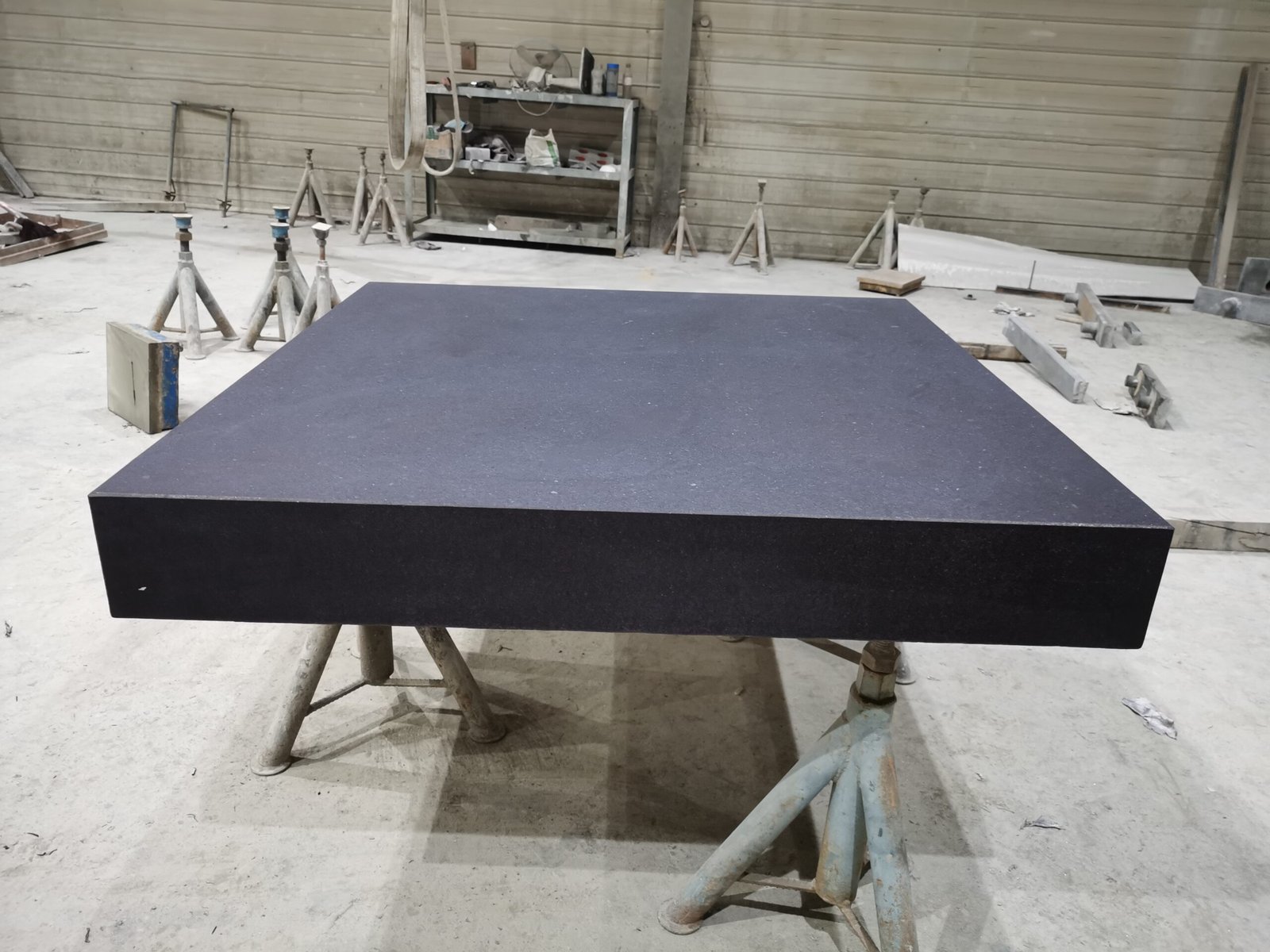
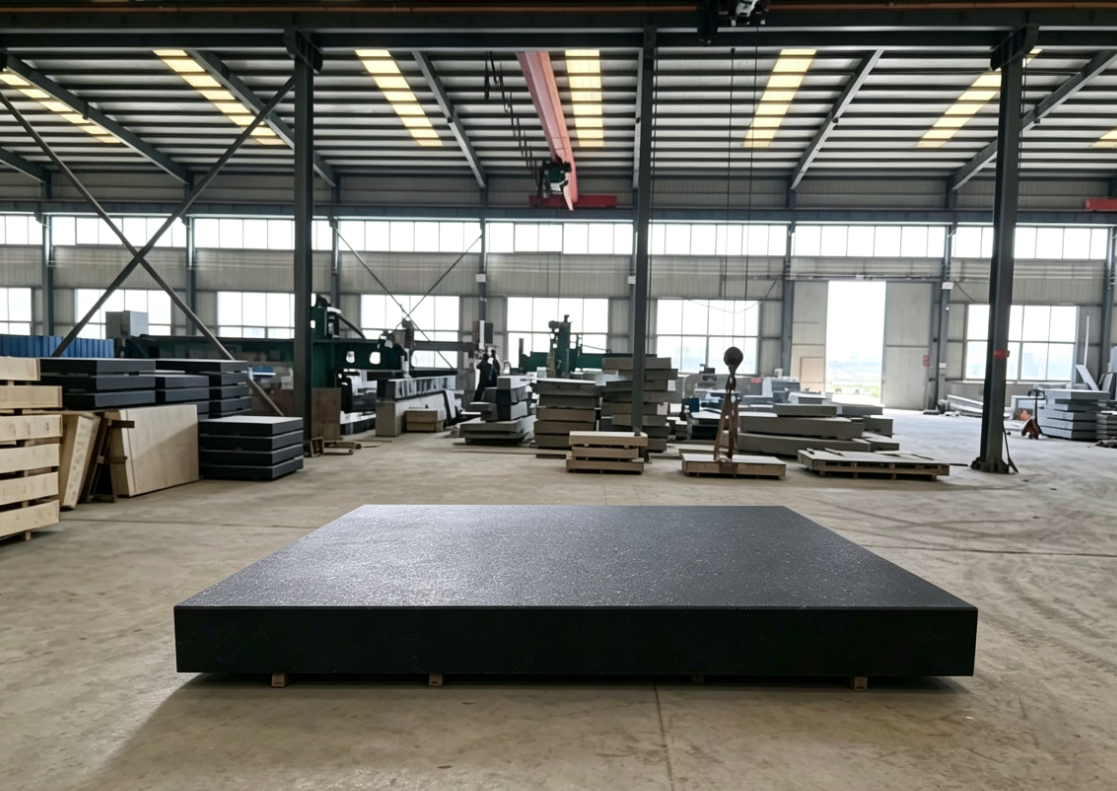
The XYZ three-axis module is responsible for linear interpolation, positioning, and high-speed motion in 3D space; the marble (Jinan Blue Granite) base provides zero drift, high damping, and high geometric reference. The two are not simply superimposed but are coupled and synergistic across four layers: mechanical, thermal, dynamic, and control. This solves the three major precision shortcomings of metal bases: thermal expansion, vibration transmission, and load deformation.
Core Synergy and Adaptation Characteristics of Marble (Comparison with Aluminum / Steel)
Table
Performance Indicator Jinan Blue Marble Aluminum Alloy Carbon Steel Synergy Value
Coefficient of Thermal Expansion 4.5×10⁻⁶/℃ 23×10⁻⁶/℃ 11×10⁻⁶/℃ Suppresses three-axis thermal drift, reduces compensation amount
Damping Ratio 0.02 0.002 0.0015 Absorbs three-axis start-stop impact and workshop resonance
100kg Load Deflection ≤0.005mm 0.03mm 0.018mm Ensures XYZ three-axis perpendicularity and parallelism
00-Level Flatness ≤0.005mm/m Difficult to maintain long-term stability Large time-dependent deformation No inherent error in guide rail installation reference
II. Four Mainstream XYZ Architecture Synergy Forms
- Bottom-mounted X-axis Gantry Y-axis Vertical Z-axis (Most Universal)
Synergy Structure: The X-axis module is directly locked onto the precision-machined installation surface of the marble base; the Y-axis gantry beam is mounted on the X-axis slide; the Z-axis is vertically mounted on the Y-axis beam.
Synergy Key Points: The marble base bears all reaction forces of the X-axis and absorbs the high-speed reciprocating vibrations of the Y-axis; the base flatness determines the parallelism of the dual guide rails, avoiding gantry sway and Z-axis perpendicularity deviation.
Applications: Laser processing, 3C inspection, wafer probers. - Fixed X/Y Marble Platform Z Single-axis Lift (Worktable Stationary, Spindle Moves)
Synergy Structure: X and Y guide rails are embedded / locked into the integrated marble platform; the workpiece is placed on the marble platform; the Z-axis module provides vertical feed.
Synergy Advantages: The workpiece reference and motion reference share the same origin, eliminating secondary reference conversion errors in measurement / processing; the marble directly isolates external vibrations, significantly improving the stability of probe / laser optical paths.
Applications: 2D/3D machines, CMM, optical inspection, micro-assembly. - Fully Integrated Marble Gantry Base (High-end Linear Motor Three-axis)
Synergy Structure: The base and gantry beam are integrally ground and formed; the X-axis stator magnetic track is directly bonded / bolted to the marble; no aluminum beam transition parts.
Synergy Characteristics: Thermal expansion is completely synchronized, with no deformation difference between different materials; the overall rigidity forms a closed loop, allowing high-speed 5G acceleration without torsional deformation; damping is uniformly distributed across the entire domain.
Applications: Semiconductor lithography machines, laser direct writing, nano-positioning platforms. - Separated Marble Base (Large-stroke Heavy-duty XYZ)
Two marble blocks respectively support the left and right of the X-axis, with the Y/Z modules arranged in the middle; rigidly locked via positioning pins to eliminate misalignment at the joint surface.
III. Four-Dimensional Collaborative Design (Mechanical / Vibration Damping / Thermal / Control)
(I) Mechanical Rigidity Collaboration: Eliminating Module-Base Relative Slip
Installation Datum Matching
Marble-machined Grade 00 installation surface, flatness ≤2μm/m; guide rail module bottom surface scraped / precision milled, contact rate ≥90%, eliminating local stress deformation that causes guide rail distortion and three-axis motion stuttering.
Locking Structure Collaboration
High-strength hex bolts stainless steel threaded inserts (marble tapping is prone to stripping, inserts ensure rigidity during repeated assembly/disassembly);
Standard torque specifications: M10 ≥60N·m, M12 ≥80N·m, relative displacement between module and base ≤5μm after tightening;
Cylindrical positioning pin limit: Restricts horizontal shear force, offsets the reverse impact force from X/Y high-speed start/stop, protecting three-axis perpendicularity.
Force Flow Collaboration
Z-axis lifting load and Y-axis acceleration inertial forces are all transmitted to the entire marble base, relying on high compressive strength to disperse stress, preventing the center of the aluminum base from sagging, ensuring long-term stability of three-axis orthogonality.
(II) Vibration Damping Dynamics Collaboration: Internal and External Vibration Isolation
Vibration is the largest source of fluctuation in three-axis repeatability, with marble and module layered vibration damping collaboration:
Base Self-Damping (Passive Vibration Damping)
High damping absorbs the 10–50Hz impact vibration generated by module start/stop, reducing vibration amplitude from 0.01mm to 0.003mm, and reducing grating feedback signal fluctuation by 70%.
Module-Base Interface Vibration Isolation
For high-precision scenarios, Shore 60 hardness nitrile rubber pads are added to block high-frequency vibrations from the guide rail from diffusing into the marble; linear motor modules can be paired with air-float vibration isolation pads to suppress resonance peaks.
Whole-Machine Bottom Vibration Isolation Collaboration
An air-float vibration isolation platform is placed under the marble base, doubly isolating low-frequency vibrations from workshop machine tools and air compressors, ensuring nanometer-level three-axis positioning without jumps.
Modal Matching Collaboration
Through finite element optimization of marble wall thickness and stiffeners, the base’s natural frequency avoids the resonance interval of three-axis servo operation, eliminating high-speed interpolation jitter.
(III) Thermal Deformation Collaboration: Suppressing Three-Axis Thermal Drift Error
Module motors and coils continuously generate heat, and the thermal expansion difference between aluminum modules and marble will cause datum offset, with the collaborative solution divided into three layers:
Material Natural Collaboration (Basic)
The expansion coefficient of marble is only 1/5 of aluminum, so the base deformation is extremely small under the same temperature fluctuation, significantly reducing the pressure of three-axis compensation.
Heat Source Thermal Isolation Structure Collaboration
Servo motors and linear motor movers are equipped with insulation plates and cooling air ducts to prevent heat from directly conducting to the marble; an insulation gap is left between the heat-generating module and the base to block the heat conduction path.
Full-Domain Temperature Sensing Software Compensation Collaboration
Distributed temperature sensors are embedded in the marble base, working with three-axis grating scales to collect thermal deformation in real-time; the motion controller has a built-in marble expansion coefficient model to provide real-time feedforward compensation for micro-offsets of X/Y/Z axes, controlling the 1m travel error within 0.045mm under a ±10℃ temperature difference.
Constant Temperature Chamber Matching Collaboration
Ultra-precision equipment places the entire marble three-axis system in a ±0.01℃ constant temperature cover, almost eliminating thermal deformation and achieving long-term sub-micron stability.
(IV) Motion Control Synergy: Unified Reference Achieves High System Precision
Homogeneous Reference Closed-Loop
The grating scale mounting reference surface is machined on marble, ensuring the position measurement reference and the guide rail motion reference are completely homogeneous. This eliminates measurement offsets caused by aluminum frame deformation, making the three-axis interpolation trajectory authentic and reliable.
Three-Axis Orthogonality Calibration Synergy
The marble base comes with a factory-calibrated micron-level right-angle reference. During assembly, the base reference is used to correct the perpendicularity of the X/Y/Z axes, eliminating the need for extensive post-assembly shim adjustments. The base geometry remains unchanged over long-term use, requiring only a simple annual orthogonality re-verification.
Dynamic Error Compensation Linkage
Data from marble vibration sensors and temperature sensors are fed into the servo system to simultaneously compensate for four types of errors: straightness, perpendicularity, thermal drift, and vibration jitter, achieving a dual gain of “stable base precise module”.
IV. Standard Assembly Synergy Process Steps
Leveling the marble base: Multi-point leveling with a horizontal error ≤0.02mm/m; bottom air float/vibration damping pads are pre-pressed for 24 hours to release internal stress.
Cleaning the mounting surface: Wipe the contact surfaces between the marble and the module with anhydrous alcohol to remove dust particles (particles cause local high points, leading to guide rail wear during operation).
Pre-install positioning pins, pre-tighten bolts to 50% torque, and monitor guide rail straightness and parallelism with a dial indicator.
Step-by-step diagonal bolt tightening to standard torque, followed by re-measuring three-axis geometric accuracy (X/Y parallelism, X/Z perpendicularity, Y/Z perpendicularity).
Wiring and thermal isolation: Keep motor cables away from the marble main body, and install heat dissipation components on heat sources.
Sensor installation: Multi-point temperature measurement and vibration collection on the base are integrated into the motion control program.
Full-machine timed run: Three-axis high/low-speed reciprocating motion for 8 hours to release assembly stress, re-verify repeatability, and complete the writing of compensation parameters.
V. Common Synergy Issues and Optimization Solutions
Large fluctuations in three-axis repeatability
Cause: Poor contact between module and base, absence of positioning pins, or lack of vibration isolation; Optimization: Add positioning pins, grind contact surfaces, and install damping pads.
Significant trajectory offset after temperature changes
Cause: Motor heat directly transmitted to the marble, or lack of temperature compensation; Optimization: Add thermal insulation structures and deploy distributed temperature compensation algorithms.
Deterioration of three-axis perpendicularity over long-term use
Cause: Load deformation of the aluminum base; Optimization: Replace with a marble base and machine the reference surface as a single unit.
Resonance noise during high-speed interpolation
Cause: Overlap between base modal frequency and servo frequency; Optimization: Increase marble wall thickness, use bottom air float vibration isolation, and adjust servo gain.
VI. Typical Application Synergistic Effects
Semiconductor Wafer Inspection Three-Axis
Marble base Linear motor XYZ module, repeatability ±0.1μm, 24h continuous operation temperature drift <0.3μm. Laser Micromachining Platform Grade 00 Jinan Blue marble base Gantry three-axis, speed 1m/s, positioning ±1μm, no laser spot offset caused by vibration. Precision CMM Stage Workpiece placed directly on the marble surface, XYZ motion reference and measurement reference unified, detection error reduced by 60%. VII. Summary of Collaborative Design and Selection Key Points Precision >5μm, long-term stability requirement: Must use marble base, preferably Grade 00 Jinan Blue;
High-speed three-axis linear motor: Adopt integrated marble gantry, eliminate thermal expansion difference of aluminum beams;
Optical / Metrology equipment: Integrated marble for workpiece bearing surface and guide rail base, same-source reference;
Workshop with high vibration and significant temperature fluctuations: Collaborative solution of marble double-layer vibration isolation temperature compensation.