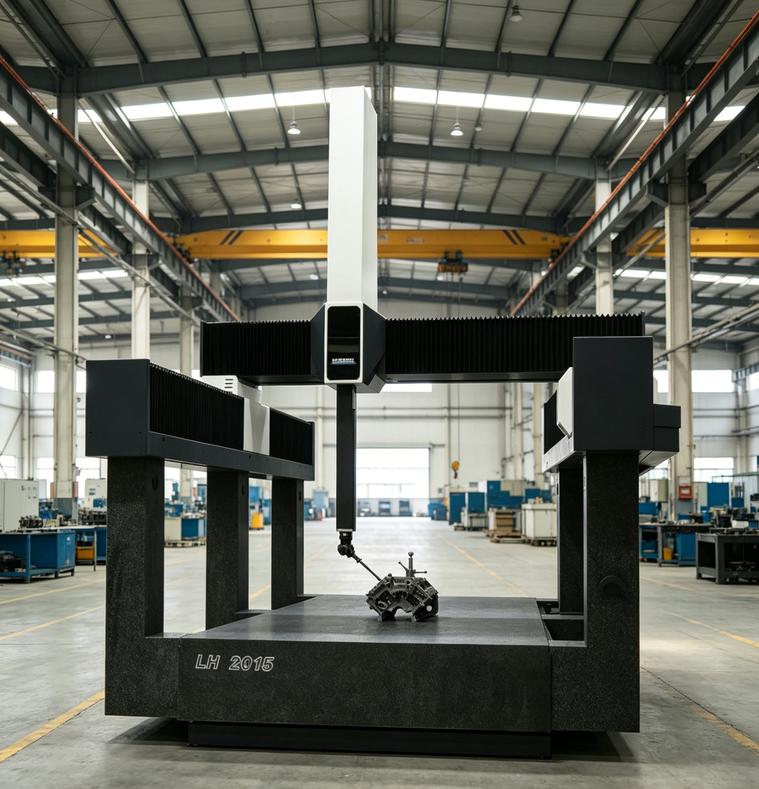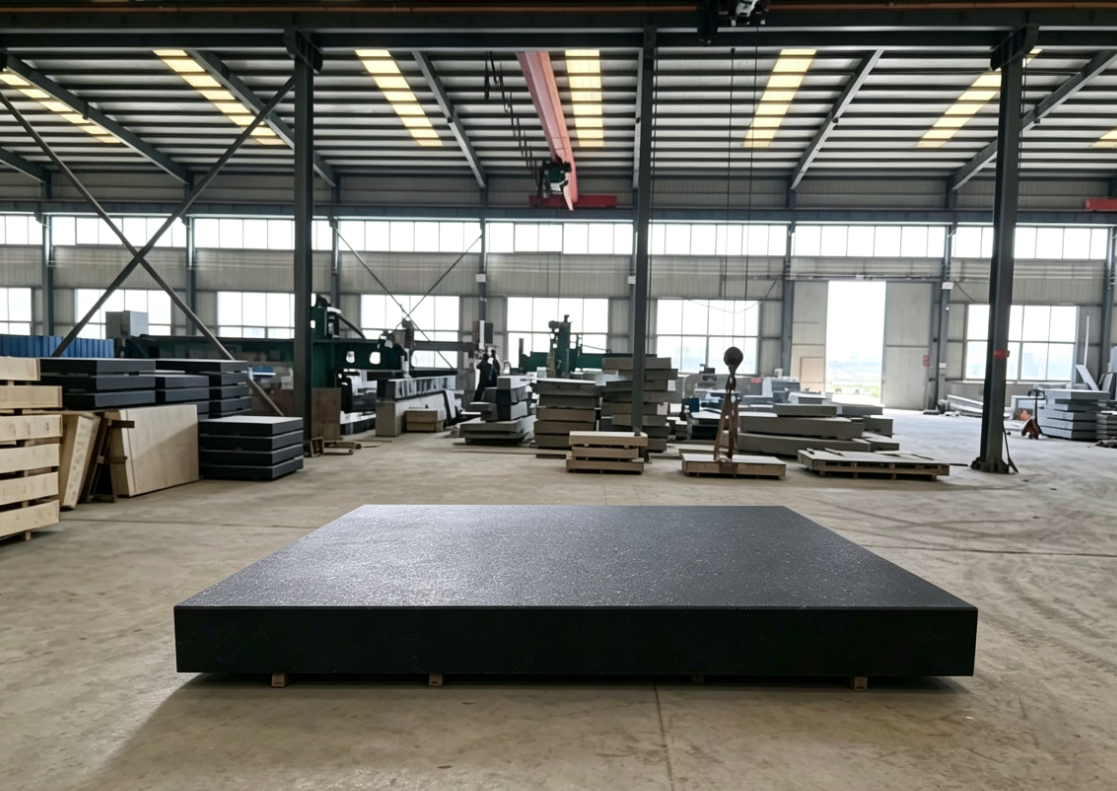
In high-end fields such as semiconductor equipment, precision machine tools, metrology and testing, and optical instruments, large integrated bases, load-bearing platforms, and vibration-isolating benchmarks are the foundation of overall machine precision. With comprehensive advantages such as high damping, low thermal expansion, high rigidity, long-term dimensional stability, and the ability to be molded into ultra-large integrated structures, precision granite has become the preferred primary material for such heavy-duty, large-sized, and highly stable structures, truly serving as the solid and reliable skeleton of the equipment.
I. Why Large Benchmark Components Prefer Precision Granite
Compared to cast iron, steel, composite materials, and structural ceramics, the comprehensive advantages of precision granite in large-sized structures are irreplaceable, especially for load-bearing structures such as bases, platforms, and benchmarks.
- Extreme Vibration Suppression, Establishing a Solid Vibration Isolation Baseline
Natural granite has a polycrystalline interwoven structure with a large number of internal micro-interfaces. Its damping coefficient is far higher than that of cast iron and metals, allowing it to rapidly absorb cutting vibrations, motion impacts, and stray vibrations transmitted from the external ground.
Fast vibration attenuation effectively blocks the transmission of vibrations to worktables, optical lenses, and wafer stations;
The overall machine operation is smoother, avoiding vibration patterns, positioning offsets, and optical imaging distortion, which is the core guarantee for the “quiet base” of precision equipment.
Application Value: The main bases of lithography machines, coordinate measuring platforms, wafer inspection tables, and CMP equipment beds all rely on granite to suppress all-domain vibrations. - Low Thermal Deformation, No Long-term Dimensional Drift
Precision-grade granite (such as Jinan Green, Zhangqiu Black, etc.) has an extremely low coefficient of thermal expansion, far superior to traditional metallic materials. In a regular constant-temperature workshop environment, the deformation caused by temperature fluctuations is negligible.
It eliminates the problems of obvious thermal expansion and contraction of metals, as well as local heat accumulation deformation;
After multi-stage natural aging artificial aging treatment, internal stresses are completely released. Even after years or over a decade of static or heavy-load conditions, the overall geometric precision exhibits almost no creep, meeting the long-term mass production requirements of semiconductor and metrology equipment. - Capable of Integrated Molding, Adapting to Ultra-Large Structures
This is the core highlight that distinguishes granite from high-hardness ceramics:
Unrestricted by sintering processes, it can be directly quarried, sawed, and processed into multi-meter-scale integrated blanks to manufacture ultra-large integrated beds, gantry bases, long guide rail bases, and heavy-duty benchmark platforms;
The overall structure is without splicing, welding, or bolted combinations, eliminating precision errors caused by assembly gaps and connection stresses from the source. The rigidity of large-span structures is complete and highly consistent. - Sufficient Rigidity and Strong Load-Bearing Capacity, No Deformation Under Heavy Loads
The dense crystalline structure gives granite high bending and compression resistance, with an evenly distributed self-weight. As a large load-bearing skeleton, it can withstand the equipment’s self-weight, workpiece loads, and alternating stresses of moving mechanisms over the long term. The deflection under heavy loads is extremely small, and it will not suffer from the long-term fatigue deformation issues common in metal parts. - Mature Processing and Strong Structural Plasticity
The supporting processing technology system is complete, enabling the completion of complex structural designs such as six-sided precision milling, slotting, multi-hole system processing, pre-embedded threaded sleeves, irregular steps, and positioning stops. Mounting holes, wiring slots, and assembly reference surfaces on large bases can all be precision-molded in one go, facilitating overall machine integration and modular assembly, with extremely strong engineering feasibility. - Non-magnetic, Insulating, and Cleanliness Compatible
Natural granite is inherently non-magnetic and does not generate magnetic interference, making it suitable for optical, electronic, and semiconductor precision stations; after surface sealing and protection, the micropores are closed, meeting the clean…
II. Core Shortcomings and Supporting Solutions
Granite is not an all-purpose material. When used as a large-scale frame, its shortcomings must be specifically avoided:
Moderate hardness, easily scratched by hard workpieces
Solution: Fine grinding and polishing of the working surface protective coating, paired with steel/ceramic guide rail pairs in key sliding areas, used in zoned applications.
Presence of microscopic pores, prone to liquid seepage
Solution: Apply penetrating sealant to the finished product to isolate cutting fluids and water vapor, preventing water absorption and expansion.
Higher brittleness than metals, strong impacts strictly prohibited
Solution: Optimize equipment layout, add protective structures around the base, and use flexible tooling for lifting and transport to avoid bumps and chipped corners.
Thermal stability inferior to high-purity ceramics
Solution: Locally pair core precision stations with small ceramic components, and manage the entire machine in a constant-temperature workshop to leverage strengths and avoid weaknesses.
III. Typical Application Scenarios (Large-scale Frame Category)
High-end Semiconductor Equipment
Overall bases for EUV/ArF lithography machines, large platforms for wafer inspection equipment, main bases for ion implanters, and load-bearing beds for packaging and bonding equipment. Relying on large-size integral molding strong vibration isolation capabilities to ensure nanometer-level positioning accuracy.
Precision Metrology and Inspection
Large granite inspection platforms, ultra-long right-angle standards, overall bases for bridge-type coordinate measuring machines, and reference tables for laser interferometers, serving as the reference frame for geometric quantity transfer.
Precision Machining Equipment
Large gantry milling machines, grinder beds, and ultra-long guide rail bases, balancing heavy loads, vibration resistance, and motion accuracy.
Optical and Laboratory Equipment
Optical platforms, precision laboratory tables, and astronomical instrument bases, isolating external vibrations to ensure the stability of optical paths and experimental systems.
IV. Positioning Differentiation from High-Hardness Ceramics and Cast Iron
Precision Granite: Mainly used for large-size, heavy-load bases/platforms/overall frames, acting as the “main frame” of the equipment. It prioritizes stability, size, and long-term reliability, offers high cost-performance, and is the mainstream choice for large precision equipment.
High-Hardness Structural Ceramics: Mainly used for small internal cavity parts, motion friction parts, and high-temperature/plasma working condition parts, acting as “precision functional small parts” of the equipment. It prioritizes extreme precision, corrosion resistance, and wear resistance, but cannot be made into large-scale integral structures.
Cast Iron: Traditional general-purpose beds, low cost but high vibration and significant thermal deformation. Only used for ordinary precision equipment, and is gradually being replaced by granite in high-end precision fields.
V. Summary
For large bases, load-bearing platforms, and vibration-isolating standards that require large spans, heavy loads, strong vibration isolation, and long-term precision stability, precision granite is an irreplaceable frame material. It supports the overall structure of the equipment with its large-size integral molding capability, suppresses vibration interference with high damping, maintains long-term precision with low expansion and low stress, and adapts to complex assembly requirements with mature processes.
Bearing the weight of the entire machine externally, maintaining reference precision internally, isolating environmental interference externally, and ensuring smooth operation internally — this is the core value of precision granite as the stable and heavy frame for high-end precision equipment.