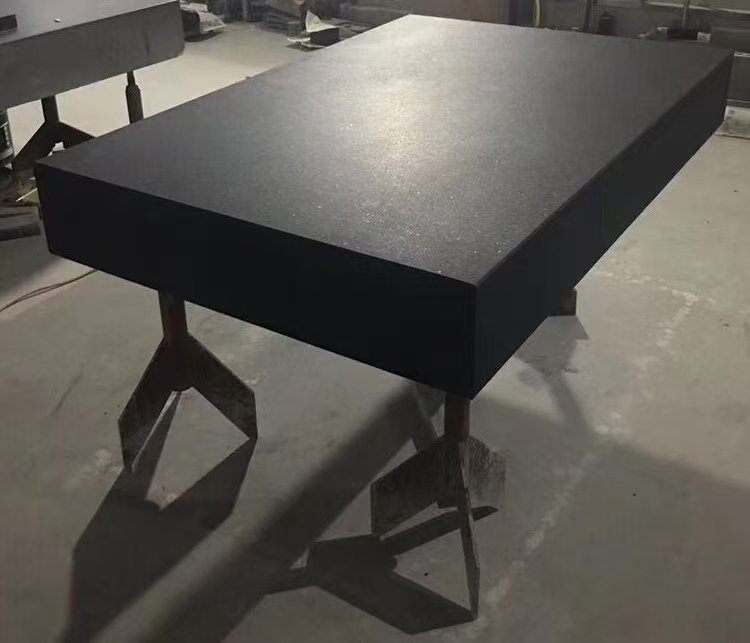
I. Three Bottom Lines to Remember Before Cleaning
Never use strong acids or strong bases
Including oxalic acid, chloric acid, caustic soda, powerful descalers, and rust removers, which will corrode stone micro-pores, destroy the gloss, and cause hidden cracks.
Never use hard tools to scrape
Steel wool, blades, metal scrapers, and sandpaper are strictly prohibited; once the precision surface is scratched, it cannot be repaired.
Nevek for a long time or rinse with large amounts of water
Granite will undergo slight deformation after absorbing water, affecting equipment precision.
II. Correct Cleaning Steps (Safe Version)
Power and stop the machine first
To prevent liquid from seeping into electrical parts and to avoid the machine moving and bumping into the base.
Wipe away loose dust with a soft cor dust-free paper
Prioritize non-woven fabric, suede cloth, or soft-bristled brushes; do not use rough rags.
Handling oil stains / cutting fluids
Ligh oil stains: Wipe with a diluted neutral stone cleaner / industrial neutral cleaner
Stubborn oil stains: Lightly wipe with alcohol or isopropyl alcohol; leaves no residue s not damage the stone
Finally, dry with a dry cloth
Ensure the surface has no standing water or residual liquid to avoid long-term moisture.
III. Correct Handling Methods for Diffrent Stains
Dust, powder: Soft-bristled brush dry cloth, light wiping; do not dry rub to avoid scratching.
Machine oil, guide rail oil: Neutral cl soft cloth, repeated light wiping; do not rub vigorously.
Coolant, water-based stains: Wipe with a slightly damp cloth and dry immediately.
Adhesives, cured subances: Use a plastic scraper to gently push away, then wipe with alcohol; strictly prohibit using metal scrapers.
IV. Daily Maintenance Habits (Avoiding Mistakes at the Source)
Cn lightly on a regular basis; do not wait until dirt accumulates
Dry and hardened oil stains are easier to wipe hard, causing damage.
Lay oil-proof mats around the equieduce direct splashing of coolant and oil onto the base.
Only use neutral cleaning liquids
Check the label when purchasing: pH 6-8 range is the safest.
Minimize wr contact on precision working surfaces
Use dry wiping instead of wet wiping whenever possible; use as little water as possible.
Keep the environment dry, ventilated, and at a constant temper
Reduce condensation and water stains attaching to the base.
V. Summary of What You Must Never Do
Do not use strong acids, strong bases, bleach, or toilet cles
Do not use steel wool, blades, or metal tools
Do not use high-pressure water guns to spray directly or soak for a long time
Do not arbitrarily grind or polish precision worki surfaces
Do not perform direct cutting, welding, or high-temperature baking on the base.