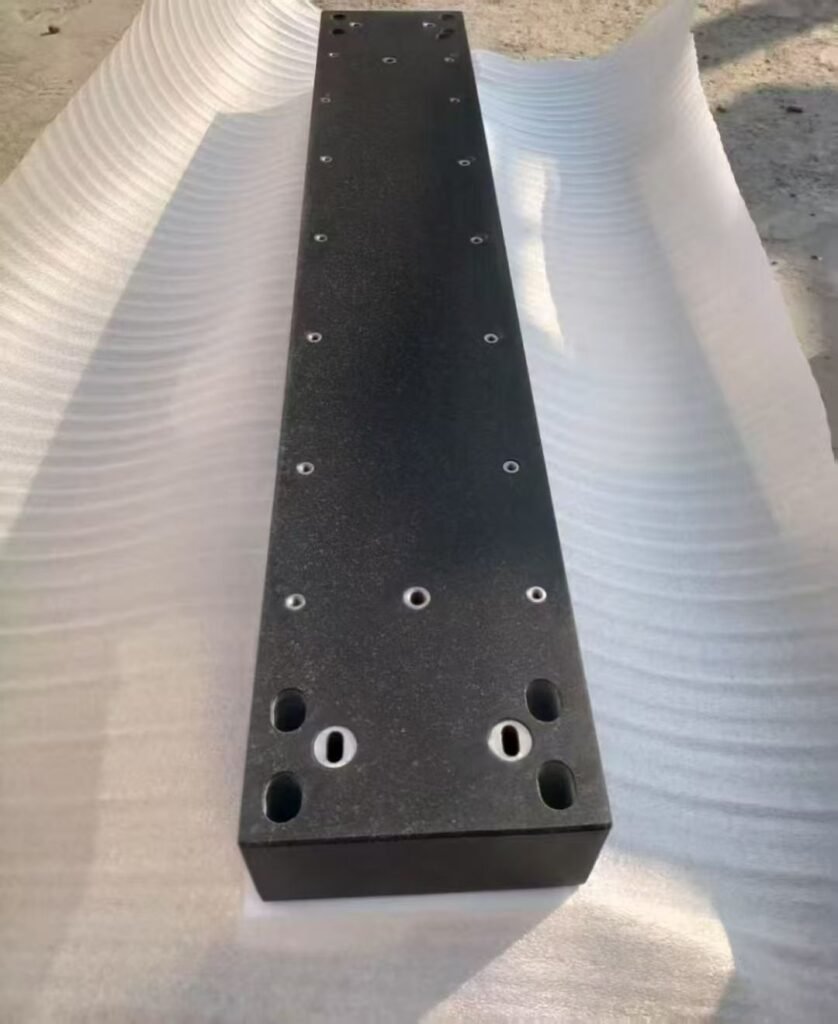
The base of the LCD panel inspection equipment is made of granite. The core reason is that it pro a long-term stable, anti-vibration, low thermal deformation, non-magnetic, and wear-resistant reference platform under nanometer-level detection precision, perfectly matching the stringent requirements of panel inpection.
I. Core Advantages (Why Choose It)
- Extreme Thermal Stability (Most Critical)
Low coefficient of thermal expansion: approximately10⁻⁶/℃, only 1/2 that of steel and 1/4 that of aluminum.
Dimensions remain almost unchanged during temperature fluctuations, avoiding drift of optical/mechanical references and ensurg micron/nanometer-level detection precision.
Eliminates “reference drift” caused by metal thermal expansion and contraction, eliminating the need for frequent calibration. - Superior Vibration D (Anti-interference)
Dense crystalline structure with a damping coefficient far higher than cast iron, capable of absorbing micro-vibrations from the workshop floor and the equipment itself.
Paneinspection (such as AOI, Cell inspection) is extremely sensitive to vibration; the granite base keeps vibration within 0.02mm/s, avoiding image blurring and measuremt errors.
No need for additional complex vibration damping devices, simplifying structure and improving stability. - Long-term Dimensional Stability (Zero Internal Stress)
Natural granite, formed over hundreds ofons of years of geological action, has completely released internal stress and is free from metal fatigue.
Almost no deformation during long-term use (10 years), with precisio drift ≤0.2μm/5 years, far superior to metal.
As the equipment “reference surface,” it can long-term guarantee the geometric precision of the installation and motion systeNon-magnetic, Insulating, and Rust-proof (Suitable for Electronic Inspection)
Completely non-magnetic, will not interfere with optical or electrical signals in panel inspection (such as FT circuits, pixel defect detection).
Resistant to acids and alkalis, does not rust, suitable for cleanroom environments, and has extremely low maintenance costs.
Good insulation avoids interference from staticctricity and leakage current affecting precision circuits. - High Hardness and Ultra-precision Surface
Mohs hardness 6–7, wear-resistant and scratch-resistant, with a surf that can be machined to a super-smooth Ra 0.02μm level.
Suitable for air-bearing rails/platforms, enabling frictionless and smooth motion, suitar high-speed, high-precision scanning.
No burrs after impact, does not affect overall flatness, ensuring long-term precision reliability.
II. Comparison with Metal Bases (Why Not Choose Metal)
Table
| Characteristics | Granite Base | Metal (Cast Iron/Steel/Aluminum) Base | Impact on Panel Inspection |
|---|---|---|---|
| Therm Expansion | Extremely low (3–5×10⁻⁶/℃) | High (Steel: 11–13; Aluminum: 23) | Metal ealy undergoes thermal deformation, leading to reference drift and detection misjudgment |
| Damping & Vibration Reduction | Extremely strong (good vibration absorption) | Weak (easy vibration transmissMetal easily amplifies vibration, affecting imaging and measurement precision | |
| Long-term Stability | Almost no deformation | Internal stress, prone to creep/fatigue | Metal requires frequent calibrationnite is long-term reliable |
| Magnetism | None | Present (easily magnetized) | Metal magnetization interferes with electronic detection; granite has no interference |
| Maintenance | Mainte, corrosion-resistant | Requires rust-proofing and demagnetization treatment | High maintenance cost for metal; almost zero maintenance for granite |
III. Specific Value in LCD Panel Inspectioaptation for Ultra-large Panels: For Gen 8.5–11 glass substrate inspection, an ultra-large, ultra-flat, and ultra-stable base is required; granite cormed integrally or spliced to ensure overall flatness.
Optical System Reference: CCD/CMOS cameras, laser interferometers, microscopes, etc., rely on granite ovide a zero-drift installation reference.
High-Speed Motion Platform: The air-bearing XY stage utilizes a granite base to achieve high-speed, smooth, and repeatable positioning, meeting production line ccle times.
Nanometer-Level Defect Inspection: For high-resolution inspection of Micro-LED, OLED, etc., a deviation of 1nm can lead to misjudgment; gr is the only material capable of maintaining this precision over the long term.
IV. Conclusion
The granite base serves as the “foundation of precision” for LCD panel inspection equipment: leomprehensive advantages of low thermal expansion, high damping, zero internal stress, non-magnetic properties, and wear resistance, it addresses the four major precision killers in panel inspection—”e, vibration, time, and electromagnetism”—making it the inevitable choice for achieving reliable detection from the micron to the nanometer level.