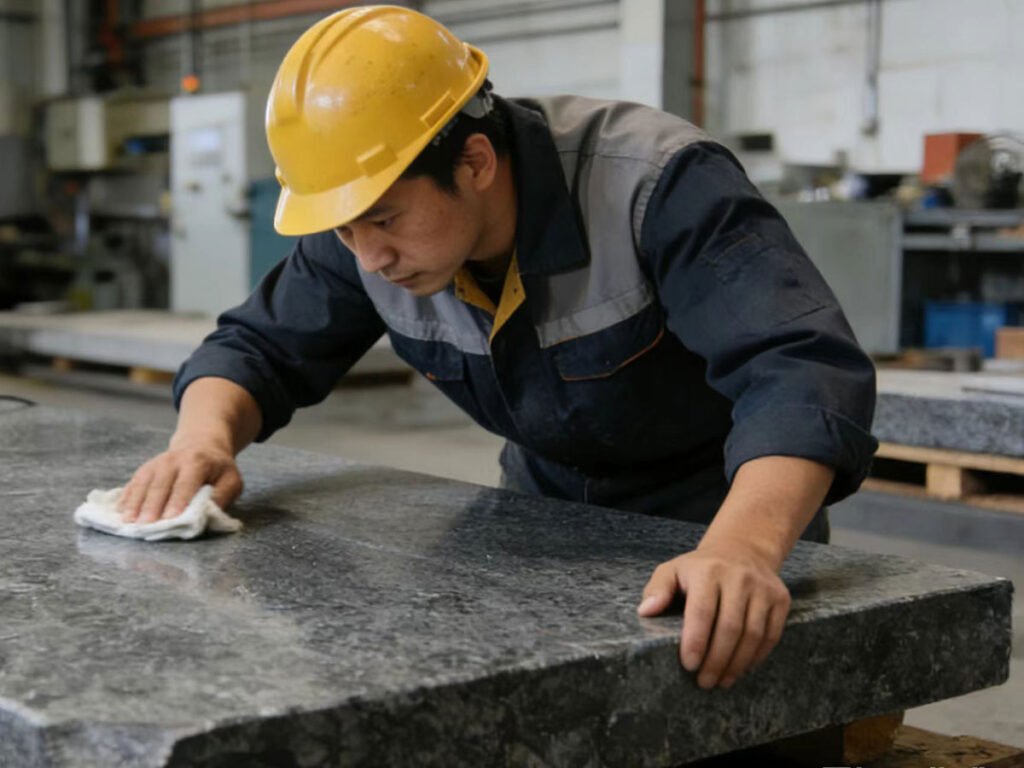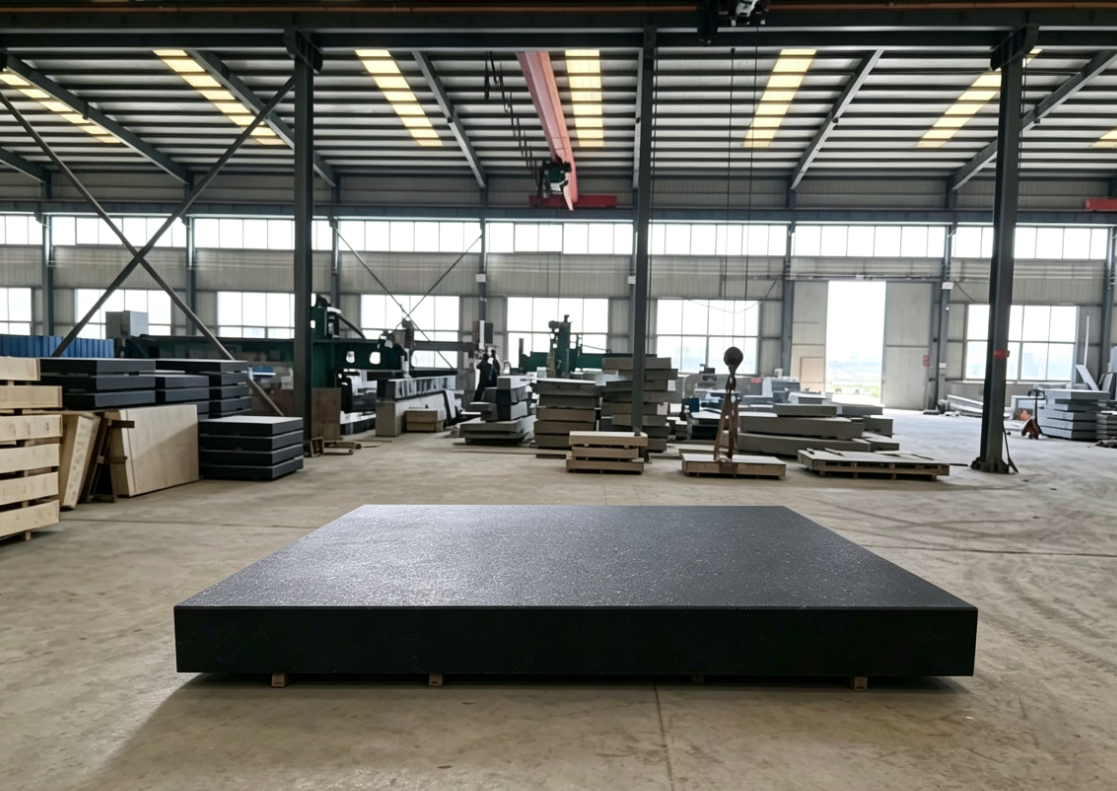
Precision granite platforms indeed possess internal stresses, which are key factors affecting their long-term dimensional stability aon retention.
I. Sources of Internal Stress
The internal stress of precision granite platforms mainly originates from two major aspects:
Geological Primary Stress
Granite is formed by the slowand crystallization of magma deep underground over hundreds of millions of years under high temperature and pressure. Under uneven cooling and geological pressure, different minerals (quartz, fedspar, mica) form residual locked-in stresses internally.
During the extraction of the block, the original geostress balance is instantly broken, and internal stresses are redistributed, becoming the initial intal stress of the blank.
Processing-Induced Stress
Mechanical processes such as cutting, rough grinding, and milling introduce mechanical and thermal stresses into the material’s surface and subsurfayers.
Local plastic deformation and temperature gradients during processing further disrupt the original stress balance, generating new residual stresses.
II. Core Processes for Eliminating Internal Stress in Production
The industry mainstrs a combined solution of multi-stage aging staged processing precision inspection to ensure sufficient stress release and long-term platform stability.
- Natural Aging — The Most Basic and Critical
Implemen: The block/rough blank is left to stand in a constant temperature and humidity environment for 6–12 months (up to 18–24 months for high-endroducts).
Principle: Utilize time and environmental temperature fluctuations to allow internal stresses to slowly relax and rebalance, reaching a stable state.
Function: Eliminate most primary and rough processng stresses; it is the foundation for ensuring long-term stability. - Staged Processing & Intermediate Relaxation
Process: Rough machining → Standstill aging (several wemi-precision machining → Further standstill → Precision machining.
Principle: Reserve a stress release cycle after each processing step to avoid introducing excessive stress in a single operation and prevent subsequent defon.
Key Point: Sufficient aging must be performed after rough machining before entering the precision grinding stage. - Low-Temperature / Thermal Aging (Auxiliary, Not Universal)
Some manufactuers use low-temperature heating (60–120°C) slow cooling on thick and large parts to accelerate stress relaxation.
Strict temperature control is required to avoid new stressesmicro-cracks caused by the thermal expansion and contraction of granite. - Precision Grinding & Hand Lapping (Final Lapping)
Adopt free abrasive grinding with low pressure and low h introducing new stresses.
Process: Grinding → Standstill → Inspection → Re-grinding, repeated until flatness meets standards.
Hand lapping can achieve micro-area stress release andface homogenization, improving final stability. - Final Stabilization Inspection and Acceptance
Finished products undergo multiple cyclic inspections in a constant temperature room (flatness, paralelism, etc.).
If continuous inspection shows no obvious deformation, it is determined that stresses have been fully released, and the product is allowed to leave the factory.
III. Comparison of Different Processes (Key Points)
Table
Process Principle Cycle Effect Applicable Scenarios
Natural Aging Time onment, slow relaxation 6–24 months Best, long-term stability All high-precision platforms
Step Machining Intermediate Aging Step-by-step release, avoid accumultion Follows machining process Good, controls deformation Essential for the entire process
Low-Temperature Thermal Aging Heating accelerates atomic migration Several days to several wr, auxiliary acceleration Thick and large parts, urgent orders
Precision Grinding / Lapping Low-stress removal micro-area balancing Several days Final stabilization, guaranteeecision Last precision machining
IV. Why Must Stress Be Eliminated?
Platforms that are not sufficiently stress-relieved will undergo micrometer-level or even sub-micrometer-level deformation dug use due to the slow release of stress, directly causing the failure of measurement/processing references.
Especially in nanometer-level precision scenarios such as semiconductors, precision me and optical equipment, internal stress is the primary source of precision drift.