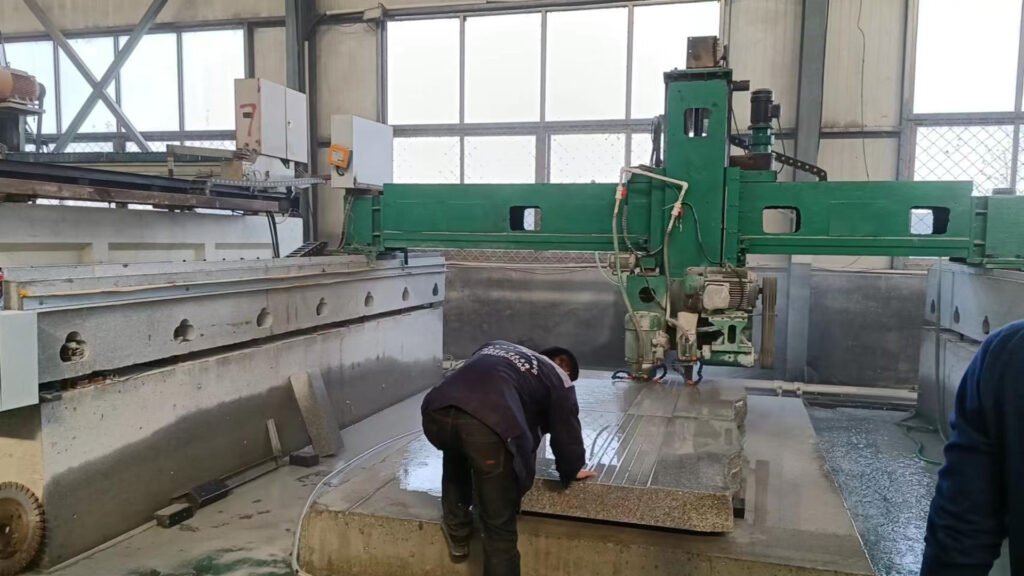
Granite Platform — The Impact of Cutting, Thickness Measurement, and Polishing on Precision, Stability, and Appearance
I. Impact of Cutting Process
- Impact on Precision
Unreasonable cutting allowance → Insufficient flatness after polishing, unevthickness in local areas.
Non-vertical cutting surface → Installation and splicing difficulties, perpendicularity of reference surfaces exceeds tolerance.
Excessive cutting speed, worn blade → Generation of micrs and hidden cracks; prone to chipping and deformation during later use. - Impact on Stability
Cutting introduces mechanical internal stress; unreleased stress → Slow deformation and warpi over time.
Incorrect cutting direction for large plates → Anisotropy of the plate, inconsistent deformation due to temperature changes. - Impact on Subsequent Processing
Poor cutting flatrge material removal during polishing, high cost, and time-consuming.
Chipping and corner loss → Parts can only be scrapped or significantly reduced in size, reducing yield.
Iof Thickness Measurement Process
- Impact on Product Precision
Uneven thickness → Platform parallelism exceeds tolerance, making installation leveling difficult.
Measuring only corners and not the center Results in a thick center and thin edges, or reverse bowing.
Too few measurement points → Unable to detect local protrusions or depressions. - Impact on Assembly and Usage
Larss deviation → Inconsistent clearance when mating with brackets, tooling, and machine tools.
During customer acceptance: Parallelism is directly judged as unqualified. - Significance for Proess Control
Thickness data serves as the feed basis for rough grinding → fine grinding → polishing.
Real-time monitoring of thickness can avoid over-grinding and waste of labor time.
IImpact of Polishing Process (Most Critical)
- Impact on Flatness
Uneven polishing pressure → Flatness fluctuates between good and bad.
Incorrect polishing sequence → Causes edge collenter convexity, or center concavity.
Excessive jump in abrasive grit size → Surface scratches cannot be eliminated. - Impact on Surface Quality
Insufficient fine polishing → Surce appears hazy, has grinding marks, and poor reflectivity.
Over-polishing → Surface is overly bright but micro-flatness decreases, making measurement prone to reflection interference.
Inadeque cleaning → Abrasive particles embedded in pores, forming dark spots and sand holes. - Impact on Measurement Performance
Excessively high Ra roughness → Poor contact between calgauge blocks, and gauge stands, leading to inaccurate measurement.
Micro-irregularities → Affect the use of optical measurement, projectors, and air-bearing equipment.
on Internal Stress and Stability
Accumulation of polishing heat → Local thermal expansion and deformation after cooling.
Forced grinding pressure → Introduces surface stress, which releases slowlyuse, causing precision drift.