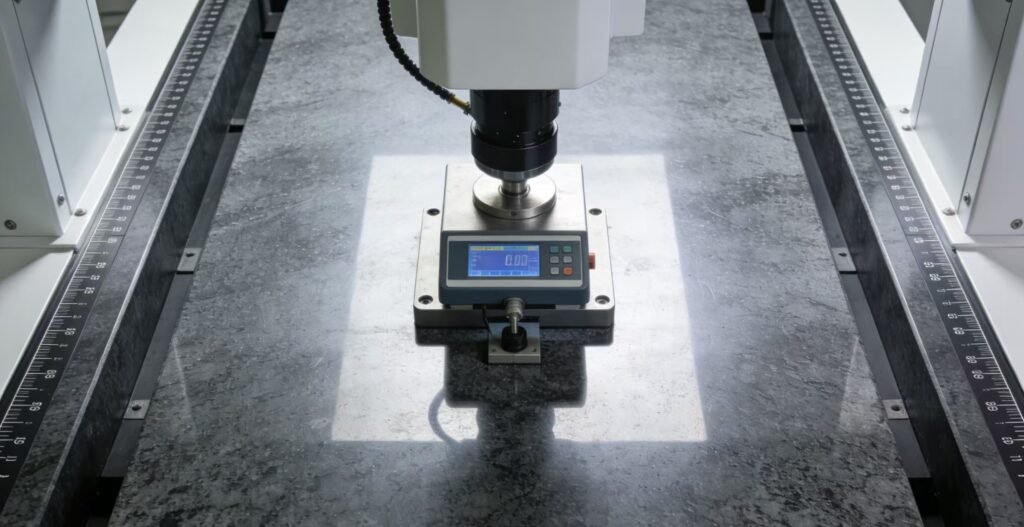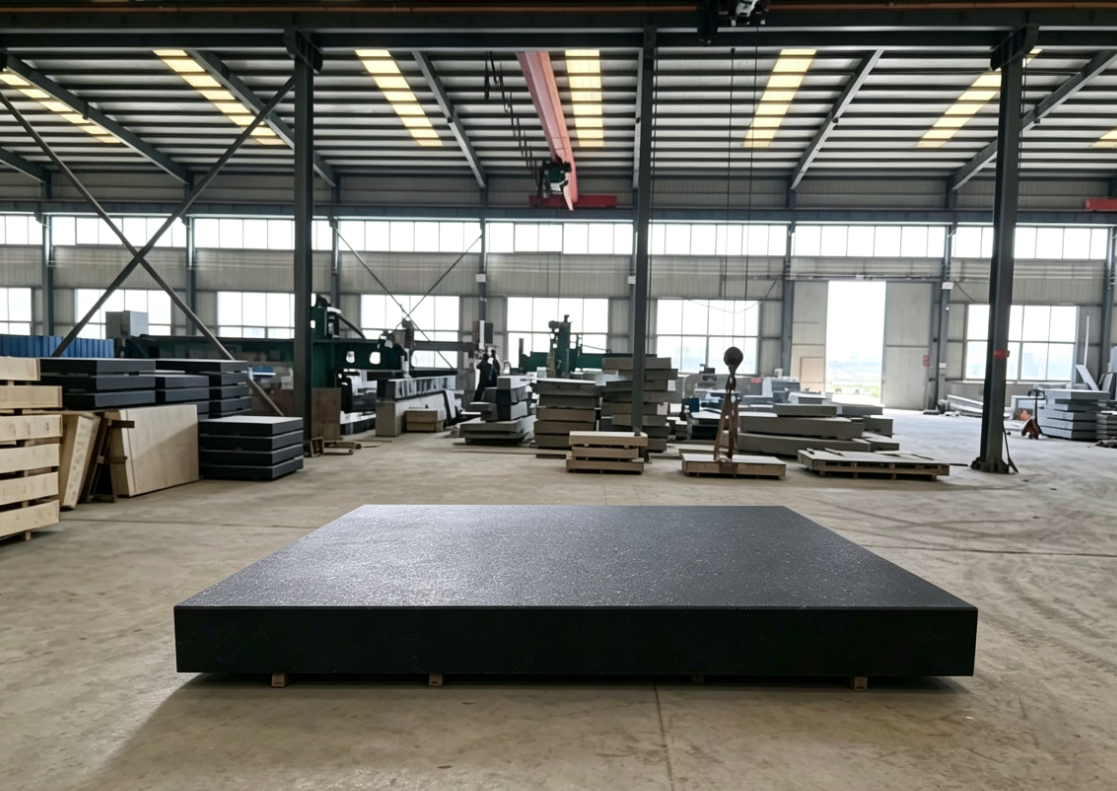
The precision grade of granite flat plates is the core guarantee for the accuracy of precise measurements. The grade classification is centered on flatness tolerance, following the national standards GB/T 20428-2006 and JJG 117-2013. The mainstream grades are 000, 00, 0, and 1. Grade 000 is used for higher precision scenarios, 00/0 grades for general precision measurement, and Grade 1 for typical workshop applications.
I. Precision Grades and Flatness Tolerance (Core Standards)
Flatness tolerance varies with the diagonal length d (mm). The general formula is:
Flatness Tolerance = k × (1 + d/1000) μm
where k (grade coefficient) is: 000 grade = 1; 00 grade = 2; 0 grade = 4; 1 grade = 8.
Common specifications flatness tolerance (μm, at 20℃ standard environment):
| Specification (mm) | Diagonal d (mm) | 000 Grade | 00 Grade | 0 Grade | 1 Grade |
| 300×300 | 424 | 1.4 | 2.8 | 5.7 | 11.4 |
| 500×500 | 707 | 1.7 | 3.4 | 6.8 | 13.6 |
| 1000×1000 | 1414 | 2.4 | 4.8 | 9.7 | 19.4 |
| 1500×1000 | 1803 | 2.8 | 5.6 | 11.2 | 22.4 |
| 2000×1500 | 2500 | 3.5 | 7.0 | 14.0 | 28.0 |
Note: Actual factory output is based on the inspection certificate. Grade 000 is an ultra-precision reference and is rarely used for routine measurements.
II. Grade Definitions and Application Scenarios (Directly Determine Measurement Accuracy)
- 000 Grade (Ultra-Precision Reference Grade)
Flatness: Sub-micron level, ≤2.4μm for a 1000mm diagonal.
Core Uses: National metrology institutes / laboratory references, CMM calibration, laser interferometer references, semiconductor testing, aerospace precision calibration.
Environmental Requirements: Constant temperature 20±0.5℃, constant humidity, anti-vibration. Used only for highest precision traceability. - 00 Grade (Laboratory / Metrology Grade)
Flatness: ≤4.8μm for a 1000mm diagonal.
Core Uses: Precision metrology rooms, CMM table surfaces, optical instrument references, final inspection of precision parts, gauge block / tool calibration.
Environmental Requirements: Constant temperature 20±1℃, anti-vibration, avoid temperature fluctuations. - 0 Grade (Workshop Inspection Grade)
Flatness: ≤9.7μm for a 1000mm diagonal.
Core Uses: Factory quality inspection rooms, precision part testing, fixture reference, machine tool accuracy verification, general precision measurement.
Environmental Requirements: Workshop constant temperature 20±2℃, basic anti-vibration, suitable for most industrial precision scenarios. - 1 Grade (General Workshop Grade)
Flatness: ≤19.4μm for a 1000mm diagonal.
Core Uses: General mechanical machining, assembly references, general part testing, scribing, fixture positioning.
Environmental Requirements: Conventional workshop environment, meeting medium precision measurement needs.
III. Core Advantages of Granite Flat Plates for Precision Measurement
Material Stability: Natural granite, after billions of years of natural时效, has no internal stress, does not rust, is non-magnetic, and has an extremely low thermal expansion coefficient (about 2.3×10⁻⁶/℃). Temperature changes have a much smaller impact on flatness than cast iron.
Hardness and Wear Resistance: Mohs hardness 6–7, Shore hardness ≥70HS. Resistant to wear and scratching, with long-term precision retention far exceeding metal platforms.
Precision Retention: No plastic deformation. With proper maintenance, 00/0 grades can be stably used for 5–10 years without major overhaul.
IV. Selection and Usage Guidelines (Ensure Measurement Accuracy) - Grade Selection Principles
Measurement error requirement ≤1μm: Select 000 grade
Measurement error requirement ≤5μm: Select 00 grade
Measurement error requirement ≤10μm: Select 0 grade
Measurement error requirement ≤20μm: Select 1 grade
Principle: Flat plate precision should be 3–5 times that of the measured workpiece to avoid reference errors dominating the measurement results. - Usage Environment Control (Critical)
Temperature: 20±2℃. Avoid direct sunlight, air conditioning blasts, and heat from dense personnel.
Anti-vibration: Install dedicated vibration isolation supports, away from machine tools, presses, and other vibration sources.
Cleaning: Wipe with a dust-free cloth and alcohol. Strictly prohibit hard objects from scratching. Cover with a dust cover when not in use.
Supporting: Install strictly according to three main supports + auxiliary supports to avoid local deformation from uneven loading. - Regular Calibration
000/00 grades: Calibrate every 6 months
0 grade: Calibrate annually
1 grade: Calibrate every 1–2 years
Calibration Basis: JJG 117-2013 ‘Flat Plates’, with certificates issued by legal metrology institutions.
V. Common Misconceptions
❌ Focusing only on grade, not size: For the same grade, larger size means larger tolerance. A 1000mm 00 grade is not equivalent to a 300mm 00 grade.
❌ Ignoring environment: Using a 00 grade in a general workshop will quickly degrade its precision to below Grade 1.
❌ Over-pursuing high precision: Using a 00 grade when a 1 grade is sufficient leads to high cost, difficult maintenance, and poor cost-effectiveness.