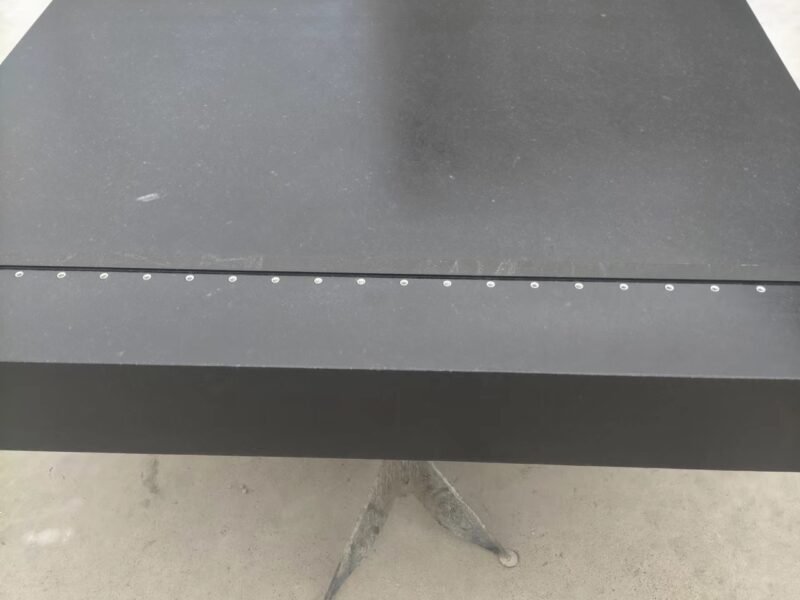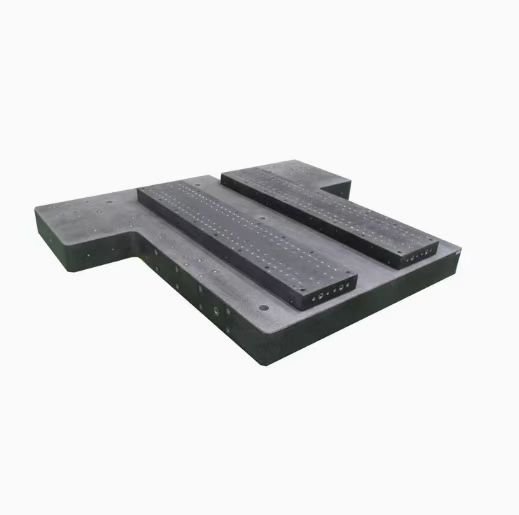
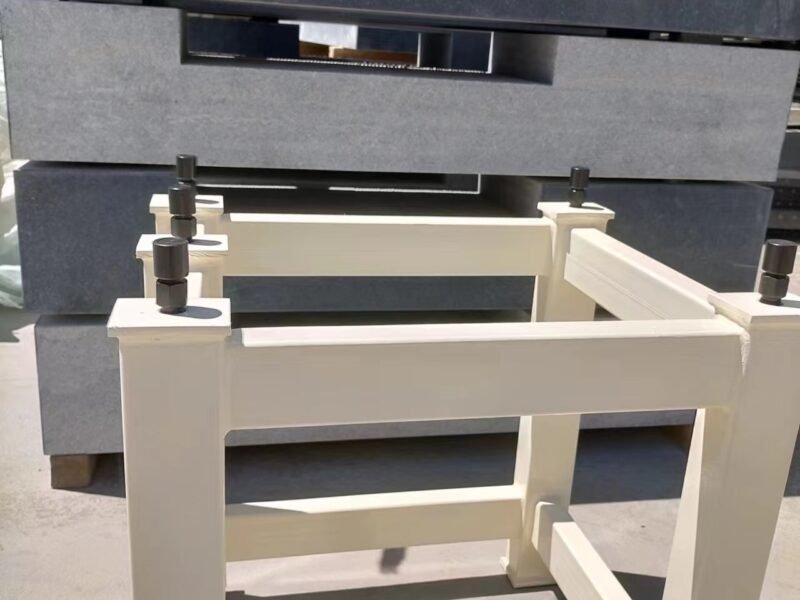
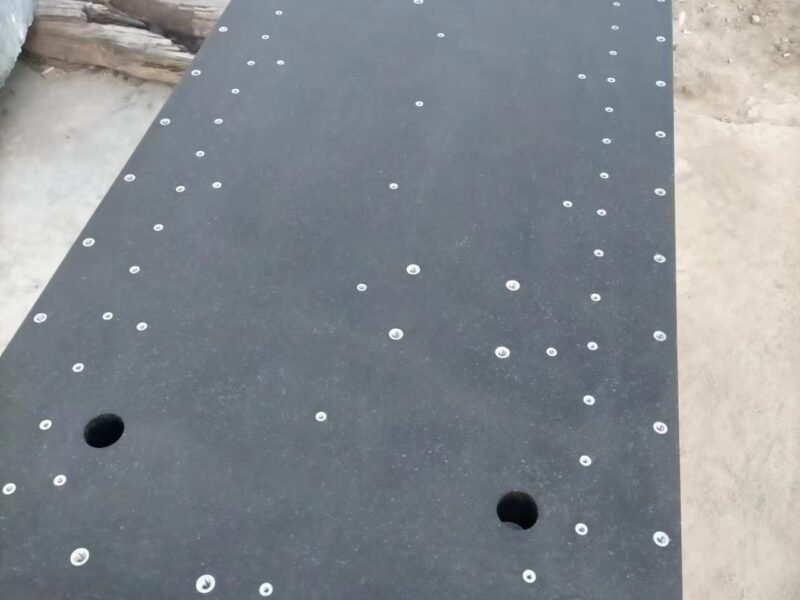
00 grade adjustable level support frame adjusting jacking platform base granite slab bottom
Welding Wonders Forging Excellence Together
PRODUCTS DETAIL
Marble (granite) platform stainless steel bracket technology and selection guide, with structure, material, installation points, that you can directly use it for procurement and on-site deployment.
I. Core material and specifications
1. Common grades: 304 stainless steel ( purpose, corrosion resistant); 316 stainless steel (humid/clean workshop/outdoor, more resistant to chloride ions); 201 is low cost but in rust resistance, not recommended for precision conditions
2. Structural form
– Welding frame style (square tube/rectangular tube, such as 8080×5mm), cross/rectangular reinforcement, post-weld annealing to eliminate stress
– Three-point/five-point support (industrial standard three-point leveling is the most stable, auxiliary support points are added for large sizes, support point positions are often taken at 2/9 of the side length)
Adjustable foot (stainless steel/alloy screw wear-resistant rubber pad, adjustment stroke ±20mm, accuracy can reach 0.02mm)- Optional casters (locked swivel wheels, convenient for moving and maintenance)
3. Surface treatment: pickling passivation (improve corrosion resistance), sandblasting; avoid painting affecting the stainless steel rust-proof nature
II. Key performance and technical requirements
– Load-bearing: designed according to the self-weight of the 1.5 times the maximum load; for example: 1000×800×100mm marble, the bracket rated load ≥100kg
– Rigidity and flatness: overall deflection of the frame <0.02mm/m; support surface flatness ≤0.0mm; contact surface Ra ≤1.6μm
– Shock absorption: damping pads/silicone pads are added to the support points to isolate ground vibrations; spring vibrationators are added when necessary
– Corrosion resistance: 304 salt spray ≥480h, 316 ≥1000h
III. Selection and installation steps
1. Confirm the size, weight, and working height of the platform; prioritize segmental reinforcement/five-point support for large
2. Environment: choose 316 for humid conditions; add a vibration isolation system if there is a vibration source; equip with locking casters if there is a need mobility
3. Installation: the sequence of leveling is three-point initial adjustment → precise adjustment with a level → lock the foot → re-measure the flatness; it strictly prohibited for a single point to hang in the air
4. Acceptance: measure the level, flatness, no shaking, load test
IV. Examples and comparisons
– Standard type (304 square tube welding, three-point support adjustable foot) is suitable for metrology rooms, precision testing
– Economic type (carbon steeling) has low cost but poor rust resistance; stainless steel bracket has long service life and little maintenance, suitable for long-term stable precision work
V. Procure and maintenance suggestions
1. Ask for material proof (spectral detection 304/316), welding process records, load/flatness test reports
. Keep it clean daily to avoid acid and alkali corrosion; regularly re-adjust the level; it is strictly prohibited to overload
FAQ
1. What is the maximum size of granite workbench that can be processed??
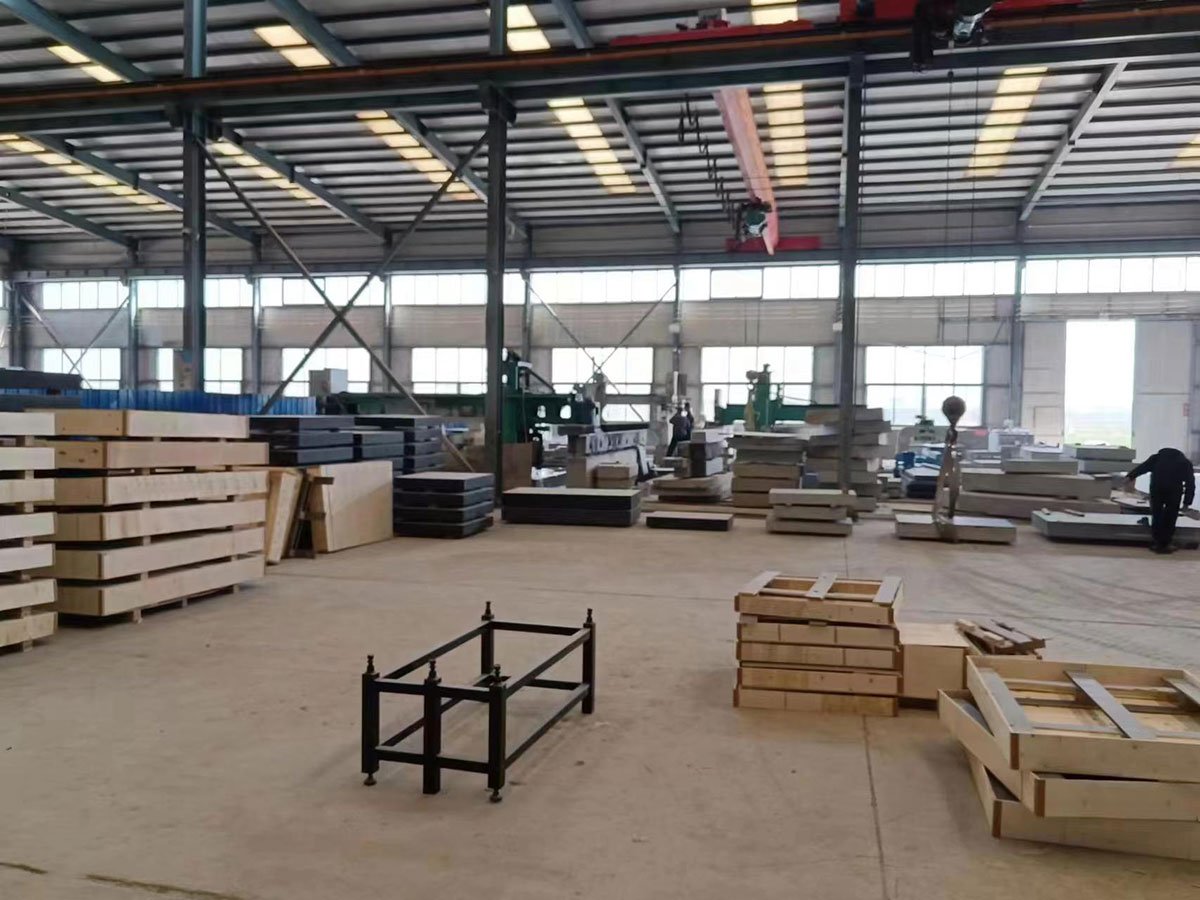
1. Our factory can achieve 4000mm × 2000mm × 700mm in a single piece (without splicing, with high-precision platforms of grade 00 and 000), with a conventional platform thickness of 150-400mm; heavy-duty bases can achieve 600-800mm;.
2. Multi piece splicing platform (can be made larger, mainly level 0, suitable for large equipment bases) Our factory can achieve 8000mm × 4000mm × 600mm (splicing short board: the accuracy at the splicing joint is slightly poor, and there is a slight risk of misalignment between the boards under long-term temperature and humidity cycles. High precision measurement should avoid splicing as much as possible).
3. Selection reference suggestions.
✅ Level 000/Level 00 Metrology Inspection Platform: Priority given to integrated whole piece, recommended ≤ 3000 × 2000mm.
✅ Level 0 large-scale assembly and equipment base: splicing solutions can be selected to achieve a size of 6 meters or even larger.
✅ Thickness selection: The larger the length and width, the thicker the height (thickness) must be to prevent deflection and deformation of the tabletop, for example, 3000 × 2000, starting from a conventional thickness of 500mm
2. How many micrometers can the flatness reach? Can the accuracy be achieved at level 00, level 0, or level 000? What are the levels of 000/00/0?
3. Should we use Jinan green or other granite?
1. Physical parameters of Jinan Qingxin: density of 3.07~3.3 g/cm ³; Water absorption rate<0.13%; Linear expansion coefficient 4.16 × 10 ⁻⁶/℃; Mohs hardness level 6-7;
Advantages: ultrafine grain size, uniform and dense structure, low internal stress, good shock absorption and damping, minimal temperature and humidity deformation, stable up to levels 000, 00, and 0; Not dyed, permanently colorfast; Resistant to cutting fluid, non-magnetic, suitable for three coordinate, optical, and semiconductor reference platforms.
Applicable scenarios: metrology room benchmark, 000 level, 00 level high-precision detection platform, high-end equipment base, etc.
2. Indian Black Granite [high-end alternative, can be used at level 000/00]
The performance is close to Jinan Qing, with high density and low coefficient of thermal expansion; Imported raw materials, large-sized raw materials are easier to obtain than Jinan Qing.
Applicable: Class 000, 00 precision base, linear motor platform; The price is slightly lower than the genuine Jinan green.
3. Zhangqiu Black [Cost effective main force, up to level 00, regular level 0]
The density is about 2.8 g/cm ³, and the performance is slightly lower than that of Jinan Qing. It is generally stable at level 0 or level 00, and level 000 is not recommended.
Attention: Some materials need to be dyed, and their water absorption rate is slightly higher than that of Jinan green.
Recommended scenarios: Ordinary workshop 0-level inspection platform, medium precision equipment base.
4. Northeast material [only level 0, ordinary tooling platform]
The grain size is coarse, the density is low, and the stability is poor. It can only achieve level 0 or 1 and cannot achieve level 00/000.
Applicable: Workshop marking, fixture positioning, not suitable for precision measurement.
4. Is there a constant temperature and humidity workshop?
Workshop environmental parameters:
reference temperature: 20 ℃ (international reference temperature for length measurement)
Class 00 control: 20 ℃± 1 ℃,
Class 000 ultra-high precision control: 20 ℃± 0.5 ℃, hourly temperature fluctuation<0.3 ℃;
Relative humidity: 40%~60% RH (conventional stable 45~55% RH), humidity fluctuation within ± 5% RH;
Supporting facilities: shock-absorbing independent foundation, dust-proof purification, no direct blowing, reducing precision interference caused by vibration and airflow.