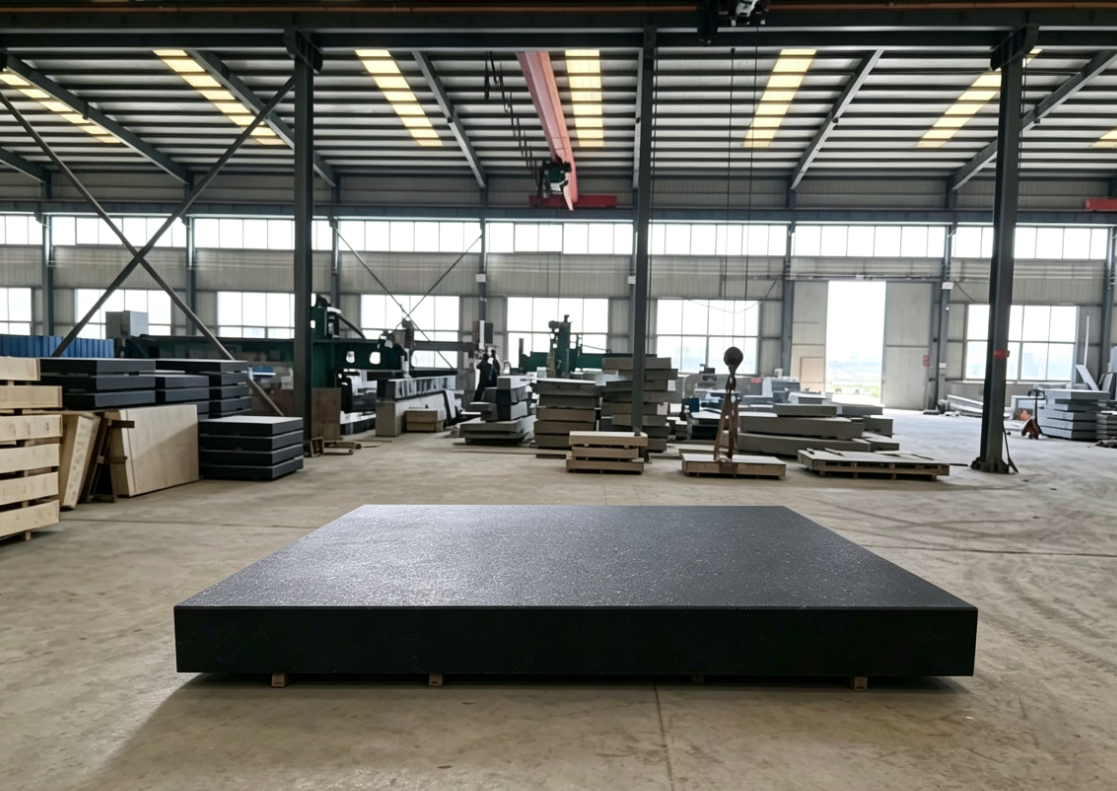
Granite measuring tools are widely used in scenarios with strict requirements for measurement accuracy and environmental adaptability due to their high precision, corrosion resistance, and anti-interference properties. The following are typical usage scenarios and specific analysis:
- Precision machinery manufacturing and processing
Scenario: Machine tool guide rail calibration, mold parting surface inspection, component flatness/perpendicularity measurement.
Advantage:
High precision: The flatness error of granite measuring tools can be controlled within ± 0.01 millimeters (00 level accuracy), meeting the micrometer level requirements for machine tool assembly and mold processing.
Wear resistance: Long term use is not easy to wear, ensuring the stability of the measurement benchmark and reducing machining errors caused by deformation of the measuring tool.
Case: In the machining of automobile engine cylinder blocks, a granite inspection platform was used to verify the machine tool guide rails, reducing the machining error from ± 0.05 millimeters to ± 0.02 millimeters. - Aerospace and Defense Industry
Scenario: Aircraft component inspection, satellite component assembly, missile guidance system calibration.
Advantage:
Anti magnetic interference: Granite is a non-metallic material with no magnetization reaction, which avoids the influence of metal measuring tools on high-precision sensors or navigation systems due to magnetization.
Thermal stability: The coefficient of linear expansion is extremely low, and measurement accuracy can still be maintained under extreme temperature changes (such as high-altitude environments).
Case: A certain aerospace company used a granite ruler to inspect the sealing surface of a rocket fuel tank, ensuring that the sealing meets the standard under a temperature difference of -50 ℃ to 80 ℃. - Semiconductor and Electronic Manufacturing
Scenario: wafer inspection, chip packaging, circuit board flatness measurement.
Advantage:
Electrical insulation: To avoid the risk of electrostatic discharge (ESD) caused by the conductivity of metal measuring tools and protect sensitive electronic components.
Low water absorption rate: prevents the adsorption of liquids or dust, meeting the environmental requirements of clean rooms (Class 100).
Case: A semiconductor manufacturer used a granite ruler to inspect the wafer cutting machine workbench, reducing the frequency of equipment downtime maintenance from twice a month to once a quarter. - Optics and laser equipment
Scenario: Optical lens grinding, laser interferometer reference platform, telescope assembly and debugging.
Advantage:
Surface smoothness: After precision grinding, the surface roughness of granite is as low as Ra 0.32 μ m, reducing light scattering and improving optical measurement accuracy.
Shock absorption performance: The natural damping characteristic can absorb vibration energy and avoid vibration interference with laser beams or optical systems.
Case: A certain observatory used a granite pedestal to support a telescope, reducing the amplitude of observation image jitter by 80%. - Chemical and Ocean Engineering
Scenario: Detection of corrosive liquid containers, calibration of offshore platform equipment, installation of chemical pipelines.
Advantage:
Corrosion resistance: chemically stable, resistant to acid and alkali corrosion, and does not rust after long-term use in environments such as hydrochloric acid and seawater.
Structural strength: The compressive strength reaches 245-280MPa and can withstand high pressure or heavy load environments.
Case: A certain offshore platform used a granite square ruler to inspect the installation surface of valves, and maintained accuracy without degradation for 10 years in a seawater corrosive environment. - Research and metrology institutions
Scenario: Laboratory benchmark platform, length measuring standard instruments, material mechanical performance testing.
Advantage:
Long term stability: After natural aging treatment, the internal stress is completely released, and the deformation rate can be ignored, making it suitable as a measurement benchmark.
Environmental safety: non-toxic and harmless, in line with laboratory environmental requirements, and fire-resistant and explosion-proof.
Case: The National Institute of Metrology uses granite measuring blocks as length standards, and their accuracy retention exceeds the requirements of the international standard (ISO 3650). - Automobiles and Rail Transit
Scenario: Body welding line inspection, wheelset tread measurement, high-speed rail track straightness verification.
Advantage:
Impact resistance: Although the texture is brittle, a well-designed structure (such as thickened edges) can withstand certain impacts and meet the needs of industrial sites.
Large size adaptation: can be processed into ultra large platforms (such as 10m × 3m), covering the entire vehicle inspection range.
Case: A high-speed rail manufacturer used a granite platform to detect track flatness and reduced train vibration noise by 3 decibels. - Construction and Decoration Engineering
Scenario: High end building curtain wall inspection, stone processing accuracy control, indoor decoration baseline.
Advantage:
Aesthetics: Natural granite has a beautiful texture that can balance functionality and decoration.
Weather resistance: Not prone to aging and cracking when used outdoors, with a lifespan of over 50 years.
Case: A landmark building uses granite measuring tools to verify the accuracy of curtain wall installation, ensuring that the building appearance meets design requirements.