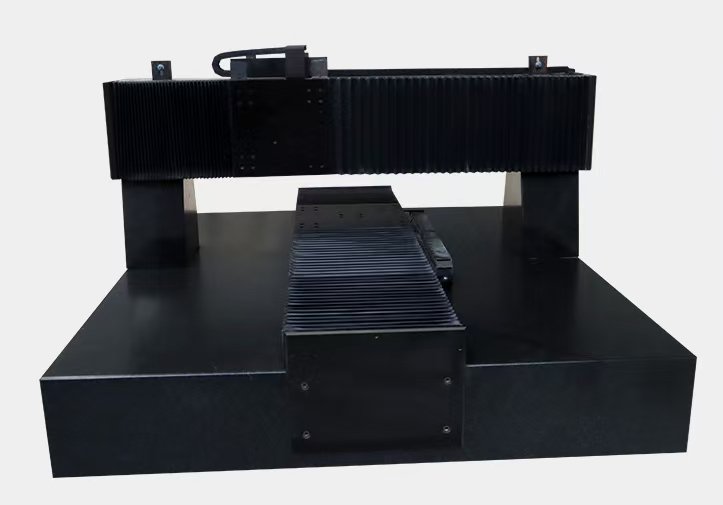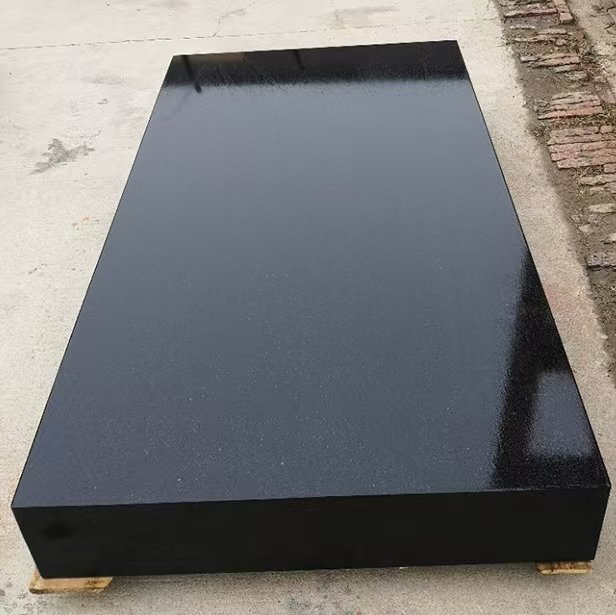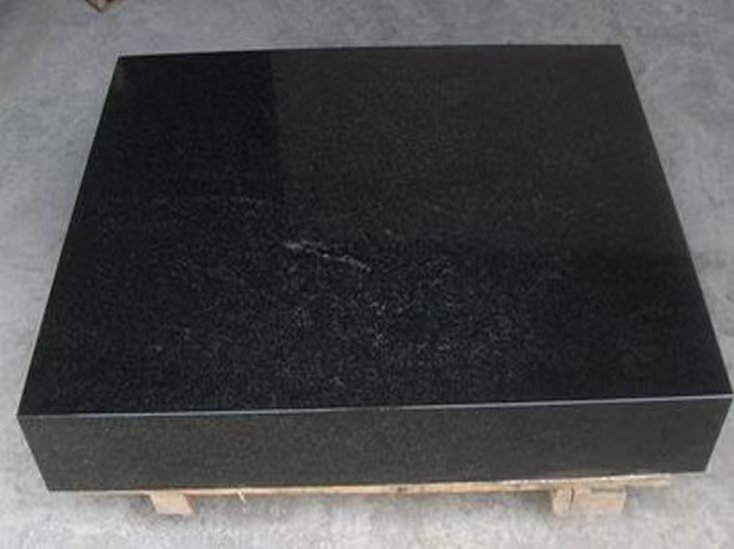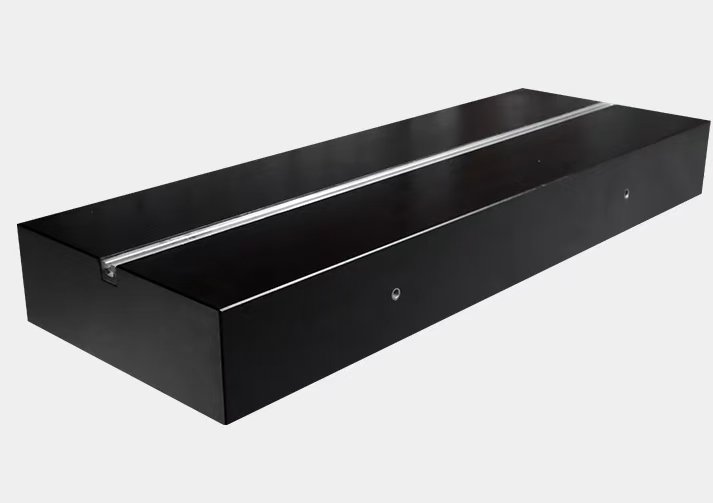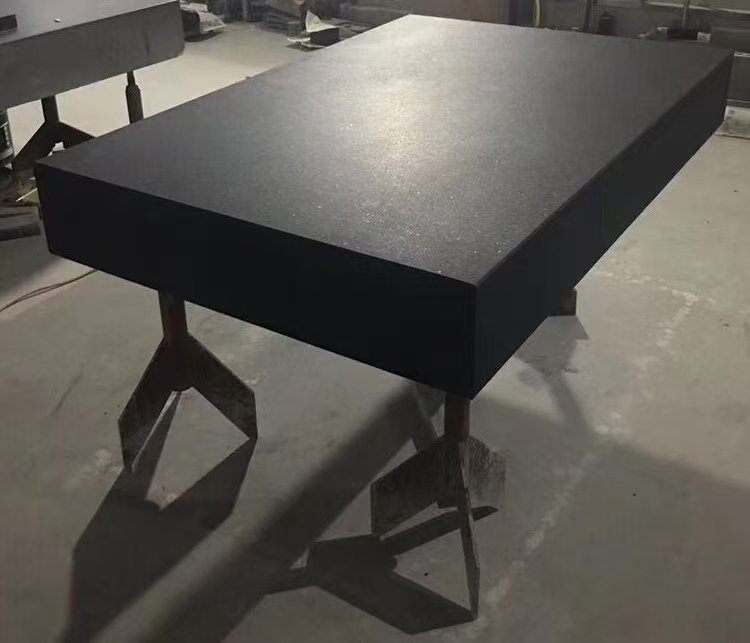
The manufacturing of precision granite components (platforms, bases, guides, gantries a precision process chain from raw blocks to micrometer-level finished products, with the core being stability, stress relief, step-by-step precision machining, and strict inspection. The followingaks down the complete process and marks Critical Control Points (CCP).
I. Raw Material Preparation (Source Determines Stability)
- Ore Source and Material Selection (CCP0)
Prefe stones: Jinan Green, Zhangqiu Black, Fujian Green, Indian Black Sandalwood (fine, uniform grain, no layering, low expansion).
Physical properties
Density ≥ 2.6 g/cm³
Compressive strength ≥ 80 MPa
Thermal expansion coefficient (2.5–5)×10⁻⁶ ℃
No cracks, color lines, holes, or impurities.
Grade: Precision parts must use Grade A / Grade 00 material. - Raw Block Initial Inspection and Pre-treal inspection flaw detection (ultrasonic) to reject defective material.
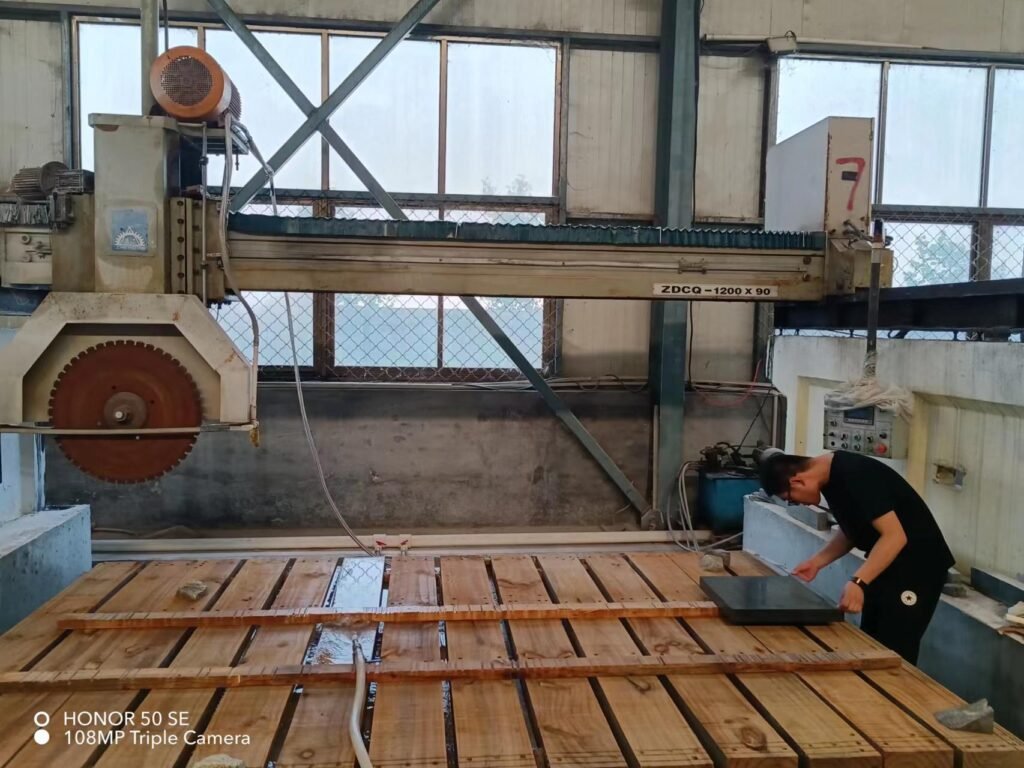
Raw block cutting: Cut into rough plates/rough blanks using diamond gang saws / wire saw, leaving a 2–3 mm machining allowance.
II. Rough Forming (Removing Large Allowances, Establishing Benchmarks)
- Sawing and Shaping
Frame saw / ided cutting machine for slicing → CNC wire saw / water jet for shaping.
Allowance: 2 mm for length/width, 3 mm for thickness. - Rough Grindf Benchmarks (CCP1)
Gantry thicknessing machine rough grinds six sides to establish reference planes.
Flatness control: ≤ 0.2 mm/m.
PurposeTo provide a stable reference for subsequent aging and precision grinding.
III. Stress Relief and Aging (Most Critical, Most Easily Overlooked)
- Natural Aging (Preferred)
Place r / constant temperature workshop for 7–15 days (months for large pieces) to release internal stresses from cutting and rough grinding. - Thermal Aging (Accel
80°C curing chamber for 24 h → deep freeze at -10°C for 4 h, cycle 1–2 times.
Purpose: To completely eliminate internal stresses and preventation during subsequent machining / use. - Constant Temperature Stabilization
After aging, stabilize in a 20±1°C, 50%±5% humidity envonment for ≥ 24 h to stabilize dimensions.
IV. Precision Machining (Micrometer-Level Forming)
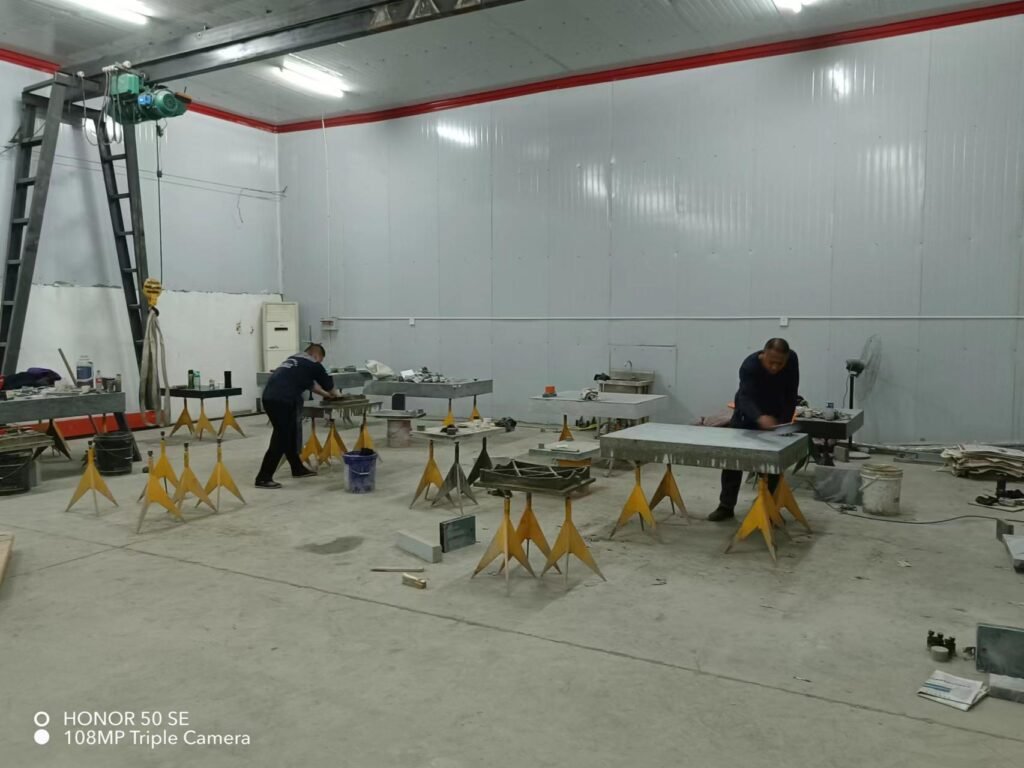
- Semi-precision Grinding / Precision Grinding (ry precision grinding machine, diamond grinding wheels for step-by-step grinding:
Rough grinding → Semi-precision grinding → Precision grinding
Flatness gradually improvedto ≤ 5–10 μm/m.
Sides, perpendicularity, and parallelism processed simultaneously. - Drilling / Slotting / Tapping (CCP3)
CNC drilling machine / machning center, diamond drill bits.
Hole position accuracy ±0.01 mm, perpendicularity ≤ 0.005 mm/100 mm.
Strictly prohibited torily enlarge or modify holes later. - Cleaning and Chamfering
High-pressure water / air cleaning to remove dust and debris.
Blunting sharp eges (C0.5–C2) to prevent chipping and scratching.
V. Ultra-precision Grinding (Final Precision)
- Plane Ultra-precision Grinding (CCP4)
Precision grinding mach, resin-bonded diamond grinding discs, processed step-by-step from 600# to 2000# grit.
Flatness: Gre 00 ≤ 2–5 μm/m; Grade 000 ≤ 1–2 μm/m.
Surface roughness: Ra ≤ 0.1 μm (mirror finish). - Side and Geometric Precision Refinement
5-axis side grinding / grinding to ensure final perpendicularity, parallelism, and hole position accuracy.
VI.and Assembly (If Required)
- Insert Preparation
Stainless steel / copper bushings / threaded inserts, machined according to drawings. - Constant Temperature Assembly
Component andrts are kept at a constant temperature of 20±1°C for 8–12 h.
Press fitting / bonding (epoxy adhesive), ensuring interference fit and perpendcularity. - Secondary Precision Grinding
Local precision grinding after inserts, ensuring
VII. Cleaning, Sealing, and Protection
- Deep Cleaning
Ultrasonic cleaning → Pure water rinse → Dust-fee drying. - Sealing Treatment (Clean Room / Anti-contamination)
Dense, non-porous material is optional; porous material must undergo epoxy resin sealing to prevent moisture absorption and conamination. - Rust Prevention / Protection
Apply rust preventive oil to non-working surfaces; apply protective film to working surfaces.
VIII. Full-Size Inspection (CCP5, M for Factory Release)
- Core Precision Inspection
Flatness: Laser plane interferometer, electronic level.
Perpendicularity / Parallelism: Autocollimator, marble right an.
Dimensions / Hole Positioning: Coordinate Measuring Machine (CMM).
Roughness: Surface roughness meter (Ra). - Appearance and Performance
No cracks,no chipping, no scratches.
Density and water absorption rate spot checks. - Report Issuance
Attach precision inspection report (flatness, perpendicularity, hole positioning, rouhness).
IX. Packaging and Shipping
Wooden crate / Aluminum case shock-absorbing foam, fixed with three-point support (to prevent deformation during transportation).
Moisture-proof and colproof labels.
Summary of Key Control Points (CCP) Throughout the Process
Raw Material Selection: Grade A / Grade 00, defect-free.
Rough Grinding Benchma: Flatness ≤ 0.2 mm/m.
Aging Treatment: Natural / Thermal aging, complete stress relief.
Precision Grinding / Super Precision Grinding: Gradually improved to Grade precision.
Drilling Precision: Hole position ±0.01 mm, perpendicularity ≤ 0.005 mm/100 mm.
Final Inspection: Full-sze and full-precision qualification required for factory release.
One-sentence Summary:
Precision granite components = Good material Thorough stress relief Step-by-step precision grinding Strict inspection; nof these can be missing.