Application Fields
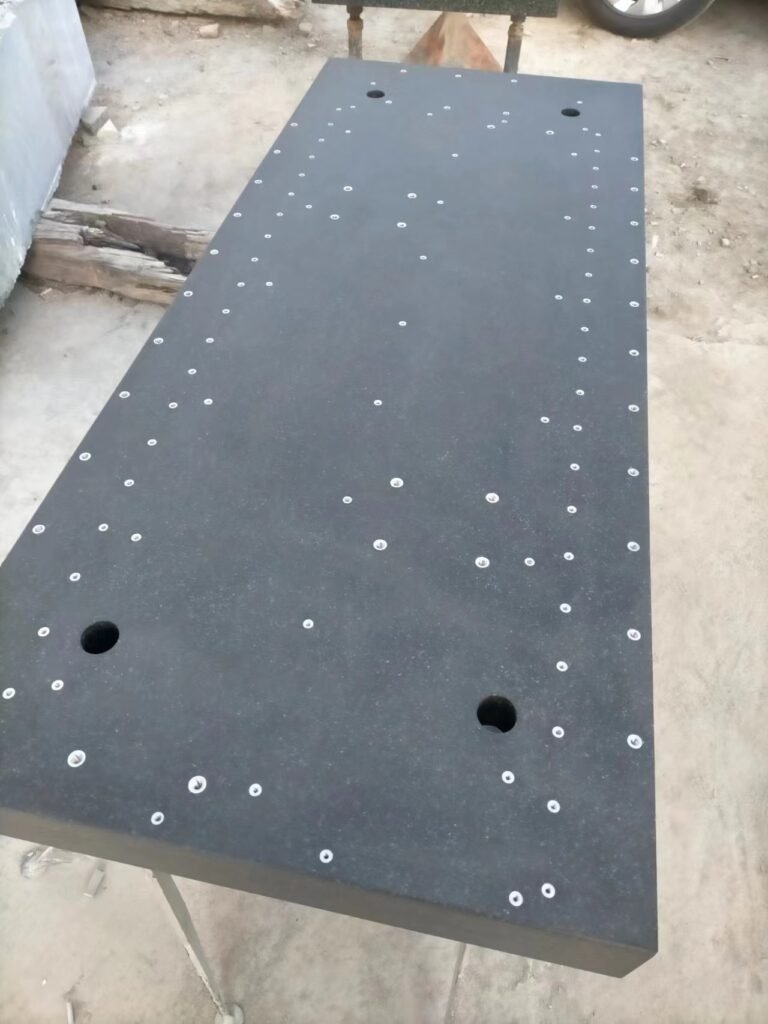
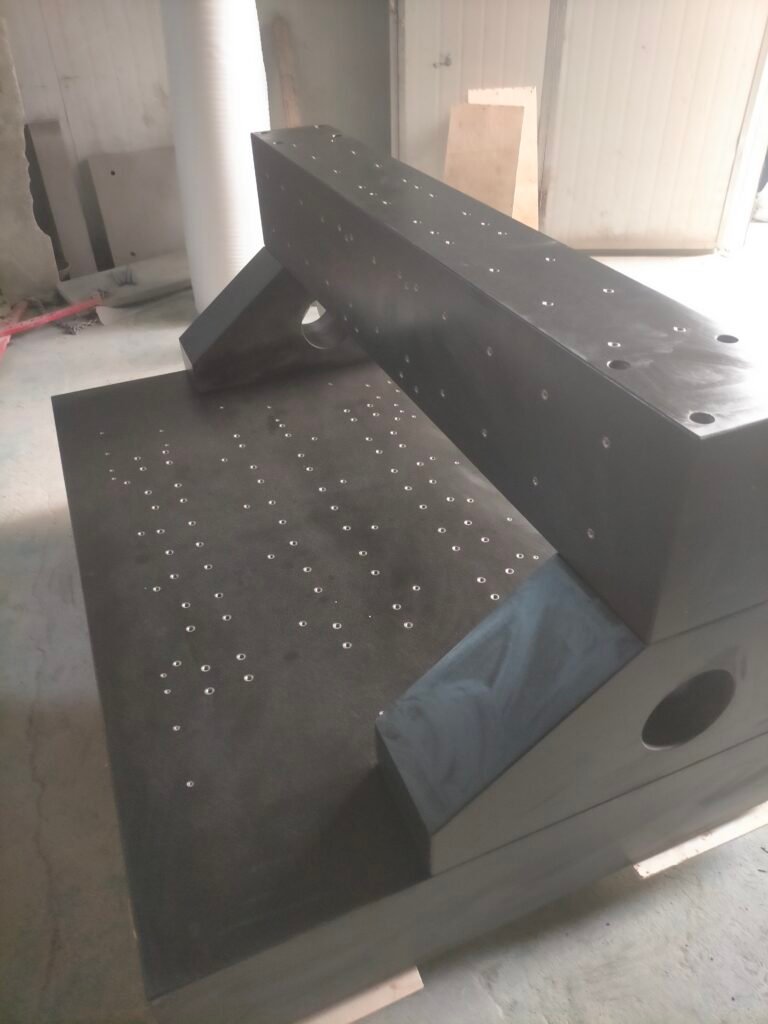
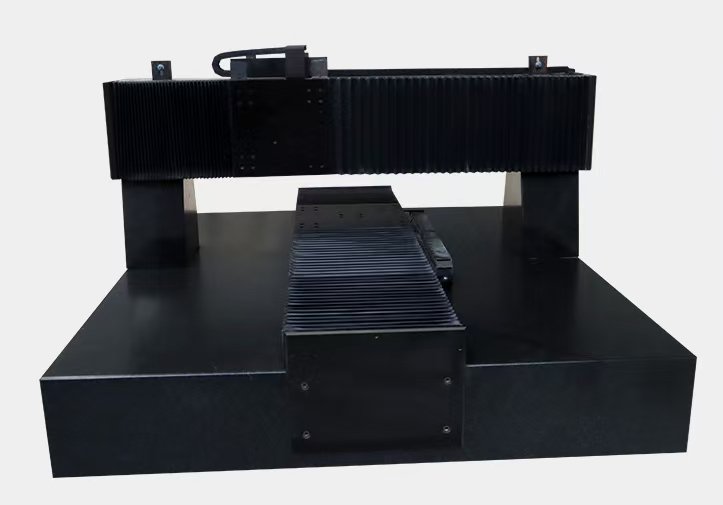
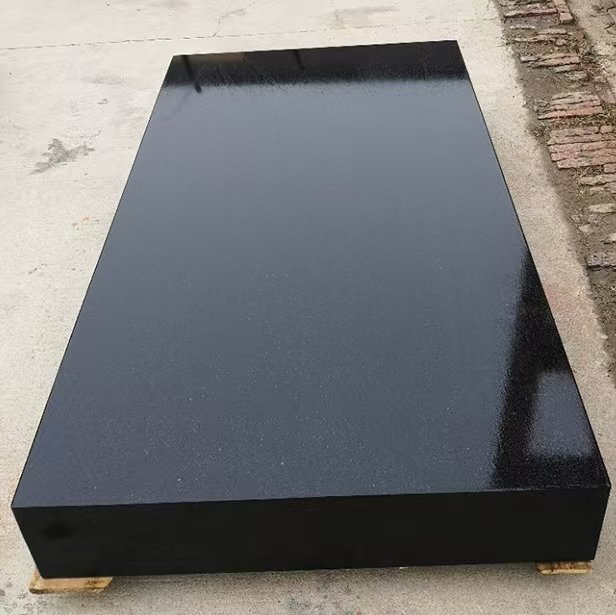
The application scenarios of granite precision components are concentrated in fields with stringent requirements for precisi stability — their core value lies in addressing the “long-term high-precision retention” demands that traditional materials cannot meet. From semiconductor lithography to aerospace inertial navigation, angh-precision metrology to high-end machine tools, their application scope covers multiple core sectors of modern industry.
3.1 Precision Measurement and Metrology
In the field of metrology an inspection, granite components serve as the “reference carriers” for value transmission — their precision directly determines the reliability of measurement results:
Coordinate Measuring Machines (CMMs): As torktable and guide rail base of CMMs, the flatness error of granite must be controlled within ±0.5μm/m, meeting the Grade 000 stdard of GB/T 4987-2019. For example, the Z-axis guide rail of the Zeiss CONTURA G2 CMM uses5-meter-long Jinan Black granite, with a straightness error of less than 1μm within 1 meter, ensuring high-precision measurement of complex curved parts (such as airngine blades and automotive molds).
High-Precision Gauges: Granite straight edges, square gauges, V-blocks, and other gauges are core tools for inspecting straightne parallelism, and perpendicularity in mechanical processing. For instance, the dimensional error of a granite V-block is ≤0.7μm, and parallelsm is ≤1.0μm/1000mm, enabling high-precision positioning of shaft parts with an error reduction of approximately 50% compared to metal V-blocks.
Metrology Referene Platforms: National-level metrology institutes’ length standard laboratories adopt spliced granite platforms as reference carriers. For example, an 80-meter length standard laboratory of a metrology institute isnstructed by splicing 200 pieces of Jinan Black granite, with an overall flatness error of ≤0.5μm/m², providing a stable reference for laerferometric length measurement systems to ensure the accuracy of value transmission.
3.2 Semiconductor Manufacturing Industry
The semiconductor manufacturing industry is one of the fields with the highest precision requirements — theing accuracy of lithography equipment needs to reach the nanometer level, and granite components are the core support for achieving this precision:
Lithography Machine Worktable: The workle of the ASML EUV lithography machine uses granite as the base, requiring a positioning repeatability of < 5nm and a flatness errorof ≤0.2μm/m². The low thermal expansion coefficient and high damping characteristics of granite effectively isolate environmental vibrations and temperature fluctuations, ensuring nanometer-level positioning accuracy for wafers — this is a key equisite for EUV lithography to achieve process technologies with line widths of 7nm and below.
Wafer Cutting Machines and Bonding Machines: The platforms of these devices require hflatness and stability to ensure wafer cutting precision and bonding yield. For example, the platform of a wafer cutting machine from a semiconductor equipment enterprise is made of Jinan Black gr with a flatness error of ≤0.3μm/m², reducing the chipping rate of wafer cutting from 0.5% to 0.1%.
Responsendustry Pain Points: The operating environment of semiconductor front-end equipment features motor vibrations and uneven heat source distribution, which can easily cause micro-deformation of granite platforms. To address this is enterprises in the industry pre-install strain gauge networks inside the platforms to monitor deformation data in real-time and perform dynamic compensation via closed-loop control systems, keeping deformatio within 0.1μm.
3.3 Aerospace and Defense
The aerospace field demands extremely high precision and reliability in equipment — even minute err can lead to mission failure. The application of granite components in this field is primarily concentrated in inertial navigation and high-precision testing scenarios:
Inertial Navigation System (INS) est Benches: The calibration of inertial sensors such as gyroscopes and accelerometers requires high-precision, high-stability bases. The non-magnetic and low thermal expansion coefficient propertie effectively avoid environmental interference and ensure the testing accuracy of sensors. For example, NASA’s SLS rocket inertial navigation test bench uses granite as the turntable frame, with adial runout error ≤0.1μm, providing a guarantee for the rocket’s navigation accuracy.
Spacecraft Docking Simulation Platforms: In a large laboratory of the Shanghai Academy oft Technology, a single piece of granite is used as the base for the docking simulation platform. Through air-bearing devices, a 1mm ground clearance is achieved to simulate the docking mecs under zero-gravity conditions in space. The platform’s flatness error is ≤0.2μm/m², ensuring the precision of docking simulation and providing support for docking systeof aerospace missions such as Chang’e-6.
Radar Antenna Test Platforms: Granite platforms can ensure the high-precision positioning of radar antennas. With a flatnes error ≤0.5μm/m², they effectively reduce antenna pointing errors and improve radar detection accuracy. For example, the test platform of a certain type of phased array radar is manufactured usint Tai Black granite, resulting in a positioning accuracy improvement of approximately 30% compared to metal platforms.
3.4 Machine Tools and Precision Machining Equipment
In the high-end e tool field, granite components are the core foundation for achieving ultra-precision machining — their properties can directly enhance the machining accuracy and stability of machine tools:
Ultra-precision GrinderBeds: Ultra-precision grinders such as surface grinders and coordinate grinders require extremely high guide rail straightness and thermal stability. The straightness error of granite bes is ≤1μm/m, ensuring the relative positional accuracy between the grinding wheel and the workpiece, and enabling surface roughness machining below Ra0.01μm. For example, an enterpise’s ultra-precision surface grinder uses a Jinan Black granite bed, achieving an optical glass surface roughness of Ra0.008μm.
High-speed Milling Mac Slides: The slides of high-speed milling machines must withstand high-frequency reciprocating motion. The damping characteristics of granite effectively suppress slide vibration and improve the quality of the machined surface.For example, a German enterprise’s high-speed milling machine, after adopting a granite slide, reduced the surface roughness of machined aluminum alloy parts from Ra.8μm to Ra0.2μm.
Industry Trends: With the growing demand for ultra-precision machining, the application ratio of granite beds is rapidly increasing. According to industry reports, the applicato of granite beds in domestic ultra-precision machine tools has risen from 25% in 2020 to 45%
3.5 Optical Engineering and Laser Technology
The fields of optical engineering and laser technology are extremely sensitive to equipment vibration and temperature fluctuations — any sligvibration or deformation can lead to beam deviation or image blurring. The characteristics of granite components perfectly meet the stringent requirements of this field:
Laser Interferometer Platforms: Laser interferome measurement precision at the nanometer level, requiring platforms with extremely high flatness and stability. Granite platforms have a flatness error of ≤0.5μm/ensuring the stability of interference fringes and enabling high-precision length measurement. For example, the platform of a certain dual-frequency laser interferometer is manufactured using Jinan Qing granite, sulting in a measurement precision improvement of approximately 20% compared to metal platforms.
Astronomical Telescope Mounts: The pointing accuracy of large optical astronomical telescopes directly affects observatlts. Granite mounts effectively isolate ground vibrations, ensuring telescope pointing accuracy. For instance, the 2.16-meter optical astronomical telescope of the Nanjing Institute of Astronomicad Technology (NIAOT), Chinese Academy of Sciences, uses granite as the equatorial mount base, achieving a pointing accuracy of 0.1 arcseconds, allowing for clear obof celestial bodies 10 billion light-years away.
Laser Cutting Machine Beds: The beds of laser cutting machines require high rigidity and thermal stability to ensure the motion precision ofcutting head. Granite beds have a coefficient of thermal expansion ≤3×10⁻⁶/℃, effectively avoiding cutting precision drift caused by temperature fluctuations. For example, afteng a granite bed, a company’s fiber laser cutting machine improved its cutting precision from ±0.05mm