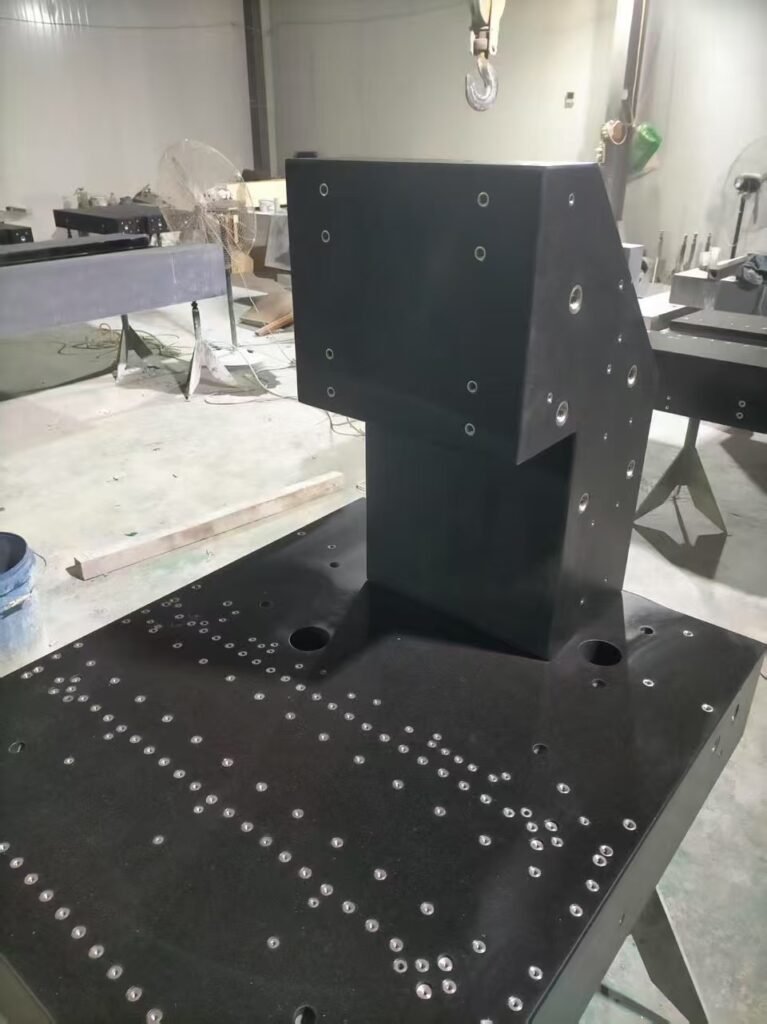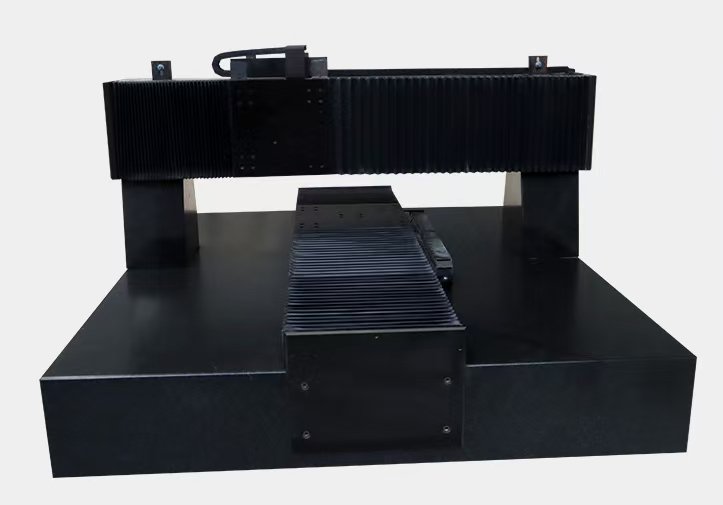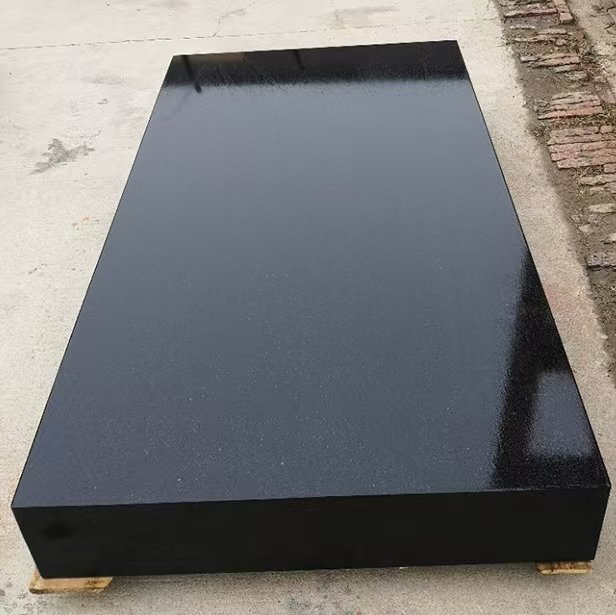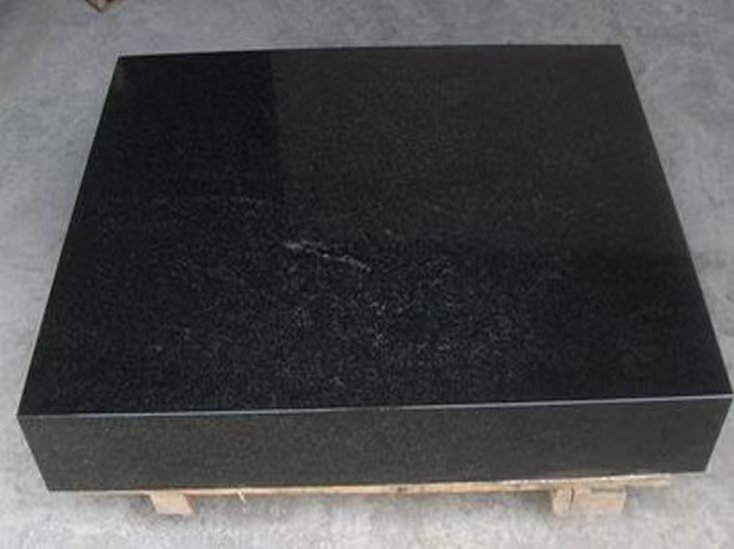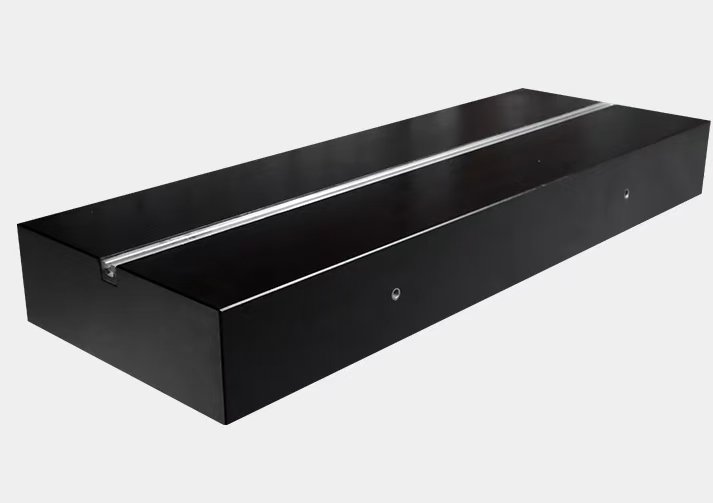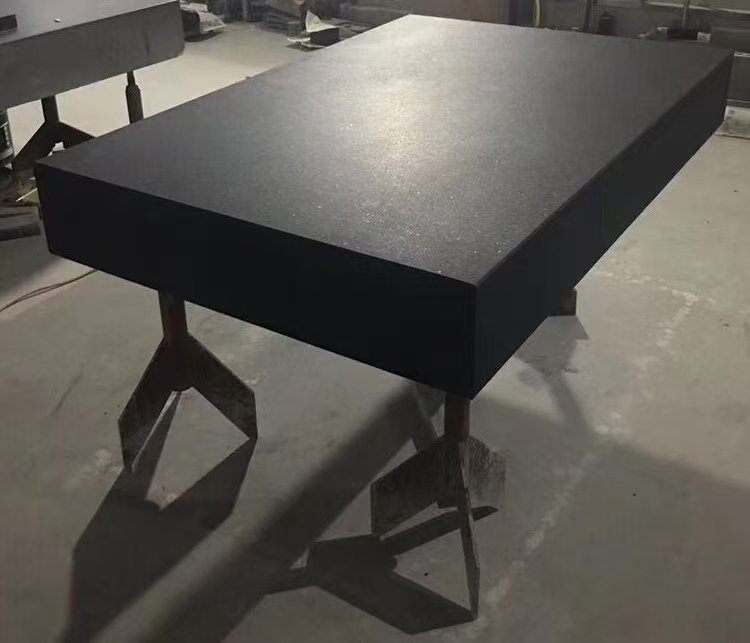
Granite is becoming the ideal base material for CNC machine tools and robotic automation, thanks to its extreme thermal stability, superior damping and vibration reduction, long-term precisiotention, and low maintenance costs, perfectly matching the stringent requirements of high-end manufacturing for micron-level precision and long-term stability.
I. Core Advantages (Compared to Cast Iron / Steel)
- Thermal Stability: “Stabilizer” of Precision
Extremely low coefficient of thermal expansion: approximately (2.5–3)×10⁻⁶/℃, 1/3–1/4 that of cast iron and 1/5 that of steel.
Minimal impact from temperature fluctuations: Under workshop temperature changes, the deformation of granite machine beds/bases can be colled at the 0.001–0.002mm/m level, significantly reducing the need for thermal compensation.
Extremely low long-term precision drift: 5-year presion drift ≤ 0.2μm, far superior to metal’s 1μm. - Damping and Vibration Reduction: The “Shock Absorber” ning Quality
Damping coefficient is 5–10 times that of cast iron; the crystalline structure can quickly absorb and attenuate high-frequency vibrations.
Direct benefits:
Surfaess improves by 30%, making it easy to achieve a “mirror” finish.
Tool/grinding wheel life extends by 30%–40%.
During highbot movement, end-effector positioning is more stable and trajectory accuracy is higher. - Structural and Dimensional Stability: No Internal Stress, No Deformation
Naturally aged forons of years, with internal stresses completely released and no residual stress deformation.
No metal fatigue, no plastic deformation during long-term use.
High stiffness ratio: Specific stiffness (modulus oelasticity / density) is superior to cast iron; structures are more stable at the same weight. - Durability and Low Maintenance: Lifecycle Cost Advantage
High hardness and wear resstance: Mohs hardness 6–7, annual wear rate only 0.03μm (cast iron approx. 0.8μm).
Chemical corrosion resistanoes not rust, resistant to coolants/acid-base, simple maintenance.
Long service life and extended calibration cycle: Can be extended from 6 months to 2 years, reducing maintenace costs by 60%. - Other Advantages
Non-magnetic: Does not interfere with precision sensors and motion control.
Environmentally friendly: Natural material, low processing energy umption, and pollution-free.
II. Typical Application Scenarios - CNC Machine Tools (Core Application)
Precision grinders, coordinate boring machines, high-speed machining centers: Machine bds, columns, worktables, guide rail bases.
5-axis linkage, ultra-precision machining: Scenarios with zero tolerance for thermal deformation and vibration.
Case: High-end machine tool bras like Danobat and Hermle widely adopt granite machine beds, offering significantly superior precision and stability compared to cast iron. - Industrial Robots and Automation
Robot bases, gantry frinear motion platforms: Ensures repeat positioning accuracy and trajectory stability.
Semiconductor / Photovoltaic / 3C automation: Wafer transfer, silicon wafer sorting, precision assemrobots.
Case: Granite bases for automotive welding robots; position offset <0.002mm during 12 hours of continuous operation, increasing assembly pass ratefrom 92% to 98%. - Precision Measurement and Inspection
Coordinate Measuring Machines (CMM), laser interferometers, profilometers: The preferred material for reference platforms.
. Granite vs. Cast Iron: Key Performance Comparison
Table
Performance Indicator | Granite | Cast Iron (HT300) | Advantage
—|—|—|—
Coefficienal expansion (×10⁻⁶/℃) | 2.5–3.0 | 11–12 | Granite
Damping coefficien | High (5–10 times cast iron) | Medium | Granite
Internal stress | None (natural aging) | Present (requires artificial stress relief) | Granite
Modulus of elaticity (GPa) | 70–85 | 110–130 | Cast Iron
Specific stiffness (E/ρ | 28.3 | 17.4 | Granite
Annual wear rate (μm) | ~0.03 | ~0.8 | Granite
Corrosion resistance | Excellentt) | Average (prone to rust) | Granite
Processing difficulty | High (specialized equipment) | Medium
IV. Limitations and Selection Recommendations
Limitations
The modulus of elasticity is lower than that of cast iron; structural optimization and reinforcement are required for h cutting and high-load scenarios.
Difficult to machine, long production cycles, and high initial costs.
Weaker impact resistance than metal; severe impacts must be avoided.
Selection Recommends
Prioritize granite: High precision, thermal sensitivity, long-term stability, and low vibration requirements (e.g., precision machining, semiconductors, metrology).
Still selecron: General-purpose machine tools for heavy cutting, high loads, and high impact.
V. Conclusion
In the trend of high-end manufacturing pursuing sub-micron precision, long-terability, and unmanned production, granite is rapidly replacing traditional cast iron as the preferred base material for CNC machine tools and robotic automation, thanks to its comprehensive advantages of thermal stability, vibration dam stress-free properties, wear resistance, and low maintenance. Its value is irreplaceable, especially in precision fields such as semiconductors, optics, medical, and